Материал: 62. Bara, B.G. Cognitive pragmatics the mental processes of communication 2011
AUTHOR’S COPY | AUTORENEXEMPLAR
Cognitive pragmatics: The mental processes of communication 453
tween the recognition of a communicative intention issued by an observed linguistic behavior and the recognition of the same communicative intention issued by an observed gestural behavior: The dynamic intentional network should be recruited independently of the modality used to convey the different intentions.
Enrici et al. (2011) in a fMRI study on 24 healthy participants showed that linguisticandgesturalmodalitiesshareacommoncommunicativecompetence at the pragmatic level, viz. at the level at which an actor’s communicative intention has to be reconstructed by a partner. The second issue we wished to addresswaswhetheranyadditionalbrainareasotherthanthoseinvolvedatthe pragmatic level, that is, the intentionality network areas, are specifically recruited depending on the modality used. Perisylvian language areas are recruited by the linguistic modality, whereas sensorimotor and premotor areas are recruited by the extralinguistic modality. In conclusion, we proved that the intentionality network is modality independent, while the expressive means involved activate the brain regions corresponding to language or to gestures.
3. Behavior games: The social framework of communication
In conversation, we must make a clear distinction between communicative competence and interaction schemas. Communicative competence is a general characteristic of the mind, whereas stereotypical interaction schemas are culture-bound.Indeed,thelattermaypertaintoasmallgroupofindividuals,or even two people. The idea that will be developed in this chapter is that communicativecompetencemaybeviewedinformaltermsasametalevelproperty that controls first-level inferences; such inferences are carried out on shared representations of stereotypical interaction schemas.
Consider the following concrete example:
(7)A: Tomorrow’s Thursday. Will you coordinate the exam supervision? B:Actually, the Vice Chancellor has fixed a meeting for 9 a.m.
In every standard context, B’s reply would be taken as a justification for refusing to carry outA’s request.As stated earlier, B cooperates conversationally but not behaviorally. The intuitive concept of a behavior game allows us to explain conversation (7), for it enables us to assert that, through her request,A is proposing that she and B play the behavior game:
(8)Pedagogical Duties
A is responsible for running the departmental activities from Monday to Wednesday;
B is responsible for running the departmental activities from Thursday to Saturday.
AUTHOR’S COPY | AUTORENEXEMPLAR
AUTHOR’S COPY | AUTORENEXEMPLAR
454 Bruno G. Bara
With his reply, B rejects A’s proposal, justifying himself by explaining he has a duty that takes priority over examinations.A thus takes B’s reply as concurrently constituting a counterrequest on B’s part to take over his exam session.Thepointisthatinordertocooperate,atleastatthelevelofconversation, both agents must share the behavior game Pedagogical Duties. In real terms, mutual knowledge of game (8) is exploited to achieve conversational cooperation, even if B fails to execute the moves foreseen byA, and, therefore, behavioral cooperation is not achieved.
The reason for introducing behavior games is that the literal meaning of an utteranceisonlythedeparturepointforitscomprehension.“Whyisshesaying this to me?” and “What does she want from me?” are the real questions requiring an answer. If someone sitting in the reader’s office says to him:
(9) “I’d like a coffee.”
it is obvious that she is proposing a game such as Hospitality, and the rules of that particular game place the encumbrance of providing coffee on the host. And indeed, either the host does produce coffee or else he is obliged to explain why he has not deigned to satisfy the indirect request. If the same assertion weretobeutteredinacontextinwhichthereaderisnotthepersonresponsible for the pleasurable aspects of the situation, for example in the course of taking a walk in the park with a colleague, then that utterance will be interpreted as a proposal to play a different behavior game, for instance Going to the Cafe. However, if a stranger pops his head round the reader’s office door and utters (9), then the poor reader will be utterly at a loss as to how to interpret that utterance. In real terms, either the reader is able to find a behavior game that will enable him to interpret the statement, in which case he will know what the stranger expects of him, or else he will be nonplussed.
Although the semantic meaning of expression (9) is immediately comprehensible, the effects the speaker wishes to activate in the hearer must be induced. In the case just mentioned, there is no context that enables both the reader and the stranger to identify a behavior game known to both parties that may be connected to the utterance: hence the failure to understand.
A behavior game is that structure which enables actors to coordinate their interpersonal actions, and that actors employ to select the intended meaning of an utterance among the many meanings that utterance might in theory convey.
3.1. The structure of a behavior game
For two actors to cooperate at the level of behavior, they must operate on the basis of a plan that is shared at least in part. FollowingAirenti, Bara, and Co-
AUTHOR’S COPY | AUTORENEXEMPLAR
AUTHOR’S COPY | AUTORENEXEMPLAR
Cognitive pragmatics: The mental processes of communication 455
lombetti (1993), I will call a behavior game between A and B an action plan that is shared byA and B. The shared knowledge required for two actors to be abletointeractinthesamegamemaybeacombinationoftacitandexplicit.As we shall see later, the two actors may have an explicit representation of the game, or they may have a tacit representation that is sufficient to enable them to direct their actions. Stated differently, for a game to be playable, it must be represented in the actor’s memory.
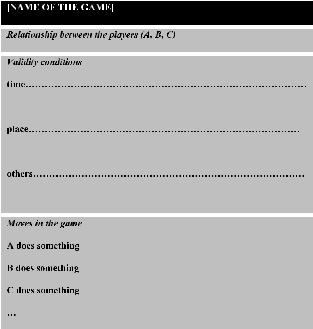
In addition to actions, behavior games include validity conditions that specify the conditions under which the game may be played. Validity conditions may be viewed as an extension of the felicity conditions that Austin (1962) invoked to guarantee the success of performatives. The essential features of validity conditions, which do not apply only to performatives but to any move of the game, are time and place. However, some games may impose other conditions connected to the mental states of the participants, or constrained by the actions to be executed.
Finally, a game is playable only if the relationship between the participants allowsit.Insomecases,ifthegamehaswidesocialapplicability,asisthecase with someone asking the time, then the participants need not even be acquainted. In other cases, participants must be members of the same group. For example, only two freemasons who have both recognized their common status as freemasons may discuss topics reserved to those belonging to that lodge.At theextremeofthistypeofcasewehavegamesthatmaybeplayedonlybytwo specific players and by no one else. This is the case, for example, with games played by parent and child, or by a married couple.
The relationship is therefore the set of behavior game that two people may play together.
ThestructureofabehaviorgameisshowninFigure3.Thefirstthingtonote isthateachagenthasherownsubjective,andnotobjective,visionofthegame, since the entire process is based on the notion of shared knowledge, this latter notion also being subjective and not objective. In our notation, then, beside the name of each game there should appear the perspective of each player: G (A, B) represents game G viewed from A’s standpoint, while G (B, A), instead, represents the same game, G, viewed from B’s standpoint.
We will now examine some examples to clarify the concept of behavior game. The first instantiation is one that is widely applicable, the game that allows us to ask a stranger the way.
Assigning games a declarative knowledge structure means that we can talk about them, mentioning them if needs be. This does not imply, however, that the actors in a game must be aware of the structure of the game, of the moves,orofthemotivationsthatinducethemtoplaythegame.Inotherwords, players may have, but need not have, an explicit representation of the games they play.
AUTHOR’S COPY | AUTORENEXEMPLAR
AUTHOR’S COPY | AUTORENEXEMPLAR
456 Bruno G. Bara
Figure 3. Structure of the behavior game.
3.2. Types of game
Among the various criteria that may be used to classify the different types of behavior games, I will, in the first instance, privilege an extensional criterion. I will consider games as having essentially an equivalent structure, differing with regard to the number of people capable of playing them.
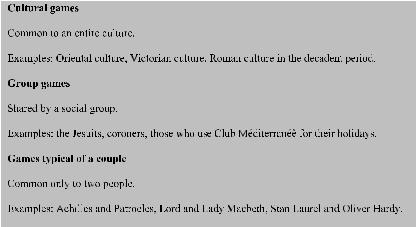
There are three main types of games: Cultural games are common to an entire culture, affecting a large number of people. Group games are shared by a more or less restricted number of people forming a given group. Couple games are shared by only two people.
We will now examine these three types singly, bearing in mind that a classification of this nature is not based on rigid, watertight distinctions (Figure 4).
3.2.1. Cultural games. “Culture” as I intend it refers to large-scale phenomena that may vary from the civilized world to Western culture, from the
Mitteleuropa tradition to the Parisian style. What this means is that if two people belonging to the same culture find themselves in a given situation and a specific game is enacted, both know reciprocally what they expect the other to do.
AUTHOR’S COPY | AUTORENEXEMPLAR
AUTHOR’S COPY | AUTORENEXEMPLAR
Cognitive pragmatics: The mental processes of communication 457
Figure 4. Game types.
Naturally, the more the game is widespread, the more the expected behavior approximates to a social norm. As such, it may be taught explicitly as well as throughexperience.Examplesrangefromaskingsomeonefordirectionstothe multiplicity of rites laid down by books on etiquette. That such rules change from one country to another is something the traveler is well aware of: Saying one is sorry is as obligatory in the West as it is forbidden in Japan, for in the lattercountryexcusingoneselfwouldbeinterpretedasarefusaltotakeresponsibility for one’s actions.
Studies on intercultural communication (Piller 2010) and on linguistic anthropology (Duranti 1997) have shown that culture affects the different pragmatic possibilities of realizing interaction. Also due to the influence of crosscultural psychology (Berry, Poortinga, and Pandej 1997), this approach has caused the weakening of the thesis of universality and a greater attention to an ethnocentric dimension. As examples we can think here of the deployment of compliments and expressions of thanks. These are rigidly defined by each culture, but their workings are far from obvious. For example, table manners vary from belching at the end of the meal to serving oneself to each dish twice and twice only (the first time to be courteous, the second time to show one has appreciated the food).
According to cultural psychologists, common ground between people consists in large part of a repertoire that is “in the mind” because it has been put there by the communities into which the individual was born, has lived in, and in which he now lives (Tomasello 2009).
AUTHOR’S COPY | AUTORENEXEMPLAR