Материал: 62. Bara, B.G. Cognitive pragmatics the mental processes of communication 2011
AUTHOR’S COPY | AUTORENEXEMPLAR
478 Bruno G. Bara
6.2.1. Conflicting representations. Conflicting representations involve a discrepancy between what is communicated and what is privately entertained by the actor. In the case of no conflict, we are dealing with standard communication, where the actor merely produces an utterance that is in line with her private belief and with the behavioral game she shares with the partner. In the case of conflict, we are dealing with nonstandard communication, which involves the violation of default rules and the occurrence of more sophisticated mental representations.
Direct communication acts, conventional indirects, and nonconventional indirects are all examples of standard communication: In terms of mental representations, the partner has merely to compare the actor’s utterance to a valid behavior game. Deceit and irony are instead examples of nonstandard communication, in which the partner has to deal with the difference between the mental states expressed by the actor and those she privately entertains. It may be consequently predicted that standard communicative phenomena are easier to deal with than nonstandard ones.
6.2.2. Representations where shared beliefs are exploited. Representations involving a belief expressed by an actor that is in contrast with a belief shared with the partner are more difficult to handle than representations that do not involve such a contrast.
When comprehending a deceit, the partner recognizes the discrepancy between the mental states that are expressed and those that are privately entertainedbytheactor.Anutterancebecomesironicwhen,alongwiththisdiscrepancy, the partner also has to recognize the contrast between the expressed mental states and the scenario provided by the knowledge shared with the actor. The concurrent activation of the representation of actor’s utterance ( p) andofthecontrastingsharedbeliefmakesironicstatementsdifficultforachild to manage. It follows that deceits should be easier to deal with than ironies.
6.2.3. Inferential load. The necessity of building a long chain of inferences iswhatdiscriminatesbetweensimpleandcomplexcommunicationacts.Direct and conventional indirect speech acts may be referred as simple communicationactsbecausetheyimmediatelymakereferencetoabehavioralgame.Nonconventional indirect speech acts may be linked to complex communication acts because they do not make direct reference to a behavioral game and require a more complex inferential process. The length of the inferential chain necessary to connect the communication act to the behavioral game shared between the interlocutors is the factor determining the different levels of difficulty children find in comprehending simple and complex communication acts.
AUTHOR’S COPY | AUTORENEXEMPLAR
AUTHOR’S COPY | AUTORENEXEMPLAR
Cognitive pragmatics: The mental processes of communication 479
In Bucciarelli, Colle, and Bara (2003) we started to investigate those theoretical points. We administered to a large group of children — ranging in age from2.5to6yearsold — anexperimentalprotocolstructuredinbothlinguistic and extralinguistic modalities and comprising simple and complex pragmatic phenomena. Half of the children were randomly assigned to the linguistic protocol, and half to the extralinguistic one. The results of the study globally confirmed our predictions. Standard communication was easier to comprehend than nonstandard communication in both linguistic and extralinguistic modality.Also, in both modalities, directs and simple indirects were equally easy to comprehend, and they were easier than simple deceits, which were easier than simple ironies.
More recently, in order to provide a more comprehensive picture of children’s pragmatic abilities, we used a new experimental protocol (see section 6.3) derived from theAssessment Battery for Communication (ABaCo, Sacco etal.2008).Theprotocolwasadministeredto390childrenranginginagefrom 5 to 8.5 years old, and comprised a wide range of pragmatic phenomena (Bosco,Angeleri, Colle, Sacco, and Bara, under review).
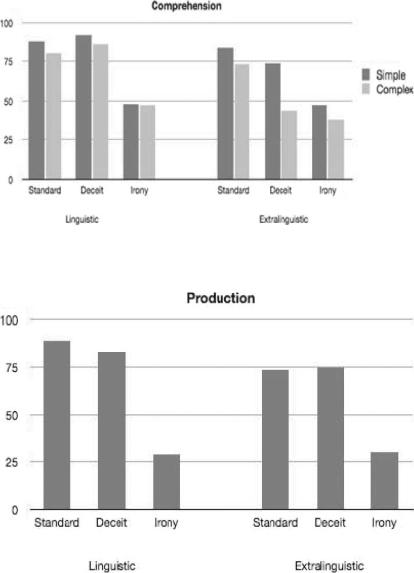
In this study, we investigated different pragmatic phenomena (standard deceit and irony), different levels of complexity (simple and complex com munication acts), different expressive modalities (linguistic and extra linguistic), and different perspectives (comprehension and production). The results confirmed again our theoretical predictions: First of all, in regard to the comprehension and production of standard and nonstandard communi cation acts, children’s performances followed the same pattern in both the linguistic and extralinguistic modality, thus supporting the assumption that linguistic and extralinguistic communication share relevant cognitive factors and may be thought as different aspects of a single communicative competence.
Secondly, in regard to the variation among different pragmatic phenomena, we found that the difficulty in manipulating mental representations of increasing complexity also played a role in influencing children’s pragmatic performance.The result is in line with our expectations:We found that children both understood and produced standard communication acts more accurately than deceit, followed by irony, which they understood and produced least accurately, both in linguistic and extralinguistic modality production.
Finally, the results concerning the comprehension of simple vs. com plex communication acts extend also to the extralinguistic modality the idea that the increasing inferential chain required by complex communications acts is a relevant factor that may influence children’s communicative performance.
The experimental results are summarized in Figure 7 and Figure 8.
AUTHOR’S COPY | AUTORENEXEMPLAR
AUTHOR’S COPY | AUTORENEXEMPLAR
480 Bruno G. Bara
Figure 7. Comprehension. Children’s comprehension of standard communication acts, deceit and irony, both for linguistic and extralinguistic modality.
Figure 8. Production. Children’s production of standard communication acts, deceit and irony, both linguistic and extralinguistic scale.
AUTHOR’S COPY | AUTORENEXEMPLAR
AUTHOR’S COPY | AUTORENEXEMPLAR
Cognitive pragmatics: The mental processes of communication 481
6.3.Neuropragmatics
The aim of using a neologism in the title of this section is to draw attention to anareathathasnotyetbeenconsolidated,butwhichisofgreatmethodological importance: that dominion that investigates the correlations between the mental processes involved in communication and the areas of the brain that are responsibleforthoseprocesses(BambiniandBara2011).Inparticular,inview of the fact that research in this sector is still in its initial stages, the data that will be examined are those that link up different types of cerebral lesions, both diffuse and focal, with particular impairments in communication (Bara and Tirassa 2000).
Takinguponeofmyinitialmethodologicalassumptions,namelythatthemind is a biological structure, I will take it for granted that a valid theory of communicationshouldbeabletoidentifywhichareasofthebrainunderliethephysical realization of communication. This means specifying which areas of the brain are activated when a person is engaged in communicative activity (see section2.3),andtolookattheissuefromtheoppositeviewpoint,whattypesof deficits may be predicted as a result of lesions occurring to any of these areas.
With different collaborators, I have carried out some research in this direction. Most of the work, however, remains to be done: We have only been able to test a few classes of subjects, such as individuals affected by traumatic head injuries (Bara, Tirassa, and Zettin 1997; Bara, Cutica, and Tirassa 2001; Cutica, Bucciarelli, and Bara 2006), patients suffering from Alzheimer’s disease (Bara, Bucciarelli, and Geminiani 1999), neuropsychologically atypical children (Bara, Bosco, and Bucciarelli 1999), and autistic children (Bucciarelli, Colle, and Bara 2003).The aim of our experimental studies was first to outline for each type of patient a performance profile as regards the prominent pragmatic phenomena. The second aim was to explore in detail how each type of neuropsychologicaldamageactuallyaffectscommunication.Basically,inthese studies we have found a trend analogous to that reported above in Figure 6.
The assessment of pragmatic abilities in patients affected by acquired cerebral lesions is relevant, since a deeper understanding of their specific communicative deficits will be crucial for both theoretical advances and clinical suggestions. Traditionally, communicative deficits have been interpreted as linguistic disabilities, but in more recent years clinical researchers have highlighted the need for a more comprehensive assessment that will offer a complete picture of patients’ communicative effectiveness in their everyday life (e.g., Holland 1991; Penn 1999).
Our research group has recently created a new assessment battery, ABaCo (AssessmentBatteryforCommunication),thatcanbeprofitablyusedtoevaluate the various abilities involved in communication, comprising a wide range of pragmatic phenomena and communicative modalities (Sacco et al. 2008).
AUTHOR’S COPY | AUTORENEXEMPLAR
AUTHOR’S COPY | AUTORENEXEMPLAR
482 Bruno G. Bara
ABaCo comprises five evaluation scales — linguistic, extralinguistic, paralinguistic, context, and conversational — which include several kinds of pragmatic phenomena — for example, deceit, irony, social appropriateness, Grice’s maxims — for a total of 190 items. The idea was to create a new clinical tool, which would represent a valuable starting point for a complete understanding of the pragmatic deficits involved in different types of cerebral lesions.
We used ABaCo in a study aimed at investigating the pragmatic performances of traumatic brain injury (TBI) patients (Angeleri et al., 2008). Results showed that although patients’comprehension was damaged, it was nevertheless linguistically valid; on the other hand, they performed worse than controls in extralinguistic comprehension of deceit and irony. TBI patients showed impairedproductioninboththelinguisticandextralinguisticmodality.Moreover, the difficulty in manipulating mental representations had a great impact on patients’ performance: we found an increasing trend of difficulty in different kind of pragmatic phenomena that require to deal with embedded mental representations. Specifically, both comprehension and production of standard communication acts were easier than deceits, which in turn were easier than ironies.
TBI patients also showed a pronounced impairment in managing paralinguistic aspects, neglecting the emotional meaning expressed through facial expression or prosody. Finally we found that TBI patients were impaired in grasping subtler conversational violations.
This study represents the first detailed investigation of pragmatic abilities in TBI patients, and shows how the cognitive pragmatics theory can be used to formulate specific predictions about the communicative impairments resulting from pathology.
7. Conclusions
In this paper I synthesized the main theoretical assumptions of cognitive pragmatics theory, as well as the empirical evidence enforcing the deriving predictions. Our experimental results and those in the literature on the development, the decay and the neural basis of communication, can be easily accommodated within the advanced unified framework.
Acknowledgments
This research was supported by Regione Piemonte, Project: Institutions, Behaviour and Markets in Local and Global Settings (Project IIINBEMA).
AUTHOR’S COPY | AUTORENEXEMPLAR