Chapter 7 • Basal Ganglia
Clinical Correlate (Continued)
Hemiballismus results from a lesion of the subthalamic nucleus usually seen in hypertensive patients. Hemiballismus refers to a violent projectile movement of a limb and is typically observed in the upper limb contralateral to the involved subthalamic nucleus.
Tourette syndrome involves facial and vocaltics that progress to jerking movements ofthe limbs. It is frequently associated with explosive, vulgarspeech.
Wilson disease results from an abnormality of copper metabolism, causing the accumulation of copper in the liver and basal ganglia. Personality changes, tremor, dystonia, and athetoid movements develop. Untreated patients usually succumb because of hepatic cirrhosis. A thin brown ring around the outer cornea, the Kayser-Fleischer ring, may be present and aid in the diagnosis.
ChapterSummary
•The basal ganglia play important motor functions in starting and stopping
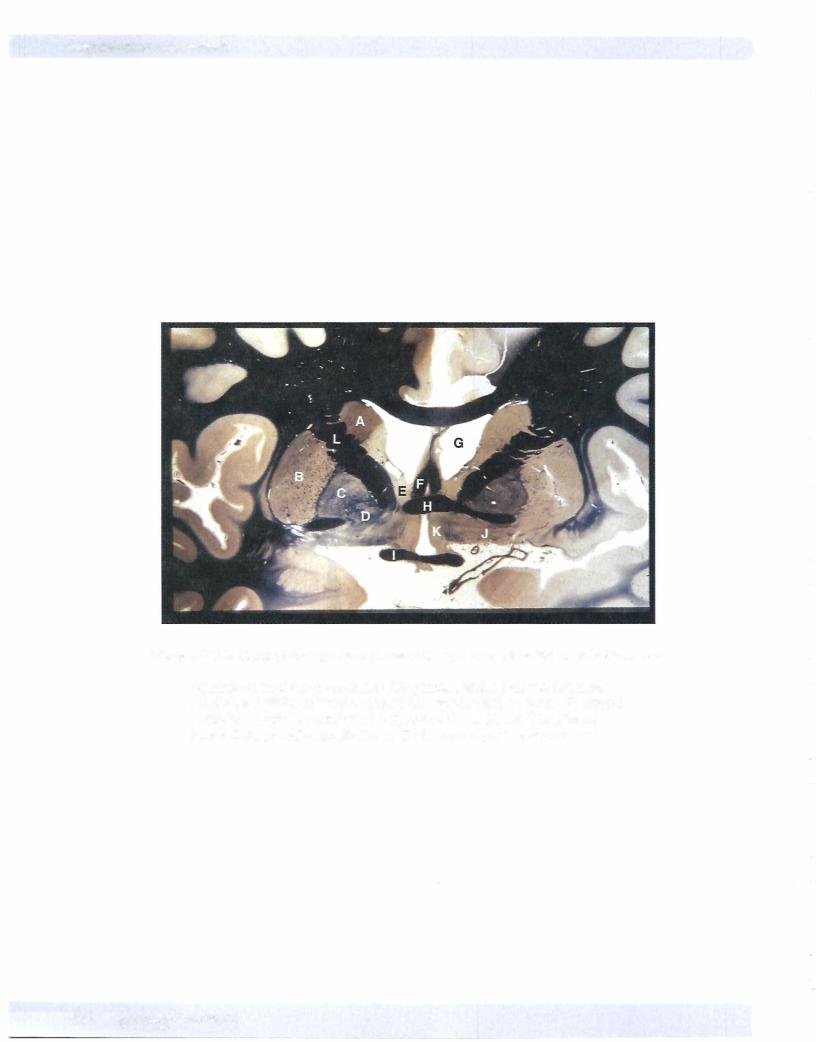
voluntary motor functions and inhibiting unwanted movements. The basal ganglia consists of 3 nuclei masses deep in the cerebrum (caudate nucleus, putamen, and globus pallidus), one nucleus in the midbrain (substantia nigra), and the subthalamic nucleus ofthe diencephalon. The striatum combines the caudate nucleus and the putamen while the corpus striatum
consists ofthese 2 nuclei plus the globus pallidus.
•There are 2 parallel circuits (direct and indirect) through the basal ganglia. These circuits receive extensive input from the cerebral cortex that project back to the motor cortex after a relay in the ventrolateral (VL) nucleus ofthe thalamus. Both ofthese pathways demonstrate disinhibition. The direct pathway increases the level of cortical excitation and promotes movement. The indirect pathway decreases the level of cortical excitation and suppresses unwanted movement.
•The striatum is the major input center and the globus pallidus is the major output centerforthe pathways through the basal ganglia. Critical to proper function ofthe striatum is dopamine production by the substantia nigra.
Dopamine excites the direct pathway and inhibits the indirect pathway.
•Lesions of the direct pathway result in an underactive cortex, which produces hypokinetic motor disturbances. The classic disorder caused by degeneration of dopaminergic neurons of the substantia nigra is Parkinson disease. These patients are characterized by tremor at rest (pill-rolling), increased muscle tone, mask face, and hypokinetic movement.
•Hyperkinetic disorders result from lesions ofthe indirect pathway and cause an overactive motor cortex. These movements occur spontaneously at rest and cannot be controlled by the patient. Examples ofthese disorders include chorea (multiple quick movements), athetosis (slow serpentine movements), and hemiballismus (violent flinging movements). Hemiballismus results from hemorrhagic destruction ofthe contralateral subthalamic nucleus.