Материал: Russian Journal of Building Construction and Architecture
Issue № 4 (36), 2017 |
ISSN 2542-0526 |
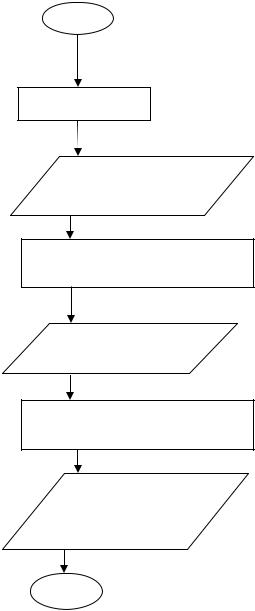
model, the geometric, material properties and load condition of components were inputted using the algorithm described in Fig. 2. Due to the complexity of the suspen dome structure, results for a three dimensional FEM analysis are considered to be more comprehensive and reliable than results of empirical formula.
Start
Create a model
Inputting material constants
Structural discretization
Inputting boundary conditions
Solution of simultaneous equations
Computation and graphic display
End
Fig. 2. Flowchart for the analysis
Comparison of Structural Types
The material type proposed by the author is compared with the prototype-Beijing Olympic suspen dome by (Zhang et al, 2007) in terms of internal forces, displacement and frequency.
111
Russian Journal of Building Construction and Architecture
Static analysis
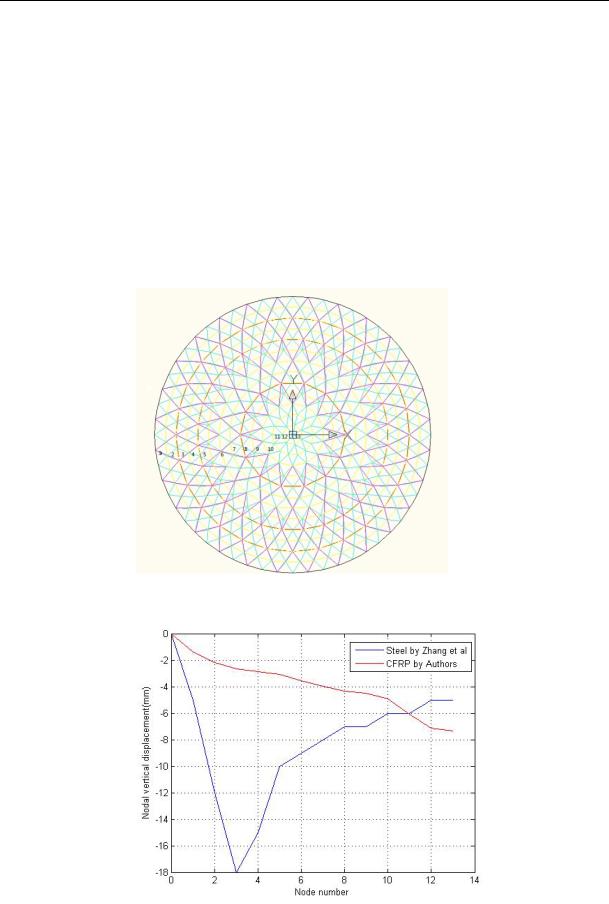
Due to the symmetrical nature of the dome structure, nodes and elements can be represented by one typical node or element. Fig 3 illustrates the nodes and elements of the dome, Fig 4 illustrates the nodal displacement for the nodes as stated in fig 3 for the suspen dome. The nodal displacement of the CFRP tensegrity are much lower than the steel tensegrity system which implies that the CFRP tensegric system of the suspen dome is more effective than the steel tensegric results obtained by (Zhang et al, 2007), it can be observed that the outer position of the nodes had smaller nodal displacement, the farther the nodes are away from the mid rib, the larger is the displacement.
Fig. 3. Numbering of nodes
Fig. 4. Comparison of nodal displacement
112
Issue № 4 (36), 2017 |
ISSN 2542-0526 |
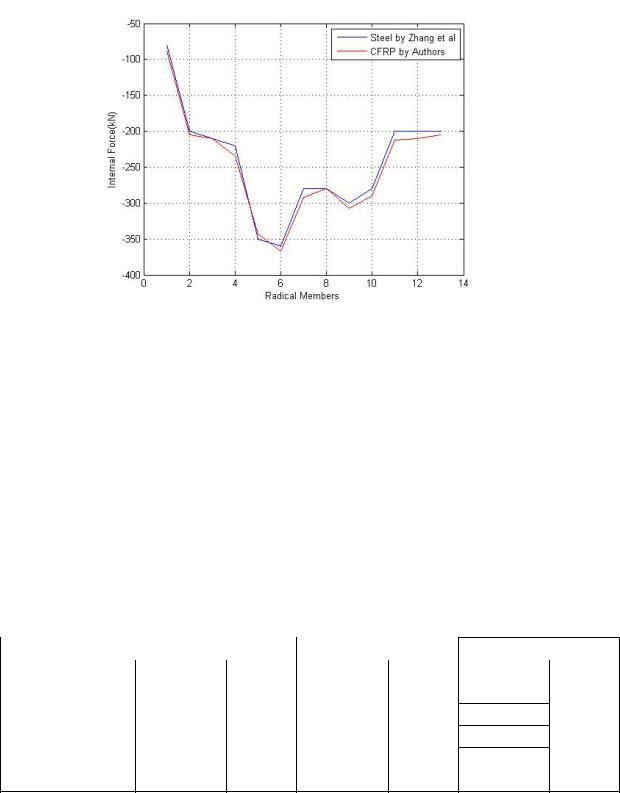
Fig. 5. Comparison of Internal force of radical members
Fig 5 illustrates the internal forces in the radical members for the two dome structures which are similar; it implies that CFRP tensegric system has little effect on the internal forces generated in the radical members. In addition, it was observed that the internal force was at its largest at the outermost ring and lowest at the centre.
Furthermore, Table 4 illustrates the result obtained from the computation and comparison of the interior force in the loop truss. It was observed that there was a slight decrease in CFRP cables comparedtosteel cables by (Zhang et al, 2007) which shows thereductionof interior forces.
|
|
|
|
|
|
|
Table 4 |
|
|
Comparision of Interior Force Analysis in the Loop Truss |
|
|
|||||
|
|
|
|
Lower ring truss chord |
||||
Outer ring truss chord |
|
Inner ring truss chord |
||||||
|
|
|
|
|
|
Minimum |
|
|
(kN) |
Minimum |
Maximum |
Minimum |
Maximum |
Maximum |
|||
value |
value |
value |
value |
value |
value |
|||
|
||||||||
|
|
|
|
|
|
15.94 |
|
|
Zhang et al |
18.6 |
55.29 |
–131.04 |
148.73 |
|
–5.57 |
||
|
|
|
|
|
|
13.41 |
|
|
Authors |
16.1 |
51.45 |
–120.87 |
139.74 |
|
–4.70 |
||
|
|
|
|
|
|
|
|
|
Percentage |
13.4 |
6.9 |
7.7 |
6.0 |
|
15.8 |
15.6 |
|
difference(%) |
|
|||||||
|
|
|
|
|
|
|
||
.
Modal analysis
The natural frequencies for the first mode carried out through modal analyses are shown in Table 5. The frequency of the structure predicts the ability of the structure to avoid collapses caused by earthquake and wind storm.
113

Russian Journal of Building Construction and Architecture
|
|
Table 5 |
|
Comparison of natural frequency |
|
|
|
|
Material type |
Steel by Zhang et al(Hz) |
CFRP by Authors(Hz) |
|
|
|
Frequency |
5.70 |
6.50 |
|
|
|
From table 5 it can be observed that the frequency of CFRP tensegrity system is much lower than that of steel with a percentage difference of 23.8% which presents a better resistance capacity.
Conclusion
In this study, a finite element model of Beijing gymnasium suspen dome was established. Analyses were carried out to investigate the behavior of carbon fibre reinforced polymer (CFRP) cable as a constitute material. From the comparison, the following conclusions are drawn:
1)The application of CFRP by the authors is practical based on the satisfactory results obtained from the numerical analysis.
2)The concept for the application of CFRP cable is to strengthen the dome; this was proven with CFRP cables having lower nodal displacement than that of steel cables which implies that CFRP has more stiffness capability.
3)The frequency result proves that CFRP tensegrity system would successfully overcome fatigue and other harmful effect of forced vibration such as earthquake and wind storms over steel cables.
Thus, the application of CFRP cables demonstrates an outstanding performance and the results show an efficient design.
References
1.ANSYS Inc., ANSYS, (2008), Release 10.0 Documentation for Ansys, USA.
2.Behnam S., Ali D., Howlyar E., Babak P., Investigation into the behavior of suspen-dome comparison with single-layer dome, World Academy of Science, engineering and technology, 2012, vol. 6.
3.Feng Fu. Structural behavior and design methods of tensegrity domes, Journal of Constructional Steel Research, 2005, pp. 23––25.
4.Ge Jiaqi, Zhang Guojun, Wang Shu. The overall stability analysis of the suspend-dome structure system of the badminton gymnasium for 2008 Olympic Games[J]. Journal of Building Structures, 2007, no. 28 (6), pp. 22–– 30, 44 (in Chinese).
114
Issue № 4 (36), 2017 |
ISSN 2542-0526 |
5.Ge Jiaqi, Wang Shu, Liang Haitong. Design and research of the large-span steel structure of the badminton gymnasium for 2008 Olympic Games[J]. Journal of Building Structures, 2007, no. 28 (6), pp. 10––21, 51 (in Chinese).
6.Jiamin Guo, Shilin Dong, Xingfei Yuan. Research on static property of suspen dome structure under heap load,Advanced steel construction, 2012, vol. 8, no. 2, pp. 137––152.
7.Kitipornchai S., Kang W. J., Lam. H., Albermani, F. Factors affecting the design and construction of Lamella suspen dome system. Journal of construction steel research, 2005, vol. 61, pp. 764––785.
8.Liu Xuechun. Innovation of New-type Large-span Prestressing suspend-dome Structure System and Application of Project for Beijing Olympic Games[D]. Beijing: The College of Architecture and Civil Engineering of Beijing University of Technology, 2010 (in Chinese).
9.Subramanian N. Space Structures: Principles And Practice, Multi-Science Publishing Co Ltd, Brentwood, Essex, UK, 2006.
10.Wojciech G, Joanna K., Paulina O. Application of tensegrity structures in Civil Engineering. Procedia Engineering III, 2015, pp. 242––248.
11.Wenjiang K., Zhihua C., Heung-fai L. Chenian Z. Analysis and design of the general and outmost ring stiffened suspen dome structure. Engineering structures, 2003, vol 25, pp. 1685––1695.
12.Xu Xie, Xiao Zhang Li, Yonggang Shen, Static and dynamics characteristic of a long span cable-stayed bridge with CFRP cables, Materials, 2015, no. 7, pp. 4854––4877; doi:10.3390/ma7064854
13.Zhang Ailin, Liu Xuechun, Zhang Baoqin, Zhang Xiaofeng. Stability analysis of suspend-dome of badminton gymnasium for 2008 olympic games, Industrial construction, 2007, vol. 37, no. 1 (in Chinese).
115