Материал: Russian Journal of Building Construction and Architecture
Issue № 4 (36), 2017 |
ISSN 2542-0526 |
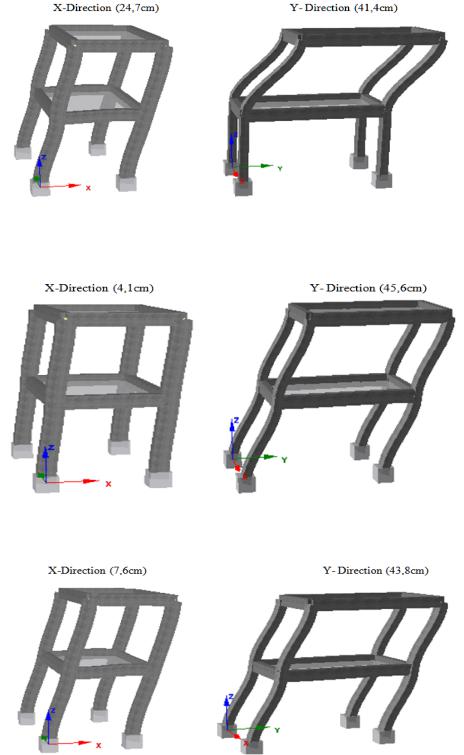
Fig. 10 b. Deformation of building in both directions for Trilinear Concrete Model
Fig. 10 c. Deformation of building in both directions for Chang –Mander Nonlinear Concrete Model
Fig. 10 d. Deformation of building in both directions for Kappos-Konstantinidis Nonlinear Concrete Model
The comparison of peak displacement amounts obtained for four different concrete models used is shown at Table 1.
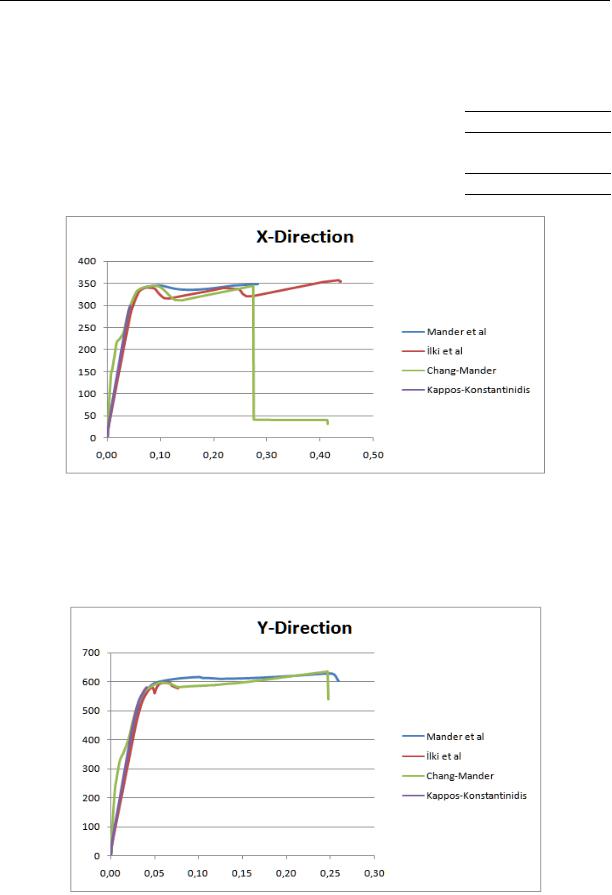
The comparison of static pushover analysis curves for X direction for four different concrete models used in the study is given all Fig. 11.
101
Russian Journal of Building Construction and Architecture
Table 1
Comparision of peak displacement for concrete models
Model |
|
Direction |
|
X (cm) |
|
Y (cm) |
|
|
|
||
|
|
|
|
Mander et al (1988) |
25.90 |
|
28,80 |
Ilki et al (2003) |
24.70 |
|
41.40 |
Chang and Mander (1994) |
4.10 |
|
45.60 |
|
|
|
|
Kappos and Konstantinidis (1999) |
7.60 |
|
43.80 |
Fig. 11. Comparision of pushover curves for X direction
The comparison of static pushover analysis curves for Y direction for four different concrete models used in the study is given at Fig. 12.
Fig. 12. Comparision of pushover curves for X direction
102
Issue № 4 (36), 2017 |
ISSN 2542-0526 |
Conclusions
A civil engineer should reach an economic resolution under adequate safety while designing a structure. For this, three principal elements; material, dimensions and load are needed. A civil engineer takes the numerical values for the materials to be used in structures from stress-strain relationship while designing. As these features of materials are based up several factors, stress-strain relationship is idealized, establishing mathematical models. There has been a number of models regarding concrete materials which is the weakest link of concrete structures. The analysis is simplified by these models and the margin of error is reduced as possible.
By this study, information on concrete material constituting concrete structures and the models regarding them is given and these models’ usability on structure design and the differences between them are aimed to be revealed.
In this study, a static pushover analysis for four different concrete models is conducted in a structure selected for this selection. For each model, the peak strain in X and Y axes are calculated. Furthermore, for each model, static pushover values of X and Y axes are measured and comparisons are made.
The peak strain values calculated in X axis are very close to each other in Mander et al. (1988) and İlki et al. (2003) models, while very different from the other two models. The calculations of those two models are close to each other as well. In the Y axis; the peak strain values in Ilki et al, Chang and Mander (1994) and Kappos-Konstantinidis (1999) models are very close to each other. In the Y axis, the value measured in Mander (1988) model is smaller than others.
The static pushover analysis results made for different concrete models and in different axes are found to be compatible with each other. The results of the concrete models used are not different from each other significantly. It has been found out that all of these four models can be used as a concrete model in structure design.
References
1.Işık E., Kaya C. and Tapancı T. Effects of Material Strength on Structural Performance for the Irregularity Structur. Int. Journal of Novel Research in Civil Structural and Earth Sciences, vol. 2, no.2, 2015, pp. 23––28.
2.Mander J. B., Priestley M. J. N., Park R. Theoretical Stress-Strain Model for Confined Concrete. Journal of Structural Engineering, ASCE, 1998, vol. 114, no. 8, pp. 1804––1825.
103

Russian Journal of Building Construction and Architecture
3.İlki A., Fukuta T. and Özdemir P. Sargılı Beton Davranışı ve Üç Doğrudan Oluşan Gerilme –– Şekil Değiştirme Modeli. IMO Teknik Dergi, Yazı No: 190, 2003, pp. 2853––2871.
4.Chang G. A. and Mander J. B. Seismic Energy Based Fatigue Damage Analysis of Bridge Columns: Part 1 –– Evaluation of Seismic Capacity. NCEER Technical Report No. NCEER-94-0006, State University of New York, Buffalo, N. Y, 1994.
5.Kappos A. and Konstantinidis D. Statistical Analysis of Confined High Strength Concrete. Materials and Structures, 1999, vol. 32, pp. 734––748.
6.Türk K. Betonarme I Ders Notları, Harran Üniversitesi, Şanlıurfa, Turkey, 2011.
7.Çağlar N. Betonarme. Available at: http://slideplayer.biz.tr/slide/2798854/ (accessed 15.03.2016).
8.Celep Z. and Kumbasar N. Deprem Mühendisliğine Giriş ve Depreme Dayanıklı Yapı Tasarımı, Beta Dağıtım. 742 p.
9.Wu H. Constitutive Model of Concrete Confined by Advanced Fiber Composite Materials and Applications in Seismic Retrofitting, 2007, ProQuest.
10.Antoniou S. and Pinho R. Seismostruct–Seismic Analysis program by Seismosoft, Technical manual and User manual, 2003.
11.Code, Turkish Earthquake. Specification for Structures to be Built in Disaster Areas” Ministry of Public Works and Settlement Government of Republic of Turkey, 2007. 168 p.
12.Özmen H. B. and İnel M., Betonarme Yapılarda Malzeme Dayanımı ve Detaylandırma Özelliklerinin Sismik Hasar Üzerine Etkisinin Değerlendirilmesi. 1. Türkiye Deprem Mühendisliği ve Sismoloji Konferansı, 11––14 Ekim 2011, Ankara, Turkey.
13.Rediiar M. K. M. Stress-Strain Model of Unconfined and Confined Concrete and Stress-Block Parameters. Diss. Texas A&M University, 2009.
14.Nagashima T., Sugano S., Kimura H. and Ichikawa A. Monotonic Axial Compression Test on Ultra-High-
Strength Concrete Tied Columns. In 10th World Conference on Earthquake Engineering, 1992, no. 5, pp. 2983––2988.
15.Sheikh S. A. and Uzumeri S. M. Analytical Model for Concrete Confinement in Tied Columns. Journal of the Structural Division, 1982, vol. 108, no. 12, pp. 2703––2722.
16.Aydınoğlu M. N. A Response Spectrum-Based Nonlinear Assessment Tool For Practice: Incremental Response Spectrum Analysis (IRSA), ISET Journal of Earthquake Technology, 2007, vol. 44, no. 1, pp. 169––192.
17.Doran B., Akbaş B., Sayım İ., Fahjan Y. and Alacalı S. N. Uzun Periyotlu Bir Yapıda Yapısal Sağlık İzlemesi ve Deprem Performansının Belirlenmesi. 1. Türkiye Deprem Mühendisliği ve Sismoloji Konferansı, 11––14 Ekim, ODTÜ, Ankara, 2011.
18.Kutanis M. and Boru O. E. The Need For Upgrading The Seismic Performance Objectives. Earthquakes and Structures, 2014, vol. 7, no. 4, pp. 401––414.
19.Ilki A. and Celep Z. Betonarme Yapıların Deprem Güvenliği. 1. Türkiye Deprem Mühendisliği ve Sismoloji Konferansı, Ankara, Turkey, October, 2011.
20.Özer E. Performansa Dayalı Tasarım ve Değerlendirme, ITU, Lectures Notes, 2007.
21.Fajfar P. Capacity Spectrum Method Based on Inelastic Demand Spectra. Earthquake Engineering and Structural Dynamics, 1999, vol. 28, no. 9, pp. 979––993.
104
Issue № 4 (36), 2017 |
ISSN 2542-0526 |
22.Işık E. and Kutanis M. Performance Based Assessment for Existing Residential Buildings in Lake Van Basin and Seismicity of the Region. Earthquakes and Structures, 2015, vol. 9, no. 4, pp. 893––910.
23.Chopra A. K. and Goel R. K. A Modal Pushover Analysis Procedure for Estimating Seismic Demands for Buildings. Earthquake Engineering and Structural Dynamics, 2002, vol. 31, no. 3, pp. 561––582.
24.Jianmeng M., Changhai Z. and Lili X. An Improved Modal Pushover Analysis Procedure for Estimating Seismic Demands Of Structures. Earthquake Engineering and Engineering Vibration, 2008, vol. 7, no. 1, pp. 25––31.
25.Freeman S. A. The Capacity Spectrum Method as a Tool for Seismic Design. In Proceedings of the 11th European Conference on Earthquake Engineering, 1998, pp. 6––11.
105