Материал: Russian Journal of Building Construction and Architecture
Issue № 1(33), 2017 |
ISSN 2542-0526 |
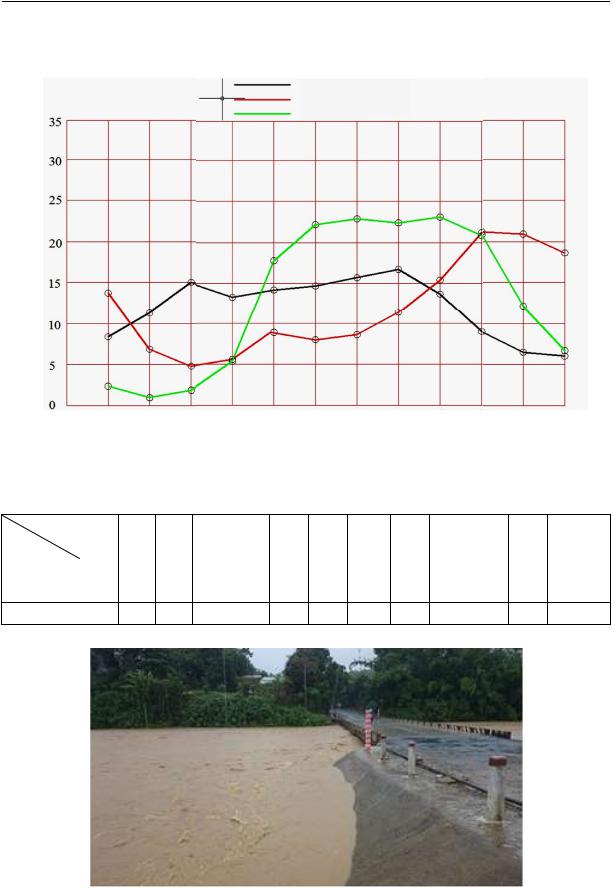
3500 mm/year of rainfall cause flooding of roadways that last from a few hours to a few weeks (Fig. 4).
Hanoi
Danang
Ho Chi Minh
Average annual number of rainy days
|
January |
February |
|
March |
April |
May |
June |
July |
August |
September |
October |
November |
December |
|
|
Fig. 3. Average annual rainfall in different areas of Vietnam |
|
|
|
||||||||
|
|
|
|
|
|
|
|
|
|
|
|
|
Table |
|
|
|
|
|
Amount of rainfall, mm/day |
|
|
|
|
|
|||
Month |
I |
II |
III |
IV |
V |
VI |
VII |
VIII |
IX |
X |
XI |
XII |
Average |
Area |
|
|
|
|
|
|
|
|
|
|
|
|
|
Southern |
15 |
4 |
13 |
42 |
221 |
331 |
314 |
268 |
334 |
268 |
114 |
56 |
165 |
Central |
101 |
31 |
12 |
18 |
47 |
42 |
99 |
117 |
447 |
530 |
221 |
208 |
156 |
Northern |
18 |
28 |
38 |
81 |
197 |
238 |
322 |
343 |
252 |
98 |
42 |
21 |
140 |
Fig. 4. Following a rainfall (the mouth of the Wang River in km 32+650)
51
Russian journal of building construction and architecture
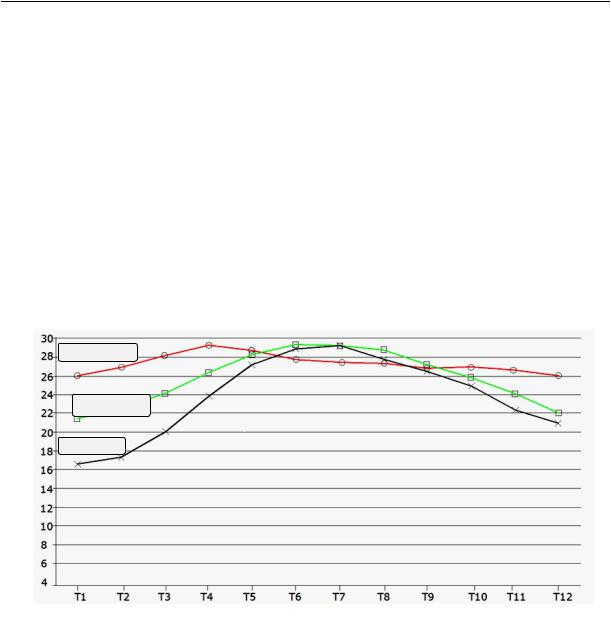
When the moisture off a road surface or gutter cannot cannot flow, it drips through the surface and slopes into the subgrade. The subgrade becomes more plastic as a result of staying wet and thus turns into a paste and then a liquid accomoanied by considerable losses in the strength and resistance to exterior loads (up to 30—60 % for sandy-loam and loamy subgrades and 70—80 % for dust types), which causes deformations of a roadway. Therefore excessive humidity is one of the natural factors in Vietnam that has a particularly significant impact on the physical and mechanical properties of subgrades since the amount of moisture (accumulation of moisture) is central to the connection between solid particles of a road structure. The analysis of the temperature in Vietnam (Fig. 5) points out significant differences not only from month to month but also from an area to area.
Southern area
Central area
Northern area
Fig. 5. Graph of changes in the temperature depending on the season
I.A. Zolotar, N.A. Puzakov, V.M. Sidenko [1] concluded that:
––as the temperature changes in the construction layers of the subgrade, there are constant diffusion processes (heating, cooling, evaporation, condensation) thus resulting in heat exchange and transformation of moisture (vapour);
––changes in the characteristics of the water and heat mode have an impact on the strength, durability of the subgrade, coating of a pavement, which results in degrading transportation and operational properties of road structures;
––an impact of the environment on a road structure is determined by the type and strength of a source of moisture and intensity of temperature effects.
52
Issue № 1(33), 2017 |
ISSN 2542-0526 |
The major task of calculating water and thermal processes is to predict the humidity of a subgrade. Existing methods of predicting the humidity of subgrades is largely based on analysing a water balance equation:
V VC VИ VВ, |
(1) |
where V is the total of the rainfall over a certain period; VD, VE, VA are drainage, evaporation and humidity absorption for a surface unit respectively.
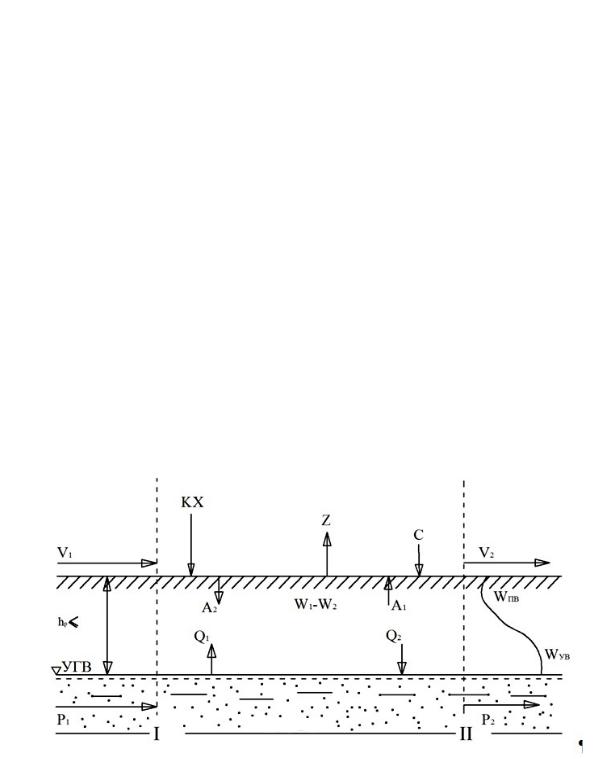
Considering the scheme of water exchange of a specified subgrade layer with the atmosphere (Fig. 6), the water balance equation can be presented using the dependence:
С W1 –W2 (Q1 –Q2) Z (V2 –V1) (G2 –G1) (S2 – S1) (P2 – P1), |
(2) |
where C is the condensation of water vapour; Z is the total evaporation off a surface; V1 and V2 are drainage of surface water; G1 and G2 are inflow and outflow of the soil moisture in a specified layer hР; S1 and S2 are inflow and outflow of groundwater in a specified layer hУГВ — hР; P1 and P2 are inflow and outflow of groundwater; W1 and W2 are humidity of subgrade in a layer h at the start and end of a specified period; Q1 and Q2 are humidity supplies in a layer hР на at the start and end of a specified period.
1,5 m
Aquifuge
Fig. 6. Scheme of humidity exchange of a specified subgrade layer with the atmosphere |
|
Following the transformation the equation (2) is as follows |
|
КХ (W1 –W2) (P2 – P1) V, |
(3) |
where |
|
V (V2 –V1) (P2 – P1). |
|
53
Russian journal of building construction and architecture
The left part of the dependence (3) contains the input elements that are all responsible for the water resources of an area. In the right part there are two balance components (evaporation Ζ and drainage V) that enable control of moisture in (W1 – W2) in subgrade soils.
The major condition of the stability and strength of the “pavement – subgrade” system in Vietnam’s weather conditions is preventing soild from being excessively wet or the humidity of a subgrade from changing too drastically.
Analyzing the mutual dependence “environment-road structures” in Vietnam, it is necessary to note that there is an extra factor that has a direct influence on the quality of asphalt concrete pavements. At all of the altitudes of Vietnam its gets sufficient solar radiation — 130 kcal/сm2 per eyar. The amount of sunny days per year in Northern Vietnam is about 1500—1700 hours, in Central and Southern it is 2000—2600 hours. The temperature mode of an asphalt concrete pavement is known to be a major factor contributing to the stress-strain and life cycle of asphalt concrete road pavements. The temperature of an asphalt concrete pavement is the function of the air temperature which is largely dependent on solar radiation, motion of temperatures in the subgrade soil and many other factors.
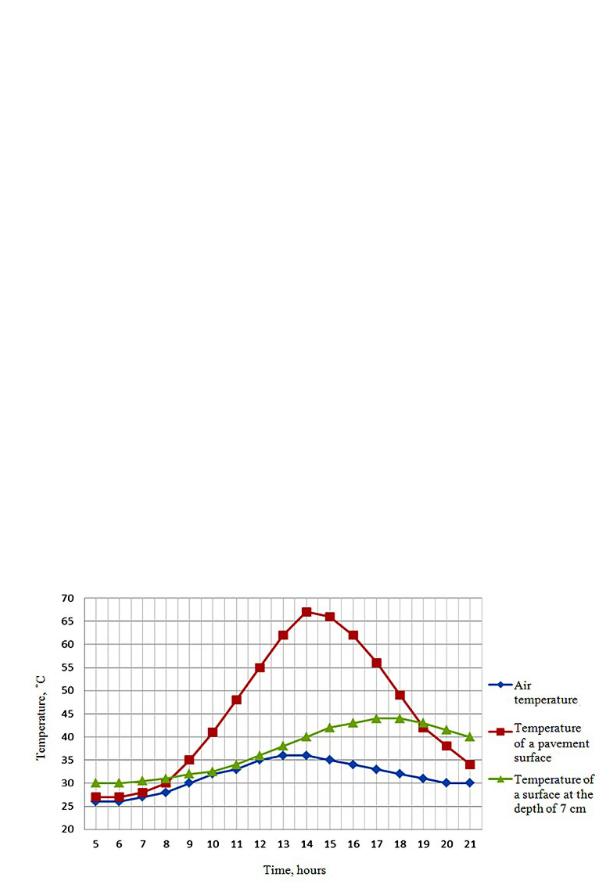
According to cyclic changes in the air temperature and solar radiation in layers of asphalt concrete pavements that are at some deep level, the amplitude of temperature oscillations is smaller than on a surface layer with daily temperature maximums taking a while to become stable. As a result, in different layers of an asphalt concrete pavement, a temperature gradient may get as high as 20—30 ˚С, which obviously has an impact on its load-bearing capacity (Fig. 7).
Fig. 7. Average daily temperature oscillations of an asphalt concrete pavement (km 621 of the highway I-А) [7]
54

Issue № 1(33), 2017 |
ISSN 2542-0526 |
The dependence of the temperature of a pavement on that of the environment is theoretically accounted for based on a thermal balance equation. In order to determine the maximum temperatures of pavements, in accordance with [4], the following formula can be made use of:
ТП ТВ ТЭКВ, |
(4) |
where ТP is the temperature of a pavement, °С; ТA is the temperature of the air, °С; ТEQ is the equivalent temperature, °С.
The equivalent temperature is a sort of an additive that is dependent on extra heating of a surface with solar rays:
(5) where А is an albedo of a surface typical of a reflective capacity; J is the intensity of solar radiation, Watt/m2; ad is the heat transfer coefficient determined with a ratio of the density of a heat flow reflected off a surface to the difference in the temperatures between the surface and an adjoining environment, Watt/(m2·degree).
Intensive heating of a road pavement with solar rays leads to higher plasticity of asphalt concrete, which is due to the viscosity of bitumen in asphalt concrete is down and there is a weaker connection between mineral particles resulting in lower strength and deformation growth under wheels –– cracks, waves, ruts, etc. Poor condition of a road pavement contributes to the degradation of users’ properties –– speed, continuity, traffic safety. Transport has a fundamental role in the development of open market economy in Vietnam.
Therefore evaluating the durability of asphalt concrete to predict its life cycle is the major issue in the Southern and Central Vietnam in the dry season with its typical high air temperature in combination with a high amount of solar radiation.
3. Developing the strategy for the maintenance of structures in the weather conditions of Vietnam. Considering diverse weather conditions of Vietnam, types of deformations and failures of road structures, a variety of routine construction technologies, maintenance and refurbishment of subgrades and pavements in challenging and at times aggressive operational conditions, it is necessary to develop a strategy for road maintenance thus with minimum costs delivering the maximum outcome that would eventually lead to a better quality of the entire road transport network.
As there is no agreement as to the standard methods of predicting life cycles of asphalt concrete, after analyzing them the following conclusion can be drawn: for varying weather and operational conditions the performance of asphalt concrete can be described using characteristics of its different properties. Hence evaluation of the operational condition of a pavement mainly focus
55