Материал: Russian Journal of Building Construction and Architecture

Russian journal of building construction and architecture
7. The optimal recipe values of the compositions of organic and minerla mixes are as follows:
––content of granular asphalt ranges from 30 to 40 % in 100 % of the mineral part;
––content of a third-class bituminous emulsion is 4 %, that of cement is 3—4 % in a complex binder over 100 % of the mineral part.
References
1.Gmurman V. E. Teoriya veroyatnostey i matematicheskaya statistika [Probability theory and mathematical statistics]. Moscow, Vysshaya shkola Publ., 1998. 480 p.
2.Gorelyshev N. V. Asfal'tobeton i drugie bitumomineral'nye materialy [Asphalt and other materials bitumomineraljnykh]. Moscow, Mozhaysk-Terra Publ., 1995. 176 p.
3.Gorelysheva L. A. Organomineral'nye smesi v dorozhnom stroitel'stve [Organo-mineral mixtures in road construction]. Avtomobil'nye dorogi: obzornaya informatsiya, 2003, vol. 3, 107 p.
4.Dymov S. Tekhnologii ispol'zovaniya asfal'togranulyata (RAP) v goryachikh i teplykh smesyakh: prezentatsiya [Technology the use of asphaltgranulate (RAP) in hot and warm mixes: presentation]. Available at: http://maxconf. ru/event/files/48
5.Kalgin Yu. I. Dorozhnye bitumomineral'nye materialy na osnove modifitsirovannykh bitumov [Road bitumomineraljnykh materials based on modified bitumen]. Voronezh, Izd-vo Voronezh. gos. un-ta, 2006. 272 p.
6.Kalgin Yu. I., Strokin A. S., Tyukov E. B. Perspektivnye tekhnologii stroitel'stva i remonta dorozhnykh pokrytiy s primeneniem modifitsirovannykh bitumov [Perspective technologies of construction and repair of road surfaces with the use of modified bitumen]. ]. Voronezh, Voronezhskaya oblastnaya tipografiya, 2014. 224 p.
7.Karamysheva V. M., Gorelysheva L. L. Primenenie vlazhnykh organomineral'nykh smesey pri stroitel'stve i remonte avtomobil'nykh dorog [The use of wet organic-mineral mixtures in the construction and repair of roads].
Avtomobil'nye dorogi: obzornaya informatsiya, 1989, vol. 4. 53 p.
8.Karelin D. Yu. Sovremennye sposoby primeneniya asfal'tovogo granulyata: prezentatsiya OOO «Virtgen- Internatsional'-Servis» [Modern methods of application of the asphalt granulate: presentation of LLC "virtgen- international-Service"]. Available at: http://maxconf.ru/event/files/48
9.Lupanov A. V., Silkin V. V., Sukhanov A. S., Gladyshev N. V. Primenenie asfal'tovogo granu-lyata pri proizvodstve asfal'tobetonnykh smesey na ABZ [The use of asphalt granulate in the production of asphalt mixes at the plant]. Available at: http://maxconf.ru/event/files/48
10.Ol'khovikov V. M. [The use of organic binders in the reconstruction of roads with gravel and macadam coating]. Trudy GPRosdornii [Works GP Rosdornii], 2000, vol. 10, pp. 104—110.
11.Panevin N. I. Opyt ispol'zovaniya asfal'togranulyata v organomineral'nykh smesyakh s bitumnoy emul'siey: prezentatsiya OOO «Avtodoris» [Experience in the use of asphaltgranulate in organic mixtures with bitumen emulsion: presentation of LLC "Avtodora"]. Available at: http://maxconf.ru/event/files/48
12.Wolff & Muller f. Asphalt concrete with reduced dust. Patent Bel'gii, no. 755694, 1971.
13. |
Dorius Carl B., Jones George M., Morse Park L. Cold-laid bituminous paving materials, Patent SShA, |
no. 3074807, 1963. |
|
14. |
Anderton Benjamin A. Cold-rollable paving mix, Patent SShA, no. 2629669, 1953. |
46

Issue № 1(33), 2017 |
ISSN 2542-0526 |
15.Huchenrojter Ju., Vjorner T. Asfal't v dorozhnom stroitel'stve [Asphalt in road construction]. Moscow, ABV-press Publ., 2013, 450 p.
16.Hochbelastete Straβendecken Europäische Argumente fur SMA. Asphalt, 1999, no. 3, pp. 21—27.
17.Holl A. Dünne Schichten im Kalteinbau. Asphalt, 1995, no. 6, pp. 18—21.
18. Maccarone S. Cold Asphalt Systems as an Alternative to Hotmix. Asphalt Review, 1995, v. 14, no. 1, pp. 19—24.
19.Suss G., Karolewski U. Erhohung der Anfangsgriffigkeit von Asphaltdeckschichten-Ergebnisse einer Pilotstudie. Asphalt, 1998, no. 4, pp. 28—32.
20.Wang Zhenjun, Wang Qiong, Ai Tao. Comparative study on effects of binders and curing ages on properties of cement emulsified asphalt mixture using gray correlation entropy analysis. Construction and Building Materials, 2014, vol. 54, no. 15, pp. 615—622.
21.Seredin P. V., Glotov A. V., Domashevskaya E. P., etс. Structural and spectral features of MOCVD AlxGayIn1-x-yAszP1-z/GaAs (100) alloys. SEMICONDUCTORS, 2012, vol. 46, iss. 6, pp. 719––729.
47

Russian journal of building construction and architecture
UDC 625.7/8
O. V. Ryabova1, Nguyen Phuong Ngoc2
DEVELOPMENT OF A STRATEGY OF THE MAINTENANCE
OF TRANSPORTATION FACILITIES
TAKING INTO ACCOUNT THE CLIMATIC CONDITIONS OF VIETNAM
Voronezh State Technical University
Russia, Voronezh, tel.: (473)236-18-89, e-mail: phuongngoc661986@gmail.com 1D. Sc. in Engineering, Prof. of the Dept. of Construction and Operation of Highways 2PhD student of the Dept. of Construction and Operation of Highways
Statement of the problem. The influence of the atmospheric (humidity, temperature, solar radiation) and soil-hydrological (wetting of the base, changes in soil temperature) factors on the strength and durability of road constructions in Vietnam are investigated.
Results. The analysis of transport-operational condition of the road network of Vietnam, the causes and conditions of the characteristic defects of road construction in southern, Central and Northern climatic regions of Vietnam is conducted. A strategy for the maintenance and repair of pavement surfacings and subgrade to increase their strength and durability is proposed.
Conclusions. When choosing the technology content of subgrade, pavement surfacings and elimination of defects, it is necessary to consider thoroughly the impact of diverse climatic factors and soil and hydrological conditions present in the three climatic regions of Vietnam.
Keywords: strength and stability of subgrade, road surfacing, durability of surfacing, temperature of asphalt concrete, moisture, water and temperature conditions.
Introduction
Vietnam’s economic strategy gives the road transportation system a key role as part of the industrial infrastructure that is to be made the government’s top priority. Designing a dynamic, functioning and well-balanced national road transportation system is crucial for the economic growth, prosperity and well-being. However, there are certain factors that make addressing this issue in the Socialist Republic of Vietnam particularly challenging:
––most of maintenance and reconstruction of a declining transport infrastructure was performed following the end of war (1975). According to the guidelines of the time, road were designed with the load-bearing capacity of 6—10 tons per axis;
––a subgrade is usually made of road-adjacent materials using soil;
––roadways are laid by means of fragile local materials;
© Ryabova, О. V., Nguyen Phuong Ngoc, 2017
48
Issue № 1(33), 2017 |
ISSN 2542-0526 |
––asphalt concrete is most common in roadways, which is despite its waterproofing, flexibility, adhesion, etc. is rather unstable and short-lived;
––a rapid growth of load-bearing capacity and traffic intensity with the total rising by 880.9 % since 1990 and is currently estimated at over 32.4 mln;
––the peculiar climate which is the result of the combination of solar radiaiton, circulation of trade winds, monsoons and relief.
Considering all of these and 30-year life cycle of roads, their capacities do not meet the current standards for quality of road construction. Creating dynamic, functioning and wellbalanced national roads is a major issue facing the country these days.
The objective of the paper is to develop a strategy for designing transports structures considering Vietnam’s climate and geographical position.
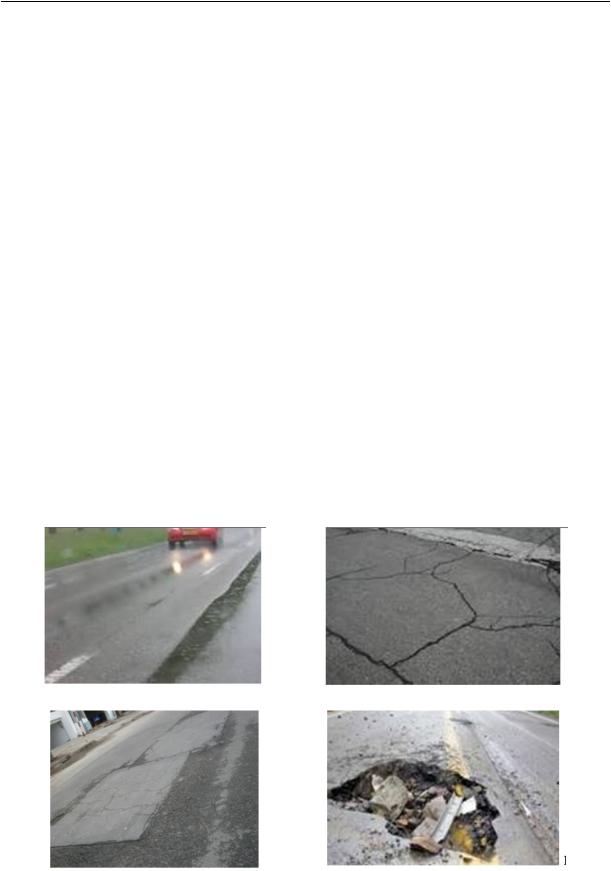
1. Determining the transportation and operational condition of a road network. According to the estimations of the Ministry of Transport of Vietnam, the operational state of the road network has the following technical properties: excellent — 10 %, good and adequate — 45 %, inadequate — 21 %, poor — 24 %. Actual life cycles of asphalt concrete pavements are commonly no longer than 4 or 5 years. The most common deformations of pavements are cracks of different shape and type of cracks that emerge as early as in the first or second year of their operation, i.e. potholes, heaving, breakages, ruts (Fig. 1).
а) |
b) |
c) |
d) |
Fig. 1. Typical defects of asphalt pavements on Federal Road 2 of Danang (intersection of Vien Ko Cham and Nguen Van Choi Street):
а) rutting on the pavement; b) a net of cracks; c) failure of the pavement; d) breakage of the pavement
49
Russian journal of building construction and architecture
2. Study of the mutual dependence “environment – road structure” in Vietnam. A detailed analysis of current studies by Yu. M. Vasiliev, I. Ye. Yevgeniev, N. B. Korsunsky, N. V. Ornatskiy, V. M. Sidenko, A. Ya. Tulayev, etc. into improving the strength and performance of roads (subgrade + pavement) concluded the following [3]:
––under the effect of natural factors as well as a combination of a transport dynamic load and static loading of the upper layers of the subgrade and pavement the strength of the subgrade drops resulting in deformations that commonly lead to failure;
––there is thus a decrease in the strength of a pavement and its major operational properties: evenness and adhesion of a carriageway. This generates a number of defects such as potholes, heaving, breakages, cracks, waves, shear, rutting on a pavement surface;
––the major causes of a lot of factors contributing to deformations, damage and failure of roadways besides transport loading are typically excessive moisture of the subgrade and extremely high temperatures, i.e. the climate of an area.
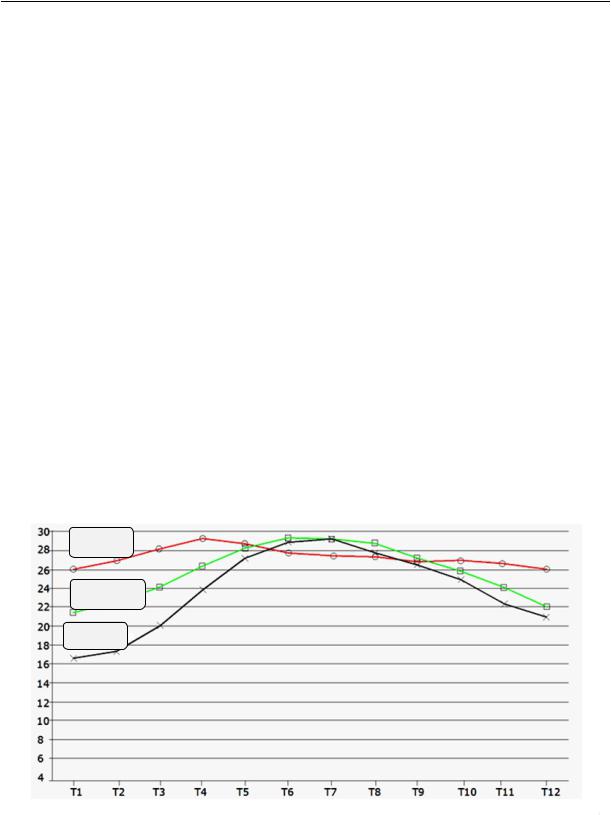
A subtropical and tropical climate of Vietnam is a result of a combination of solar radiation, circulation of trade winds, monsoons and relief. Vietnam’s weather patterns are affected by long wet and dry seasons. Due to the country being quite large from the North to the South, there are thus three climate zones – the Southern, Central and Northern where there are considerable differences in the amount of rainfall and temperature (Fig. 2, 3).
Southern
area
Central
area
Northern
area
Fig. 2. Graph of changes in the temperature depending on the season
During the wet season from July to December in the monsoon and subtropical areas of Vietnam there is a lot of rainfall (Table) that in combination with typhoons with up to 3000—
50