Материал: Russian Journal of Building Construction and Architecture

Russian journal of building construction and architecture
on the properties of materials, distribution gradients, intensity of solar radiation, wind, rain, external loads, etc. The simplex method is most effective (algorithm for optimizing linear programming by selecting the tops of cones in a multidimensional space). The method involves designing basic feasible solutions where the linear functional goes down monotonously until the necessary conditions of local optimality. This allows either to find an optimal solution or to establish that there is no one.
The essence of the simplex method is the following:
––to find out a method of identifying the optimal back-up solution;
––to establish how a transmission is made from one solution to another where the value of the objective function is closer to the optimal one, i.e. to find out how the back-up solution could be improved;
––to specify criteria that allows one either to cut short the selection of back-up solutions on the optimal oneorto concludethereis no one.
Operational properties that contribute to failure of the structure of asphalt concrete can be classed into three major groups:
––impact of transport on asphalt concrete of a road structure;
––impact of the environment causing degrading structural and mechanical characteristics of asphalt concrete;
––impact of the factors associated with the operation of asphalt concrete pavements.
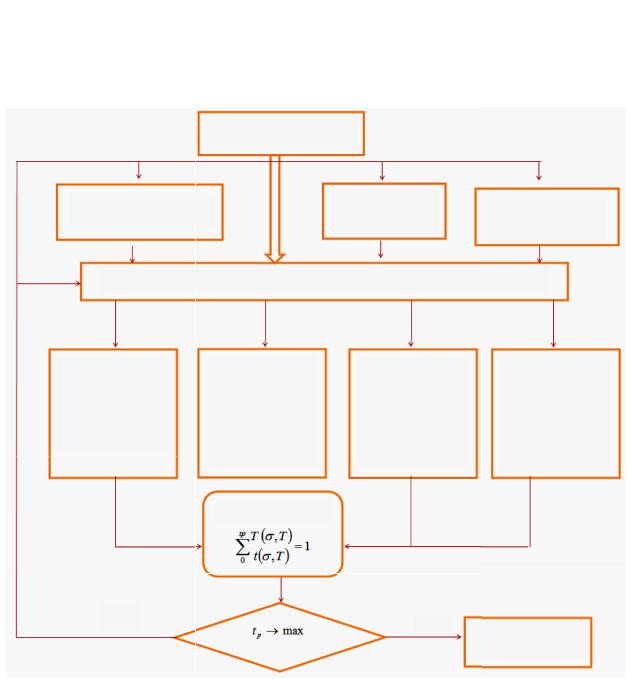
As these factors are investigated further, there are new, previously unknown ones that influence the durability and reliability of asphalt concrete pavements. Depending on them, quantitative characteristics of life cycles of road pavements might change as well. An example of the calculation of thetime before a crack emergeson an asphalt concretepavement is shownin Fig.8.
The major method of improving the strength and durability of road structures is to increase the strength and stability of the subgrade as it is the msot vulnerable part of a structure [18]. Given the weather conditions of Vietnam, the following can be recommended to maintain and reinforce the subgrade embankment:
––when a level of ground waters has a significant effect on the humidity of the operating layer of the subgrade and in order to prevent the rainfall moisture from penetrating it out of the ruts and slopes, ditches should be drained;
––in order to prevent the rainfall moisture from penetrating the subgrade body through unattended ruts or waterproof ones, in order to prevent the rainfall moisture from penetrating a failing asphalt concrete pavement as well as to prevent the embankment subgrade from ditches in the periodof autumn groundwater,itis recommendedtousethe hydroisolation of the subgrade;
56
Issue № 1(33), 2017 |
ISSN 2542-0526 |
–– for drainage of surface water and edge of the subgrade of long-term groundwater it is recommended to use ditches, back-up ditches by arranging slopes or designing terraces;
|
Composition of an asphalt |
|
|
|
concrete mix |
|
|
Transport loads |
Water and |
Water and thermal |
|
thermal impact |
|||
|
impact |
||
|
|
Structure of road pavement and its asphalt concrete
Stretching strains σ (t, T) and their impact time t (σ, T)
Rheological prop- |
Water resistance of |
|
|
erties of asphalt |
asphalt concrete: |
Long-term tensile |
|
concrete: modulus |
Tensile strength of |
||
strength |
|||
E (t, T) and effec- |
asphalt concrete |
||
τ (σ, T) |
|||
tive viscosity |
under bending |
||
|
|||
ƞ (σ, T) |
τ (σ, T) |
|
Bayley criterion
No |
Yes |
Durability |
|
|
|
|
|
of asphalt concrete |
Fig. 8. Block scheme for calculating the time before a crack emerges on an asphalt concrete pavement using the simplex method
–– in areas with stable excessive rainfall moistening and where there is no surface drainage at a high groundwater level it is recommended that roadways are refurbished with the subbase is made of fine-grained materials – hydroisolation sublayer. Th is structure allows water coming through a pavement and ruts to be intercepted and the humidity of the operating layer of the subgrade to be decreased and its load-bearing capacity to be improved. All of the above are routine measures performed to reinforce and improve the quality of a
57

Russian journal of building construction and architecture
pavement. They do not address the water and thermal balance of highways completely as do not account for particular conditions of an area, thus when applied for a specific road, it should consider local weather conditions.
Conclusions
1.An effect of atmospheric (humidity, temperature, solar radiation), hydrological (moistening of the subbase, changes in the soil temperature) and transport (dynamic impacts, vertical loading) factors contributingto the qualityof roadstructures of Vietnam can be classed into twotypes:
–– impact on the subgrade and pavement as a load-bearing structure resulting in changes in its strength, durability and performance;
–– impact on the pavement coating as a rolling surface resulting in changes in the state of its surface, rolling resistance, adhesion and thus a poorer “car-road” connection.
2.When choosing a technology for the maintenance and refurbishment of defects of subgrade and pavement, it is essential to cosnider the influence of a variety of weather and conditions that are Vietnam’s reality. It is only after the major cause of failure of road structures that a technology for the maintenance and refurbishment of road structures.
References
1.I. A. Zolotar' [i dr.]. Vodno-teplovoy rezhim zemlyanogo polotna i dorozhnykh odezhd [Water-heat mode of the subgrade and road pavement]. Moscow, Transport Publ., 1971. 415 p.
2.Dedova I. N., Dau Khoang Khyng. Otsenka sostoyaniya transportnoy infrastruktury V'etnama [Assessment of transport infrastructure of Vietnam]. Transportnoe delo Rossii, 2011, no. 7, pp. 13––17.
3.Evgen'ev I. E., Kazarnovskiy V. D. Zemlyanoe polotno avtomobil'nykh dorog na slabykh gruntakh [The subgrade of roads on weak soils]. Moscow, Transport Publ., 1976. 269 p.
4.Kovalev Ja. N., Kravchenko S. E., Shumchik V. K. Dorozhno-stroitel'nye materialy i izdelija [Road construction materials and products]. Moscow, Novoe znanie Publ., 2013. 630 p.
5.Kozhevnikov, R. A., Dedova I. N., Rezer A. V., Dau Khoang Khyng Obosnovanie prioritetov raz-vitiya transportnogo kompleksa V'etnama [Substantiation of priorities of transport development in Vietnam].
Transportnoe delo Rossii, 2012, no. 3, pp. 51––56.
6.Nguen V. L. Predlozheniya po raschetu konstruktsiy dorozhnykh odezhd s uchetom koleeustoychi-vosti pri povyshennykh temperaturakh v usloviyakh V'etnama [Suggestions for the design of road structures, taking into account coleoptile at elevated temperatures in the environment of Vietnam]. Nauchnyy vestnik Voronezhskogo GASU. Stroitel'stvo i arkhitektura, 2013, no. 2(30), pp. 74—82.
7.Nguen V. L., Chernousov D. I. Prichiny koleeobrazovaniya na asfal'tobetonnykh pokrytiyakh i metody povysheniya ikh deformativnoy ustoychivosti v usloviyakh Yuzhnogo V'etnama [Causes of cleaopatra on asphalt pavements and methods of increasing their deformation resistance in the conditions of South Vietnam].
Nauchnyy vestnik Voronezhskogo GASU. Stroitel'stvo i arkhitektura, 2013, no. 1(29), pp. 57—65.
58

Issue № 1(33), 2017 |
ISSN 2542-0526 |
8.Nguen F. N. Prichiny razrusheniya asfal'tobetonnykh pokrytiy i metody povysheniya ikh de-formativnoy ustoychivosti v usloviyakh V'etnama [The causes of destruction of asphalt-concrete coatings and methods of increasing their deformation resistance in the environment of Vietnam]. Nauchnyy vestnik Voronezhskogo GASU. Stroitel'stvo i arkhitektura, 2015, no. 2(38), pp. 75—83.
9.Podol'skiy Vl. P., Nguen Van Long, Nguen Dyk Shi. Issledovanie temperaturnogo rezhima asfal'tobetonnykh pokrytiy avtomobil'nykh dorog vo V'etname [Investigation of temperature regime of asphalt concrete pavement of roads in Vietnam]. Nauchnyy vestnik Voronezhskogo GASU. Stroitel'stvo i arkhitektura, 2012, no. 4(28), pp. 78—84
10.Podol'skiy Vl. P., Nguen Van Long, Nguen Dyk Shi. O vozmozhnosti rasshireniya resursnoy bazy dorozhnogo stroitel'stva za schet stabilizatsii i ukrepleniya gruntov [About the possibility of expanding the resource base of road construction due to the stabilization and strengthening of soil]. Nauchnyy vestnik Voronezhskogo GASU. Stroitel'stvo i arkhitektura, 2014, no. 1(33), pp. 102—111.
11.Podol'skiy Vl. P., Glagol'ev A. V., Pospelov P. I. Tekhnologiya i organizatsiya stroitel'stva avtomobil'nykh dorog: v 2 t. T. 1. Zemlyanoe polotno [Technology and organization of construction of roads: in 2 vol. Vol. 1. Roadbed]. Voronezh, Izd-vo Voronezh. gos. un-ta, 2005. 528 p.
12.Ryabova O. V., Chan V. Z. Obosnovanie meropriyatiy po zashchite otkosov poymennykh nasypey v'etnamskikh avtomobil'nykh dorog ot kavitatsionnykh i suffozionnykh deformatsiy [Justification of measures for the protection of slopes of embankments floodplain Vietnamese roads from cavitation and suffosion deformations]. Inzhenernye sistemy i sooruzheniya, 2014, vol. 3, no. 4(17), pp. 126—133.
13.Ryabova, O. V., Chan V. Z. Osnovnye printsipy primeneniya traversov dlya inzhenernoy zashchity dorozhno-transportnykh sooruzheniy na poymennykh uchastkakh [Basic principles on the use of beams for engineering protection of road facilities in floodplain areas]. Nauchnyy vestnik Voronezhskogo GASU. Stroitel'stvo i arkhitektura, 2013, no. 4(32), pp. 100—106.
14.Ryabova O. V., Nguen Fyong Ngok. Predlozheniya po reglamentirovaniyu pridorozhnogo pro-stranstva dlya dorog Republiki V'etnam [Proposals for the regulation of roadside space for roads of Republic of Vietnam]. Inzhenernye sistemy i sooruzheniya, 2014, vol. 3, no. 4(17), pp. 112—118.
15.Ryabova O. V., Glagol'ev A. A., Chan V. Razrabotka meropriyatiy po inzhenernoy zashchite av-todorog na poymennykh uchastkakh [Elaboration of measures on engineering protection of roads in floodplain areas].
Fundamental'nye issledovaniya, 2016, no. 4––2, pp. 316—322.
16.Samodurova T. V., Tyong N. V. Bazy dannykh dlya proektirovaniya nezhestkikh dorozhnykh odezhd dlya Respubliki V'etnam [Database for the design of non-rigid road pavements in the Republic of Vietnam].
Nauchnyy vestnik Voronezhskogo GASU. Stroitel'stvo i arkhitektura, 2015, no. 4(40), pp. 72—78.
17.Samodurova T. V., Tyong N. V., Bondarev A. B. Sovershenstvovanie norm proektirovaniya transportnykh sooruzheniy dlya Respubliki V'etnam [Improving design standards of transport facilities in the Republic of Vietnam]. Nauchnyy vestnik Voronezhskogo GASU. Stroitel'stvo i arkhitektura, 2012, no. 4(28), pp. 64—69.
18.Vasil'eva A. P. (red.) Spravochnaya entsiklopediya dorozhnika: v 2 t. T. 2. Remont i soderzhanie avtomobil'nykh dorog [Reference encyclopedia road: in 2 vol. Vol. 2. Repair and maintenance of roads]. Moscow, 2004. 805 p.
19.Chan Van Zy., Podol'skiy Vl. P. Problemy povysheniya deformativnoy ustoychivosti v'et-namskoy dorozhnoy seti na perekhodakh cherez poymu rek [The problem of increasing the deformation resistance of the
59

Russian journal of building construction and architecture
Vietnamese road network on transitions across the floodplain of rivers]. Nauchnyy vestnik Voronezhskogo GASU. Stroitel'stvo i arkhitektura, 2014, no. 4(36), pp. 103—112.
20.Chan Khoang Tkhyong. Znachenie razvitiya transportnoy sistemy v modernizatsii ekonomiki sotsialisticheskoy Respubliki V'etnam [The importance of the development of the transport system in modernization of economy of the socialist Republic of Vietnam]. Transportnoe delo Rossii, 2010, no. 12, pp. 159—161.
21.Chan Khoang Tkhyong. Problemy i strategii razvitiya avtomobil'nogo transporta sotsialisti-cheskoy Respubliki V'etnam [].Challenges and strategies of developing road transport of the socialist Republic of Vietnam. Transportnoe delo Rossii, 2011, no. 4, pp. 87—89.
22.Seredin P. V., Glotov A. V., Domashevskaya E. P., etc. Structural and optical investigations of AlxGa1xAs:Si/GaAs(100) MOCVD heterostructures. PHYSICA B-CONDENSED MATTER, 2010, vol. 405, iss. 22, pp. 4607––4614.
60