Материал: Russian Journal of Building Construction and Architecture

Russian journal of building construction and architecture
there are also other possibilities in his thought. Similarly, Heidegger was criticizing Yorck whilst being thankful to him.
These explanations about authenticity demonstrate that relating to the past (such as friends’ works in the past) and making original contributions to the past achievements is the basis for ontological existence and authenticity. Paul Feyerabend (1987) also says that creativity does not mean creating something out of nothing. Creativity is based on imagination, and imagination is related to the past. Thus, based on M. Heidegger’s (1995) and P. Feyerabend’s (1987) philosophies it can be interpreted that authentic architecture should also have the following characteristics:
––Athankful relationship to the past,
––Original contributions to past achievements.
Original contributions represent the timeliness of architecture, and a relationship to the past represents the culture. Each piece of architecture represents the time it was designed for. As with Paul Klee’s painting ‘Angelus Novus,’ the face of architecture is turned towards history, but the storm coming from paradise propels it into the future (Benjamin, 1940). Thus, architecture has a critical and dynamic relationship with the past and the culture from which it springs.
Because interpretations of the past and originality simultaneously exist, architectural authenticity is a complex issue that is based on architects’ personal approaches. The interviews conducted with four Iranian architects show the differences between their approaches to architectural authenticity as follows:
Reza Daneshmir: “We cannot rob from tradition. We have to add something to it. We have to expand the boundaries of tradition.”
Mohammad Majidi: “Originality is a new interpretation of an older idea. It is not necessarily related to the past, but it always contains a new idea.”
Pouya Khazaeli: “Background is needed for creating architectural work. You have to start from somewhere that has existed before. This is not imitation.”
Alireza Taghaboni: “If a relationship with past does not have innovative quality, it will not have any value. Originality is looking forward to future.”
As shown in the expressions above, the differences in these architects’ thoughts are based on rating the old and new with respect to each other. However, they all agree that modern architecture should stem from the past but be original. When compared with three structural engineering approaches to time, architecture offers infinite approaches to time.
66
Issue № 1(33), 2017 |
ISSN 2542-0526 |
Case Studies: Time Issues in Ten Stairs Designed by Contemporary IranianArchitects
Ten stairs, which represent authentic professional applications in Iran, are analysed according to their relations to time from the architectural and structural engineering perspectives. The four architects have been selected amongst those who have won prizes from the “Memar” competition in Iran, which is the most prestigious architectural competition in Iran, depending on the authenticity of the stairs they designed.
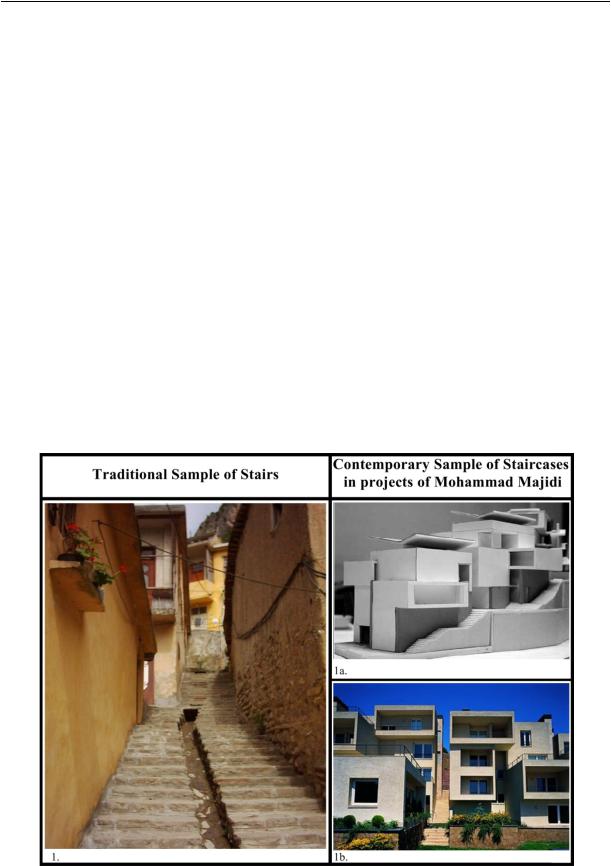
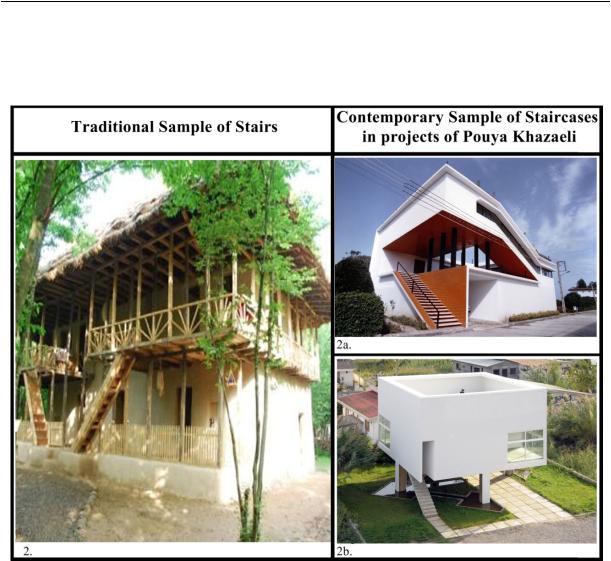
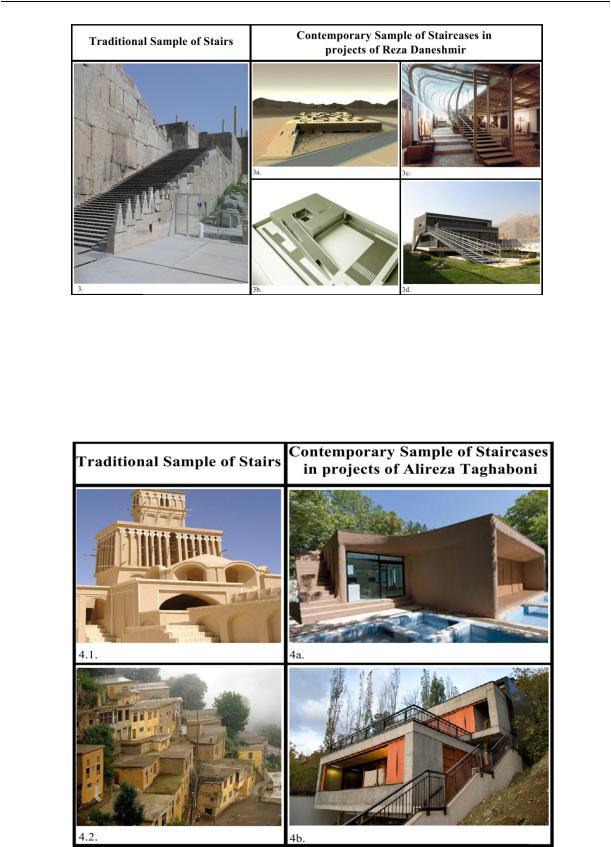
During the analysis of these stairs, first, the architectural requirements of a relationship with the past and originality are presented, and structural engineering issues are then questioned. The historical stairs, which inspired the four contemporary architects, can be observed in Figures 1 to 4, along with the new stairs that have a connection to these historical ones. Each figure demonstrates the works of one architect.
According to the interviewed architects, the aforementioned traditional stairs inspired their stair designs. Mohammad Majidi says, “In the projects of Villashahr and Villadasht, we tried to use the pattern of mountainous rural houses or, in other words, vernacular architecture that has been less often considered.”
Fig. 1. Mountainous rural houses of Iran, Masouleh (URL1, 2005):
1.a. Villadasht Residential Complex, Mohammad Majidi, 2006, Meygoun (Majidi, 2010), 1.b. Villashahr Residential Complex, Mohammad Majidi, 2006, Meygoun (Majidi, 2010)
67
Russian journal of building construction and architecture
Pouya Khazaeli says, “I’ve been inspired by the typology of vernacular architecture in northern Iran in which stairs fly through the building.”
Fig. 2. Vernacular architecture in northern Iran, Gilan (URL2, 2011): 2.a. Darvish Villa, Pouya Khazaeli, 2006, Darvishabad (Khazaeli, 2010), 2.b. Darvishabad Villa, Pouya Khazaeli, 2010, Darvishabad (Khazaeli, 2010)
Reza Daneshmir explains that “[t]he staircases in Takht-e-Jamshid’s entrance has the most spatial influence in my mind because it totally creates the feeling of a soft and smooth transition from one place to another and because its wide and continuous characteristic presents the idea of transformation as a conscious experience. The other important issue is the idea of a stage that presents a space for pause and observing the world from another level, which results in a pure architectural concept in combination with staircases. In those projects that consider the impressive surrounding environment of desert or mountains, the main idea was to conduct a dialogue with them, as we had in traditional architecture.”
68
Issue № 1(33), 2017 |
ISSN 2542-0526 |
Fig. 3. Takht-e-Jamshid, pre-Islamic traditional Iranian architecture, Shiraz (URL3, 2008): 3.a. Safaeie Multifunctional Complex, Reza Daneshmir, 2006, Yazd (Daneshmir, 2012), 3.b. Villa 3, Reza Daneshmir, 2002, Lavasan (Daneshmir, 2012),
3.c.Ave Gallery, Reza Daneshmir, 2000,Tehran (Daneshmir, 2012), 3.d. Double Skin House, Reza Daneshmir, 2002, Lavasan (Daneshmir, 2012)
Fig. 4.1. Desert houses in Iran, Kashan URL4 (2014): 4.2. Mountainous rural houses of Iran, Masouleh (URL1, 2005),
4.a.Amir Villa, Alireza Taghaboni, 2011, Karaj (Taghaboni, 2010). 4.b. Villa for a Friend,Alireza Taghaboni, 2008, Tehran (Taghaboni, 2010)
69

Russian journal of building construction and architecture
Table 1
Analysis of stairs according to time concepts in architecture and structural engineering
|
|
|
Authenticity |
|
Architect |
Building |
Structure |
Relation |
Originality |
|
|
of the stair |
to past |
|
1 |
M. Majidi |
Villadasht |
Stair on |
|
ground |
||||
|
|
|
||
2 |
|
Villashahr |
Stair on |
|
|
ground |
|||
|
|
|
||
3 |
P. |
Darvish |
RC flight |
|
Khazaeli |
Villa |
|||
4 |
|
Darvishabad |
RC flight |
|
|
|
Villa |
|
|
5 |
R. |
Safaiyeh |
Inclined RC |
|
Daneshmir |
Complex |
slab |
||
6 |
|
Hakkak |
Inclined RC |
|
|
Villa |
slab |
||
|
|
|||
7 |
|
Double-skin |
Steel two- |
|
|
House |
stringer |
||
|
|
flight |
||
|
|
|
||
|
|
|
Hanged |
|
8 |
|
Ave Gallery |
steel two- |
|
|
|
|
stringer |
|
|
|
|
flight |
|
|
|
|
RC flight |
|
9 |
A. |
Amir Villa |
covered |
|
Taghaboni |
with special |
|||
|
|
|
material |
|
10 |
|
Villa for a |
Stair on |
|
|
Friend |
ground |
||
|
|
RC – reinforced concrete
++
++
++
++
++
++
++
++
Original but
+looking old because of the cover
++
Approach to |
Innovation |
|
efficiency |
||
|
||
Optimization |
|
|
of the designed |
– |
|
structure |
|
|
Optimization |
|
|
of the designed |
– |
|
structure |
|
|
Optimization |
|
|
of the designed |
– |
|
structure |
|
|
Optimization |
|
|
of the designed |
– |
|
structure |
|
|
Optimization |
|
|
of the designed |
– |
|
structure |
|
|
Optimization |
|
|
of the designed |
– |
|
structure |
|
|
Optimization |
|
|
of the designed |
– |
|
structure |
|
|
Optimization |
The hanged |
|
structure needs |
||
of the designed |
||
structure |
special struc- |
|
tural design. |
||
|
||
Optimization |
The cover on |
|
of the designed |
the stair needs |
|
structure |
special design. |
|
Optimization |
|
|
of the designed |
– |
|
structure |
|
As seen in Table 1, the ten stairs do not have any problem with understanding time from an architectural perspective. Theywere selected to be like that from the beginning of this research. All of these stairs are authentic. They all have modern structural systems. Additionally, they all have original designs. On the other hand, when we consider the approach to these stairs’ structural efficiency, it can be observed that the buildings that contain these architecturally successful stairs were optimized without making major changes to their architecture. According to the interviews with Reza Daneshmir’s, Mohammad Majidi’s and Alireza Taghaboni’s leading structural engineers, it was necessary to be innovative to make these designs possible. Although architecture was more dominant in their design in comparison to structural engineering, engineering innovations were needed.
70