Материал: Russian Journal of Building Construction and Architecture
Russian journal of building construction and architecture
Fig. 3. Geometric designs for determining local angular coefficients of radiaiton of a linear source on an elementary area for their position in mutually perpendicular planes
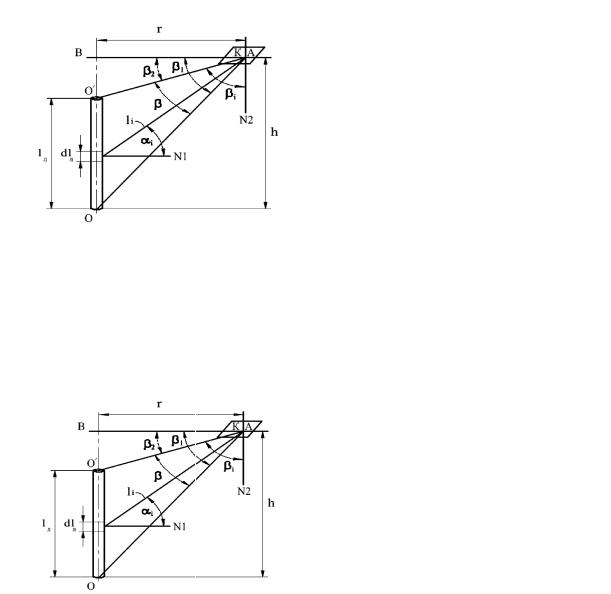
5. Geometric designs for determining local angular coefficients of radiation for an elementary area on a horizontal plane at a random height. For a position of an elementary area at any random height h from the lower (or upper) base of a linear source we have the following geometric designs (Fig. 4). The shortest distance from point А to a linear source is r. Let us designate ОАО' = , ОАВ = 1, О'АВ = 2, 1 - 2 = .
Fig. 4. Geometric designs for determining local angular coefficients of radiaiton for an elementary area on a horizontal plane ata random height
Fig. 4 suggests that for the equation (10)—(12) mutual positions of a linear source and an elementary area are appropriate. For determining a local angular coefficient of radiation of a linear source on an elementary area it is necessary to insert (10)—(12) into (2) and integrate within changes of an angle αi, i.e from 2 to 1:
lk |
Fk |
|
sin2 1 sin2 2 . |
(14) |
2 |
|
|||
|
2 rl |
л |
|
|
Average angular coefficients of radiation of a linear source on a flat surface F (see Fig. 1) lF are determined as a sum of local angular coefficients of radiation of a linear source on elementary areas on a surface F:
|
n |
|
lF |
lk , |
(15) |
|
1 |
|
where n is the number of elementary areas on a F.
36

Issue № 1(33), 2017 |
ISSN 2542-0526 |
The expressions for determining a local angular coefficient of radiation of a linear source on a surface of an elementary area positioned on random planes are obtained identically.
Energy setups with twisted fire chambers used for heat supply of buildings and structures allow an even temperature distribution in fire chambers and thus improving their life cycle.
Conclusions
1.Rotation speeds in a fire chamber decrease the consumption of a vector of absolute speed resulting in hot gases staying longer in a fire chamber and smaller heat losses for a chemical and mechanical underburning.
2.The use of twisted fire chambers intensifies heat transfer as well as increases the durability of a fire chamber by means of even temperature distribution within a fire chamber and reduces maintenance costs.
3.Based on the analytical studies, equations for determining local angular coefficients of radiation of a linear source on an elementary area for its position on horizontal, vertical, slope surfaces of heat transfer. The obtained analytical expressions supplement the available data on angular coefficients and enable new methods of calculating radiation heat transfer in twisted fire chambers.
References
1.Babich A. S., Kirnova M. A., Sotnikova K. N. Razrabotka algoritma optimizacii rashoda topliva istochnikom teploty [Development of algorithm optimization of fuel consumption by the heat source].
Inzhenernye sistemy i sooruzheniya, 2009, no. 1, pp. 125––131.
2.Makarov A. N. Teoriya i praktika teploobmena v elektrodugovykh i fakel'nykh pechakh, topkakh, kamerakh sgoraniya: v 2 ch. Ch. 2. Teploobmen v fakel'nykh pechakh, topkakh, kamerakh sgoraniya [Theory and practice of heat exchange in electric arc and torch furnaces, fire chambers, combustion chambers: in 2 parts. Part 2. Heat transfer in torch furnaces, fire chambers, combustion chambers]. Tver, TGTU, 2009. 152 p.
3.Chudinov D. M. [i dr.]. Razrabotka novykh intellektual'nykh svetoprozrachnykh ograzhdayushchikh konstruktsiy zdaniy [The development of new intellectual translucent enclosing structures of buildings].
Inzhenernye sistemy i sooruzheniya, 2010, no. 1, pp. 93––97.
4.Sotnikova K. N., Muratov A. V. Avtomatizatsiya protsessa upravleniya teplovymi potokami v pomeshcheniyakh [Automated process control of heat fluxes in the premises]. Vestnik Voronezhskogo gosudarstvennogo tekhnicheskogo universiteta, 2008, no. 12, pp. 48––50.
5.Sotnikova K. N., Kolosova N. V., Drapalyuk R. A. Modelirovanie gibridnoy ekspertnoy sistemy dlya proektirovaniya zdaniy «zelenogo stroitel'stva» [Modelling hybrid expert system for building design "green building"]. Inzhenernye sistemy i sooruzheniya, 2012, no. 2, pp. 105––113.
6.Sotnikova K. N. Povyshenie effektivnosti energosnabzheniya potrebiteley v sistemakh s netraditsionnymi istochnikami teploty [Improving the efficiency of power supply in systems with untraditional heat sources].
Vestnik Voronezhskogo gosudarstvennogo tekhnicheskogo universiteta, 2009, no. 4, pp. 66––71.
37

Russian journal of building construction and architecture
7.Sotnikova K. N. Razrabotka modeli sinteza sostava traditsionnykh sistem teplosnabzheniya s ispol'zovaniem vozobnovlyaemykh istochnikov energii [Development of a model for the synthesis of the composition of traditional heating systems using renewable energy sources]. Nauchnyy vestnik Voronezhskogo GASU. Stroitel'stvo i arkhitektura, 2009, no. 3, pp. 25––31.
8.Sotnikova O. A., Cherenkov S. I. Obosnovanie perspektivnykh napravleniy snizheniya intensivnosti korrozii teploobmennykh poverkhnostey kotlov teplogeneriruyushchikh ustanovok sistem teplosnabzheniya [Substantiation of perspective directions of reduction of the intensity of corrosion of the heat transfer surfaces of boilers heat generating installations heat supply systems]. Inzhenernye sistemy i sooruzheniya, 2009, no. 1, pp. 99––107.
9.Sotnikova O. A., Petrikeeva N. A. Raschet ekonomicheskoy effektivnosti primeneniya kondensatsionnykh teploobmennykh ustroystv teplogeneriruyushchikh ustanovok [The calculation of economic efficiency of use of condensing heat exchangers thermal generating plants]. Nauchnyy vestnik Voronezhskogo GASU. Stroitel'stvo i arkhitektura, 2008, no. 1, pp. 113––117.
10.Sotnikova O. A., Petrikeeva N. A., Turbin V. S. Matematicheskaya model' protsessov kondensatsii vodyanykh parov na teploobmennykh poverkhnostyakh [Mathematical model of the processes of condensation of water vapor on heat transfer surfaces]. Izvestiya Tul'skogo gosudarstvennogo universiteta. Stroitel'stvo, arkhitektura i restavratsiya, 2006, no. 10, p. 159.
11.Sotnikova O. A., Cherenkov C. I. Obosnovanie perspektivnykh napravleniy snizheniya intensivnosti korrozii teploobmennykh poverkhnostey kotlov teplogeneriruyushchikh ustanovok sistem teplosnabzheniya [Substantiation of perspective directions of reduction of the intensity of corrosion of the heat transfer surfaces of boilers heat generating installations heat supply systems]. Inzhenernye sistemy i sooruzheniya, 2009, no. 1, pp. 99––107.
12.Sotnikova O. A., Chudinov D. M., Kolosov A. I. Primenenie netraditsionnykh vozobnovlyaemykh istochnikov energii pri reshenii problem energosnabzheniya i ekologicheskoy bezopasnosti [The use of renewable energy in addressing energy and environmental security]. Inzhenernye sistemy i sooruzheniya, 2009, no. 1, pp. 80––87.
13.Sotnikova O. A., Bulygina S. G. Ekologicheskaya bezopasnost' ventiliruemykh pomeshcheniy restorannykh kompleksov [Environmental safety of ventilated premises of restaurant complexes]. Nauchnyy vestnik Voronezhskogo GASU. Stroitel'stvo i arkhitektura, 2012, no. 1, pp. 154––163.
14.Turbin V. S., Sotnikova O. A., Petrikeeva N. A. Razrabotka matematicheskoy modeli teplomassoobmena v napornykh teploutilizatorakh [Development of mathematical model of heat and mass transfer in the pressure recovery]. Vestnik Voronezhskogo gosudarstvennogo tekhnicheskogo universiteta, 2005, vol. 1, no. 6, p. 79.
15.Sazonov E. V. [i dr.]. Effektivnost' szhiganiya tverdykh bytovykh otkhodov v modul'nykh ustanovkakh sistem detsentralizovannogo teplosnabzheniya [The efficiency of combustion of solid waste in modular installations of systems of decentralized heat supply]. Izvestiya vuzov. Stroitel'stvo, 2006, no. 2, pp. 68––73.
16.Durbin P. A. Separated Flow Computations with K-S-O-Model. AIAA J, 1995, vol. 33, no. 4, pp. 659—664.
17.Edwards D. К. Molecular Gas Band Radiation. Advanes in Heat Transfer, 1976, vol. 12, pp. 115—193.
18.Hubbard G. L., Tien C. L. Infrared Mean Absorption Coefficients of Luminous Flames and Smoke. J. Heat Transfer, 1978, vol. 100, pp. 235—239.
19.Mengiic M. P., Viscanta R. On the Radiative Properties of Polydispersions: a Simplified Approach. Combast. Sci. and Technol, 1985, vol. 44, no. 3, 4, pp. 143—159.
20.Tomeczek J., Weber R. Radiation and Burner Geometry in the Mathematical Modeling of a Flat Gaseous Flame. Combast. and Flame, 1981, vol. 41, no. 2, pp. 149—156.
38

Issue № 1(33), 2017 ISSN 2542-0526
DESIGNING AND CONSTRUCTION OF ROADS,SUBWAYS,
AIRFIELDS,BRIDGES AND TRANSPORT TUNNELS
UDC 625.7/691.16
M. N. Panevin1, Yu. I. Kalgin2
ORGANOMINERAL MIXES BASED ON AN ASPHALT CHIP
FOR SURFACINGS AND SUBBASES OF HIGHWAYS
Ltd. «AVTODORIS»
Russia, Voronezh, e-mail: panevinn@mail.ru 1Engineer
Voronezh State Technical University
Russia, Voronezh, tel.: (473) 236-18-89, e-mail: kalgin36@yandex.ru
2D. Sc. in Engineering, Prof. of the Dept. of Construction and Operation of Highways
Statement of the problem. The problem of the development of organic-compounds characterized by the use of a mineral asphalt chip in part, to the device structural pavement layers.
Results. The results of the experiment and mathematical analysis to determine the physical and mechanical properties of organic-mineral mixes are shown. The operation of physical and mechanical and technological properties of organic-mineral mixes with different proportions of asphalt chip in the mineral part. The role of asphalt chip in improving the quality using organiccompounds. The optimum compositions of organic compounds using asphalt chips in the mineral part and the optimal characteristics of the materials for making them are presented.
Conclusions. The main factor influencing the characteristics of the organic mineral mix is the amount of bituminous emulsion making up a complex binder. Increasing the content of cement in the binder with a minimum content of the emulsion has a less significant effect on the properties of the mix. The ptimal content of asphalt chip is 40 % in the mineral part of the mix.
Keywords: asphalt concrete, asphalt chip, organic mixture, bituminous emulsion.
Introduction
Life cycle and transport and operational properties of highways can be improved by using modern technologies in their construction, reconstruction and maintenance [2, 5, 6, 12—15]. Organic and mineral mixes are one of the most effective materials used for roadways [3, 7, 10, 11].
© Panevin M. N., Kalgin Yu. I., 2017
39

Russian journal of building construction and architecture
The use of organic and mineral mixes in road construction has a few significant technological, economic and operational advantages [17—19] such as cutting-edge technology of material production to provide smoothness and roughness of a road surface, efficient and quick maintenance, reliability, possibleuse of localmaterials andsecondaryresources and primarilygranular asphalt. Granular asphalt is a loose material consisting of mineral components and an organic binder making it good for secondary use. It becomes most cost-effective if used for asphalt concrete and organic and mineral mixes. The use of granulates of old asphalt in road construction in Russia allows one to lower a demand for mineral and binding materials and reduce the total costs of their components enabling asphalt and concrete wastes to be recycled as part of the environment-friendly effort [7—11].
According to the European Asphalt Pavement Association (EAPA), there is an annual increase in the use of granular asphalt for hot and cold asphalt concrete and bituminous mineral mixes [4, 8, 9]. In Japan 98 % of granular asphalt is used in asphalt concrete mixes [4].
1. Optimization of compositions and properties of organic and mineral mixes using a regression model of their mutual dependence. In order to develop the optimal compositions of organic and mineral mixes using complex binders and secondary road industry materials, an experiment was carried out using the methods of mathematical planning [1]. It is assumed that strength and operational properties of organic and mineral mixes are completely due to their composition. The components and their proportions in a mix may fluctuate as so do the conditions for solidification such as temperature and humidity. There might also be errors in measuring the water resistance or strength limit. Let us denote the numerical value of the characteristics in question as Y and its functional dependence on the parameters as F(X1, X2, X3). Random excitation in each of the experiments is expressed through an additive Z:
Y F(X1,X2,X3) Z , |
(1) |
where according to the central limit theoreme, the random value Z has a normal distribution with the parameters M(Z) = 0 and σ(Z) = σ. Taking the mathematical expectation M from both parts, we get
M(Y) M(F(X1,X2,X3 Z)) F(X1,X2,X3) M(Z) F(X1,X2,X3). (2) The last equality means that the initial functional bond F (X1, X2, X3) expresses not Y itseld but its mathematical expectation for the specified parameters X1, X2, X3:
M(Y) F(X1,X2,X3), |
(3) |
Such a dependence is regressional and the law F(X1, X2, X3) is a regression of Y along X1, X2, X3. There is a well-developed method for obtaining a regression dependence based on experimental
40