Материал: Uchebnik_dlya_sud_expertov
MODULE 1
THE WORLD OF LANGUAGE
UNIT 1. INTRODUCTION
1..
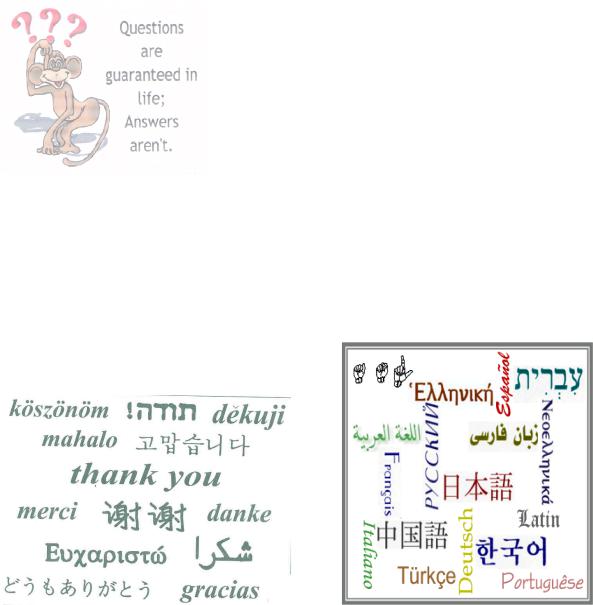
1.Can you read all words written below? Why?
2.Can you guess in what languages the words are written?
3.Can you guess what these words mean? How can you do it?
4.What do words consist of?
5.What languages can you speak?
6.Is it difficult or easy for you to study foreign languages?
7.How many different languages are spoken in Russia?
8.What is the official language of Russia?
9.What foreign languages do children study at school in Russia?
10.Do you agree that English is the language of international communication? Give your reasons.
СПАСИБО
6
2. , .
Models:
Who speaks Russian? – Russians do. Who speaks Japanese? The Japanese do.
1.Who speaks English? __________
2.Who speaks Spanish? ___________
3.Who speaks German? ___________
4.Who speaks Arabic? ___________
5.Who speaks Chinese? ___________
6.Who speaks Italian? ___________
3. , .
Models: - Where is he from?
-He is from Great Britain. He is an Englishman.
-Where is she from?
-She is from China. She is Chinese/ or /She is a Chinese woman.
(The USA, Japan, Russia, Canada, Korea, France)
4. , .
Model: Does he live in the Netherlands or Denmark? – I think he is a Dane.
1._______________? – I think he is a Pole.
2._______________? – I think he is a Spaniard.
3._______________? – I think he is a Swede.
4._______________? – I think he is a Finn.
5._______________? – I think he is a Swiss.
Model: Are they speaking Portuguese? – Yes, they are. But I think they are Brazilians.
1.Are they speaking English? – (India)______________
2.Are they speaking French? - (Canada)______________
3.Are they speaking Arabic? - (Egypt)_______________
4.Are they speaking Turkish? – (Azerbaijan)____________
5.Are they speaking German? – (Austria)_______________
6.Are they speaking Danish? – (Denmark) _____________
5..
1.He's from Brazil. He's ___.
a. Brazilish b. Brazilian c. Brazilese
2.I'm from Colombia. I can speak ___.
a. Spanish b. Colombian c. Colombish
3.She's from Russia. She can speak ___.
a. Russia b. Russy c. Russian
7
4.We're from Italy. We're ___.
a.Italien b. Italian c. Italiun
5.My friend is from Korea. He can speak ___.
a.Korish b. Korean c. Koreanese
6.Pablo is from Mexico. He's ___.
a.Spanish b. Mexican c. Mexian
7.Martha is from the United States. She's ___.
a.American b. United Statian c. United Statianese
8.My father is from China. He can speak ___.
a.Chiny b. Chinish c. Chinese
9.Gloria is from Puerto Rico. She's ___.
a.Puerto Rich b. Puerto Rican c. Puerto Riquean
10.Pierre is from France. He can speak ___.
a.Franchise b. Francese c. French
6.: “What is language?” -
!" # $#.
Human System of Communication
Language is a human system of communication that uses arbitrary signals, such as voice sounds, gestures, or written symbols.
The Armory of the Human Mind
Language is the armory of the human mind, and at once contains the trophies of its past and the weapons of its future conquests.
An Art
Language is an anonymous, collective and unconscious art; the result of the creativity of thousands of generations.
The Instrument of Science
"I am not yet so lost in lexicography as to forget that words are the daughters of earth and that things are the sons of heaven. Language is only the instrument of science, and words are but the signs of ideas: I wish, however, that the instrument might be less apt to decay, and that signs might be permanent, like the things which they denote."
(Samuel Johnson, Preface, A Dictionary of the English Language, 1755)
Laws
"In language, the ignorant have prescribed laws to the learned." (Richard Duppa, Maxims, 1830)
A Process of Free Creation
8
Language is a process of free creation; its laws and principles are fixed, but the manner in which the principles of generation are used is free and infinitely varied. Even the interpretation and use of words involves a process of free creation.
A Finite System
"Any language is necessarily a finite system applied with different degrees of creativity to an infinite variety of situations, and most of the words and phrases we use are 'prefabricated' in the sense that we don’t coin new ones every time we speak."
(David Lodge, "Where It’s At," The State of the Language, 1980)
A Barrier to Progress
Language is the biggest barrier to human progress because language is an encyclopedia of ignorance. Old perceptions are frozen into language and force us to look at the world in an old fashioned way.
A Sheet of Paper
"Language can also be compared with a sheet of paper: thought is the front and the sound the back; one cannot cut the front without cutting the back at the same time; likewise in language, one can neither divide sound from thought nor thought from sound."
(Ferdinand de Saussure, Course in General Linguistics, 1916)
The Shaper of Thought
Language shapes the way we think, and determines what we can think about.
7. % ! . % & ! ,
! #' .
QUESTIONS
1.How many languages are there in the world?
2.From how many other languages has English borrowed words?
3.How many people in the world speak English today?
4.In how many countries is English taught as a foreign language?
5.What is the most widely used English word?
6.How many countries in the world have English as their first language?
9
ANSWERS
A.English has borrowed words from over 350 other languages, and over three-quarters of the English lexicon is actually Classical or Romance in origin.
B.The form OK or okay is probably the most intensively and widely used word in the history of the language.
C.English is now the language most widely taught as a foreign language--in over 100 countries, such as China, Russia, Germany, Spain, Egypt, and Brazil--and in most of these countries it is emerging as the chief foreign language to be encountered in schools, often displacing another language in the process.
D. English has official or special status in at least 75 countries (with a combined population of two billion people). It is estimated that one out of four people worldwide speak English with some degree of competence.
E.First-language speakers: 375 million Second-language speakers: 375 million Foreign-language speakers: 750 million
F.Today there are about 6,000 languages in the world, and half of the world's population speaks only
10of them. English is the single most dominant of these 10.
8.% ! . !, ( !
.
UNIT 2. THE HISTORY OF THE ENGLISH LANGUAGE
: !
! – % ) -. :
1) –# ##.
) , , .
+ : |
to move – movement |
|
$ – & |
|
to move – to remove |
|
$ - $ |
2) – .
+ : |
respect + ability = respectability |
|
& + $ = $, $ $ |
10