Материал: Банкова ПРАЦТИЦЕ МАКЕС ПЕРФЕЦТ ПРЕСЕНТ ФОРМС 2015
11.He (find) the snake who (recognize) its old friend and (coil) round him affectionately. But, unfortunately, the snake is by now a full-grown boa-constrictor and its embrace (kill) the poor boy.
12.The snake (feel) sorry about this? – I (not know). The story (end) there.
13.How you (end) a letter that (begin), 'Dear Sir'? – I always (put), 'Yours truly', but Tom (prefer) 'Yours faithfully'.
14.What the word 'catastrophe' (mean)? – It (mean) 'disaster'.
15.What you (wait) for? – I (wait) for the shop to open. – But it (not open) till 9.00. – I (know) but I (want) to be early, as their sale (start) today.
16.Why you (smoke) a cigar, Mrs. Pitt? You (not smoke) cigars as a rule. – I (smoke) it because I (want) the ash. This book (say) that cigar ash mixed with oil (remove) heat stains from wood.
17.Who (own) this umbrella? – I (not know). Everybody (use) it but nobody (know) who (own) it.
18.You (mind) if I (ask) you a question? – That (depend) on the question. – It (concern) your brother.
19.I (refuse) to answer any question about my brother.
8.Put the verbs in brackets into the Present Simple or the Present Continuous.
1.John and Peter … (fly) to Paris on Monday on business. Their flight … (take off) at 7:10 in the morning and …. (arrive) in Paris at 9.30 in the morning. Peter’s cousin … (own) a house there, so they … (stay) with him.
2.My neighbour … (bang) on the walls of his flat when he … (do) repairs. This week he … (install) a new bath, and the noise … (drive) me crazy. He … (not/seem) to he care about the way he … (bother) other people.
3.Tom is an athlete. Every morning, he … (swim) ten laps in the pool and … (lift) weights for an hour. This year, he … (train) harder because he … (want) to compete in the next Olympic Games.
4.Denis … (live) in Glasgow and … (work) for an advertising company. He … (have) a good job and … (earn) a lot of money. He … (meet) many people every day and … (lead) a busy life. The company … (expand) rapidly, and today he … (see)a new client.
31

Unit 4
Present Perfect
USE 1 – Unspecified Time Before Now
We use the Present Perfect to say that an action happened at an unspecified time before now. The exact time is not important. You CANNOT use the Present Perfect with specific time expressions such as: yesterday, one year ago, last week, when I was a child, when I lived in Japan, at that moment, that day, one day, etc. We CAN use the Present Perfect with unspecific expressions such as: ever, never, once, many times, several times, before, so far, already, yet, etc.
Analyze the examples:
•I have seen that movie twenty times.
•I think I have met him once before.
•There have been many earthquakes in California.
•People have travelled to the Moon.
•Have you read the article yet?
•Nobody has ever climbed that mountain.
NB! The concept of «unspecified time» can be very confusing to English learners. It is best to associate Present Perfect with the following topics:
TOPIC 1 – Experience
You can use the Present Perfect to describe your experience. It is like saying, «I have the experience of...» You can also use this tense to say that you have never had a certain experience. The Present Perfect is NOT used to describe a specific event.
32
Analyze the examples:
• I have been to France.
=This sentence means that you have had the experience of being in France. Maybe you have been there once or several times.
•I have been to France three times.
=You can add the number of times at the end of the sentence.
•I have never been to an art exhibition.
=This sentence means that you have not had the experience of going to an art exhibition.
•I think I have seen that movie before.
•He has never travelled by train.
•A: Have you ever met him?
B:No, I have not met him before.
TOPIC 2 – Change Over Time
We often use the Present Perfect to talk about change that has happened over a period of time.
Analyze the examples:
•You have grown since the last time I saw you.
•The government has become more interested in arts education.
•Chinese has become one of the most popular courses at the university since the Asian studies program was established.
•My English has really improved since I moved to Australia.
TOPIC 3 – Accomplishments
We often use the Present Perfect to list the accomplishments of individuals and humanity. You cannot mention a specific time.
Analyze the examples:
•Man has walked on the Moon.
•Our daughter has learned how to read.
•Doctors have cured many deadly diseases.
•Scientists have split the atom.
33

TOPIC 4 – An Uncompleted Action You Are Expecting
We often use the Present Perfect to say that an action which we expected has not happened. Using the Present Perfect suggests that we are still waiting for the action to happen.
Analyze the examples:
•James has not finished his homework yet.
•Kate hasn't mastered Japanese, but she can communicate.
•The rain hasn't stopped.
TOPIC 5 – Multiple Actions at Different Times
We also use the Present Perfect to talk about several different actions which have occurred in the past at different times. Present Perfect suggests the process is not complete and more actions are possible.
Analyze the examples:
•The army has attacked that city five times.
•I have had four quizzes and five tests so far this semester.
•We have had many major problems while working on this pro-
ject.
•She has talked to several specialists about her problem, but nobody knows why she is sick.
Time Expressions with the Present Perfect
When we use the Present Perfect it means that something has happened at some point in our lives before now. Remember, the exact time the action happened is not important.
Sometimes, we want to limit the time we are looking in for an experience. We can do this with expressions such as: in the last week, in the last year, this week, this month, so far, up to now, etc.
34
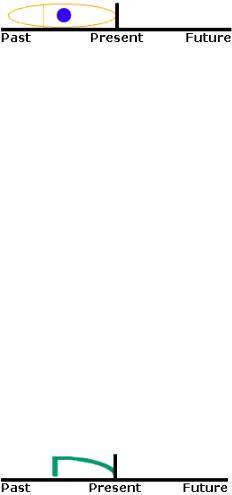
Analyze the examples:
•Have you been to Canada in the last year?
•I have seen that movie six times in the last month.
•They have had four tests in the last week.
•She graduated from university less than three years ago. She has worked for two different companies so far.
•My car has broken down three times this week.
NB! «Last year» and «in the last year» are very different in meaning. «Last year» means the year before now, and it is considered a specific time which requires Simple Past. «In the last year» means from 365 days ago until now. It is not considered a specific time, so it requires the Present Perfect.
Analyze the examples:
• I went to Spain last year.
=I went to Spain in the calendar year before this one.
•I have been to Spain in the last year.
=I have bee to Spain at least once at some point between 365 days ago and now.
USE 2 - Duration From the Past Until Now (Non-Continuous Verbs)
With Non-Continuous Verbs and non-continuous uses of Mixed Verbs, we use the Present Perfect to show that something started in the past and has continued up until now. «For five minutes», «for two weeks», and «since Tuesday» are all durations which can be used with the Present Perfect.
35