Материал: Цели и задачи обучения английскому языку для специальных целей
3. Словообразование.
а) запомните приставки чисел:
semi- (полу), mono- (один), bi- (два), tri- (три), quad- (четыре), penta- (пять), hex- (шесть), sept - (семь), oct- (восемь), dec- (десять), multi- (много).
б) подберите к английским словам их русские соответствия:
1. semicircle; 2. monochromatic; 3. binary; 4. triangle; 5. quadruple; 6. pentagon; 7. hexadecimal; 8. September; 9. octal; 10. decimal; 11. multiplexer.
1. мультиплексор, концентратор; 2. десятичный; 3. восьмеричный; 4. сентябрь; 5. шестнадцатеричный; 6. пятиугольник; 7. четверичный, учетверяться; 8. треугольник; 9. двоичный; 10. монохромный; 11. полукруг.
4. Подберите к русским словам их английские соответствия:
1. решать; 2. исходная программа; 3. краткий; 4. алгебраическая формула; 5. фраза; 6. ориентироваться; 7. включать в себя; 8. применяемая программа; 9. оператор. 10. утверждение.
1. application program; 2. involve; 3. statement; 4. orient; 5. algebraic formulae; 6. brief; 7. source program, 8. solve; 9. phrase. 10. operator.
Data processing. [ˏprəʋ`sesɪɧ]
1.Read. Write down and translate the marked words.
Data processing is "the collection and manipulation of items of data to produce meaningful information.
A data processing system is "a system that accepts data as input and processes it into information as output." The process may be automated and run on a computer. It involves recording, analysing, sorting, summarising, calculating, disseminating and storing data.
Because data are most useful when well-presented and actually informative, data-processing systems are often referred to as information systems.
Data processing may or
may not be distinguished from data conversion, when the
process is merely to convert data to another format, and does
not involve any data manipulation.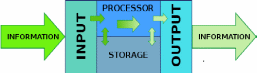
Description.
Data are facts, organized or unorganized, which need to be converted into other forms to be useful. This process of converting facts to information is processing. Practically all naturally occurring processes can be viewed as examples of data processing systems where "observable" information in the form of pressure, light, etc. are converted by human observers into electrical signals in the nervous system as the senses we recognize as touch, sound, and vision. In conventional usage the terms data processing and information systems refer to the types of processing that occur in general business environments.
A data processing system may involve some combination of various processes, including:
Validation – Ensuring that supplied data is "clean, correct and useful."
Sorting – "arranging items in some sequence and/or in different sets."
Summarisation – reducing detail data to its main points.
Aggregation – combining multiple pieces of data.
Analysis – the "collection, organization, analysis, interpretation and presentation of data."
Reporting – list detail or summary data or computed information.
Types of data processing systems.
Scientific data processing.
Scientific data processing "usually involves a great deal of computation (arithmetic and comparison operations) upon a relatively small amount of input data, resulting in a small volume of output."
Commercial data processing.
Commercial data processing "involves a large volume of input data, relatively few computational operations, and a large volume of output." Accounting programs are the prototypical examples of data processing applications.
Data analysis.
"Data analysis is a body of methods that help to describe facts, detect patterns, develop explanations, and test hypotheses." For example, data analysis might be used to look at sales and customer data to "identify connections between products to allow for cross selling campaigns."
Simple example.
A very simple example of a data processing system is the process of maintaining a check register. Transactions— checks and deposits— are recorded as they occur and the transactions are summarized to determine a current balance. Monthly the data recorded in the register is reconciled with a hopefully identical list of transactions processed by the bank.
A more sophisticated record keeping system might further identify the transactions— for example deposits by source or checks by type, such as charitable contributions. This information might be used to obtain information like the total of all contributions for the year.
The important thing about this example is that it is a system, that is, all transactions are recorded consistently, and the same method of bank reconciliation is used each time.
http://en.wikipedia.org/wiki/Data_processing_system
2. Translate the marked paragraph in the written form.
3. Запомните значения приставок pro- (прежде, вперед), auto» (само-), сo-/con- (вместе, с), подберите английским словам их русские соответствия:
1. program; 2. progress; 3. automatic: 4. coordinate; 5. connect.
1. связывать; 2. координировать; 3. автоматический; 4. ход событий, прогресс; 5, программа.
4. Переведите на русский язык, обращая внимание на выделенные слова.
1. Floppy disks are inexpensive and reusable.
2. If a printer malfunctions, you should check the interface cable.
3. The multiplexer was not. working because someone had disconnected it by mistake.
4. Improper installation of the antiglare shield will make it impossible to read what is on the screen.
5. After you transfer text using the “cut and paste” feature, you may have to reformat the text you have inserted.
6. You can maximize your chances-of finding a job if you are bilingual or even trilingual.
7. Peripheral devices can be either input devices (such as keyboards) or output devices (such as printers).
8. The octal and hexadecimal systems are number systems used as a form of shorthand in reading groups of four binary digits.
9. As the results are irregular, the program will have to be rewritten.
5. Переведите на английский язык:
Компьютеры преобразовывают данные в информацию. Данные представляют собой сырой материал; информация - упорядоченные данные. Системность модели показывает отношение между данными и информацией. Информация должна быть соответствующей, своевременной, точной, краткой и полной.
Introduction to the www and the internet. 1.Read. Write down and make sentences with the marked words.
Millions of people around the world use the Internet to search for and retrieve information on all sorts of topics in a wide variety of areas including the arts, business, government, humanities, news, politics and recreation. People communicate through electronic mail (e-mail), discussion groups, chat channels and other means of informational exchange. They share information and make commercial and business transactions. All this activity is possible because tens of thousands of networks are connected to the Internet and exchange information in the same basic ways. The World Wide Web (WWW) is a part of the Internet. But it's not a collection of networks. Rather, it is information that is connected or linked together like a web. You access this information through one interface or tool called a Web browser. The number of resources and services that are part of the World Wide Web is growing extremely fast. In 1996 there were more than 20 million users of the WWW, and more than half the information that is transferred across the Internet is accessed through the WWW. By using a computer terminal (hardware) connected to a network that is a part of the Internet, and by using a program (software) to browse or retrieve information that is a part of the World Wide Web, the people connected to the Internet and World Wide Web through the local providers have access to a variety of information. Each browser provides a graphical interface. You move from place to place, from site to site on the Web by using a mouse to click on a portion of text, icon or region of a map. These items are called Hyperlinks or links. Each link you select represents a document, an image, a video clip or an audio file somewhere on the Internet. The user doesn't need to know where it is, the browser follows the link. All sorts of things are available on the WWW. One can use Internet for recreational purposes. Many TV and radio stations broadcast live on the WWW. Essentially, if something can be put into digital format and stored in a computer, then it's available on the WWW. You can even visit museums, gardens, cities throughout the world, learn foreign languages and meet new friends. And of course you can play computer games through WWW, competing with partners from other countries and continents. Just a little bit of exploring the World Wide Web will show you what a much of use and fun it is.
The internet. 1. Read the text. Write down and translate the marked words.
The internet is a medium with which we can view information from anywhere in the world. Documents from the World Wide Web and various other services such as instant chat, email are available through the internet. Most of the time, everyone thinks that the internet and the W3 are the same, however this is not true. The internet is a network of cables, which allow users to access information of various sorts.
The data is transmitted through the Internet Protocol, which is known as the IP. Each computer will have a separate identity when it comes to the use of the internet. Though the internet was available, it only became a household word in the year 1996. But at the beginning, the use of the internet was very expensive. Most of the users went to public centers to use the internet for a high price per hour.
As the use became more popular, there was an increase in the speed of the internet and also decrease in cost. Networks were planned, and looking at the money, many service providers entered the market. They made it very simple for all users, and the use of the internet became very cheap. Everyone at home could afford to get a connection, and now most users will have unlimited access as well
This has made it possible for many people to benefit. Those who are unable to go out may get opportunities to work from home. Various other doors have been opened to the average human, and everyone has taken advantage of the creation. Almost every individual uses the internet where it is available, irrespective of age groups. This medium caters to the needs for all age groups.
The internet has made a lot of activities very easy. The medium is used for almost all purposes, even with important issues such as education and government organizations. It has come a long way from the use with only scientific organizations and institutes etc. There was a phenomenal growth in the years 1996 and 1997. The growth for the internet has been at around hundred percent per year.
Majority of the users use the English language for the internet, as computer development happened in America in all stages. There are other languages as well, such as French, German, Chinese and Arabic. Internet has also made life easy because we can view through various means.
www.articlesbase.com/internet-articles
2. Match the parts of the sentences.
We can view information by all age groups.
Various services unlimited access.
It only became a household word very simple for all users.
They made it are available through the internet.
Most of the users have life easy.
Everyone has taken from anywhere in the world.
The medium is used use the English language for the internet.
The growth for the internet has been advantage of the creation.
Majority of the users at around hundred percent per year.
Internet has made in 1996.
3. Explain the meaning of the marked words.
Are internet and the W3 the same? What is the difference?
This article describes the Internet advantages and what are its disadvantages?