Материал: Искусство дизайна. основные направления. Крячко Л.Н
Предтекстовые задания
I. Прочитайте слова со следующими звуками.
[A] - thus, grub, stump, must, number.
[W] – turn, purpose, burn, return.
[kw] – require, equip, quite, quality, quantity.
II. Запомните слова, необходимые для понимания текста.
garment, n [`gRmqnt]- одежда, предмет одежды
anticipate, v [xn`tIsIpeIt] – предвидеть, предчувствовать
bespoke tailoring [`bIspouk] – шитье, изготовление на заказ
casual, a [`kxZjuql] – элегантно небрежный
freelance, a [`frJ`lRns] – фриланс
cater to, v [`keItq] – зд. работать( на кого-л)
apparel, n [q`pxrql] – зд. одежда
painstaking, a [`peInzˏteIkIN] – тщательный, кропотливый, трудоемкий
muslin, n [`mAzlIn] – муслин, (амер. миткаль)
III. Ознакомьтесь со специальными терминами, используемыми в сфере
дизайна одежды и с их толкованиями:
A fashion designer conceives garment combinations of line, proportion, color, and texture. While sewing and pattern-making skills are beneficial, they are not a pre-requisite of successful fashion design. Most fashion designers are formally trained or apprenticed.
A technical designer works with the design team and the factories overseas to ensure correct garment construction, appropriate fabric choices and a good fit. The technical designer fits the garment samples on a fit model, and decides which fit and construction changes to make before mass-producing the garment.
A pattern maker (or pattern cutter) drafts the shapes and sizes of a garment's pieces. This may be done manually with paper and measuring tools or by using a CAD computer software program. Another method is to drape fabric directly onto a dress form. The resulting pattern pieces can be constructed to produce the intended design of the garment and required size. Formal training is usually required for working as a pattern marker.
A tailor makes custom designed garments made to the client's measure; especially suits (coat and trousers, jacket and skirt, et cetera). Tailors usually undergo an apprenticeship or other formal training.
A textile designer designs fabric weaves and prints for clothes and furnishings. Most textile designers are formally trained as apprentices and in school.
A stylist co-ordinates the clothes, jewelry, and accessories used in fashion photography and catwalk presentations. A stylist may also work with an individual client to design a coordinated wardrobe of garments. Many stylists are trained in fashion design, the history of fashion and historical costume, and have a high level of expertise in the current fashion market and future market trends. However, some simply have a strong aesthetic sense for pulling great looks together.
A fashion buyer selects and buys the mix of clothing available in retail shops, department stores and chain stores. Most fashion buyers are trained in business and/or fashion studies.
A seamstress sews ready-to-wear or mass-produced clothing by hand or with a sewing machine, either in a garment shop or as a sewing machine operator in a factory. She (or he) may not have the skills to make (design and cut) the garments, or to fit them on a model.
A teacher of fashion design teaches the art and craft of fashion design in art or fashion school.
A custom clothier makes custom-made garments to order, for a given customer.
A dressmaker specializes in custom-made women's clothes: day, cocktail, and evening dresses, business clothes and suits, trousseaus, sports clothes, and lingerie.
An illustrator draws and paints clothing designs for commercial use.
A fashion forecaster predicts what colours, styles and shapes will be popular ("on-trend") before the garments are on sale in stores.
A model wears and displays clothes at fashion shows and in photographs.
A fit model aids the fashion designer by wearing and commenting on the fit of clothes during their design and pre-manufacture. Fit models need to be a particular size for this purpose.
A fashion journalist writes fashion articles describing the garments presented or fashion trends, for magazines or newspapers.
An alterations specialist (alterationist) adjusts the fit of completed garments, usually ready-to-wear, and sometimes re-styles them. NOTE: despite tailors altering garments to fit the client, not all alterationists are tailors.
An Image Consultant, wardrobe consultant or fashion advisor recommends styles and colors that are flattering to the client.
Чтение и перевод текста
Fashion Design
F
 ashion
design is the art
of the application of design
and aesthetics
or natural beauty to clothing
and accessories.
Fashion design is influenced by cultural and social latitudes, and
has varied over time and place. Fashion designers work in a number of
ways in designing clothing and accessories. Some work alone or as
part of a team. They attempt to satisfy consumer desire for
aesthetically designed clothing; and, because of the time required to
bring a garment onto the market, must at times anticipate
changing consumer tastes.
ashion
design is the art
of the application of design
and aesthetics
or natural beauty to clothing
and accessories.
Fashion design is influenced by cultural and social latitudes, and
has varied over time and place. Fashion designers work in a number of
ways in designing clothing and accessories. Some work alone or as
part of a team. They attempt to satisfy consumer desire for
aesthetically designed clothing; and, because of the time required to
bring a garment onto the market, must at times anticipate
changing consumer tastes.
Fashion designers attempt to design clothes which are functional as well as aesthetically pleasing. They must consider who is likely to wear a garment and the situations in which it will be worn. They have a wide range and combinations of materials to work with and a wide range of colors, patterns and styles to choose from.
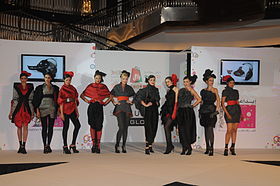
Though most clothing worn for everyday Finale of fashion show wear falls within a narrow range of conven tional styles, unusual garments are usually sought for special occasions, such as evening wear or party dresses. Some clothes are made specifically for an individual, as in the case of haute couture or bespoke tailoring. Today, most clothing is designed for the mass market, especially casual and every-day wear.
Fashion designers can work in a number of ways. Fashion designers may work full-time for one fashion as 'in-house designers' which owns the designs. They may work alone or as part of a team. Freelance designers work for themselves, selling their designs to fashion houses, directly to shops, or to clothing manufacturers. The garments bear the buyer's label. Some fashion designers set up their own labels, under which their designs are marketed. Some fashion designers are self-employed and design for individual clients. Other high-fashion designers cater to specialty stores or high-fashion department stores. These designers create original garments, as well as those that follow established fashion trends. Most fashion designers, however, work for apparel manufacturers, creating designs of men’s, women’s, and children’s fashions for the mass market. Large designer brands which have a 'name' as their brand such as Abercrombie & Fitch, Justice, or Juicy are likely to be designed by a team of individual designers under the direction of a designer director.
Fashion designers work in different ways. Some sketch their ideas on paper, while others drape fabric on a dress form. When a designer is completely satisfied with the fit of the toile (or muslin), he or she will consult a professional pattern maker who then makes the finished, working version of the pattern out of card or via a computerized system. The pattern maker's job is very precise and painstaking. The fit of the finished garment depends on their accuracy. Finally, a sample garment is made up and tested on a model to make sure it is an operational outfit. Most of the time fashion designers only have a fashion concept; the technicality and construction is not thought through during the visual conception and sketching process. Hence, the fashion designer needs to meet with a pattern maker and sample maker to figure out if the sketch on paper can be brought to life according its vision.
There is a number of well known specialized art schools and design schools worldwide that offer degrees in fashion design and fashion design technology. Some colleges also offer Masters of Fashion courses. Though it is not a requirement to have a Masters level degree, it is recommended by those already working in the industry to study at this level.
Послетекстовые задания
I. Заполните пропуски, различными частями речи, образованными от
данных слов.
noun |
verb |
adjective |
adverb |
fashion |
|
|
|
design designer |
|
|
|
|
|
aesthetic |
|
|
|
beautifull |
|
|
consume |
|
|
|
|
|
functionally |
|
|
manufacturing |
|
II. Сопоставьте термин в колонке а с его дефиницией в колонке b.
A |
B |
1. bespoke/custom tailoring - |
a) self-employed |
2. freelance - |
b) unique design, sign, symbol, words, or a combination of these, employed in creating an image that identifies a product and differentiates it from its competitors. |
3. accessories - |
c) any article of clothing, as a coat, a gown, etc. |
4. brand - |
d) the service of cutting and making a garment by an individual specially for an individual. |
5. haute couture - |
e) a subordinate or supplementary part, object, or the like, used mainly for convenience, attractiveness, safety, etc., as a spotlight on an automobile or a lens cover on a camera. |
6. garment - |
f) the creation of exclusive custom-fitted clothing. |
III. Подберите заголовок к каждому из абзацев текста.
"Kutch" Design
Ready-to-wear
Haute Couture
Mass Market
Until the 1950s, fashion clothing was predominately designed and manufactured on a made-to-measure or haute couture basis (French for high-sewing), with each garment being created for a specific client. A couture garment is made to order for an individual customer, and is usually made from high-quality, expensive fabric, sewn with extreme attention to detail and finish, often using time-consuming, hand-executed techniques. Look and fit take priority over the cost of materials and the time it takes to make.
Ready-to-wear clothes are a cross between haute couture and mass market. They are not made for individual customers, but great care is taken in the choice and cut of the fabric. Clothes are made in small quantities to guarantee exclusivity, so they are rather expensive. Ready-to-wear collections are usually presented by fashion houses each season during a period known as Fashion Week. This takes place on a city-wide basis and occurs twice a year. The main seasons of Fashion Week include, spring/summer, fall/winter, resort, swim and bridal.
Currently the fashion industry relies more on mass market sales. The mass market caters for a wide range of customers, producing ready-to-wear garments using trends set by the famous names in fashion. They often wait around a season to make sure a style is going to catch on before producing their own versions of the original look. In order to save money and time, they use cheaper fabrics and simpler production techniques which can easily be done by machine. The end product can therefore be sold much more cheaply.
There is a type of design called "kutch" design originated from the German word "kitschig" meaning "ugly" or "not aesthetically pleasing." Kitsch can also refer to "wearing or displaying something that is therefore no longer in fashion." Often, high-waisted trousers, associated with the 1980s, are considered a "kitsch" fashion statement.
Грамматические упражнения
I. Соедините части предложений в колонках a и b.
-
A
B
1. Tom hasn’t spoken
a) five times this morning.
2. Have you ever been
b) since I was 12 years old.
3. Sam has called me
c) his honmework.
4. How long have you
d) to Lee for three years.
5. I haven’t seen my grandmother
e) eaten dinner yet.
6. Jason has already finished
f) lived in Chicago.
7. We are hungry because we
haven’t
g) failed an exam.
8. Molly is an excellent student and has never
h) to Singapore?
II. Используя подсказки, составьте небольшие диалоги.
Example: The dog is barking. (you/take/for a walk)
A: The dog is barking. Have you taken him for a walk?
B: No, I haven’t.
1. The food is burning. (you/turn off/oven).
A: ………………………………….
B: ………………………………….
2. The flowers are dry. (Ann water them).
3. The kitchen floor is dirty. (Scott/mop/it).
4. The baby is crying. (Carol/feed/her).
5. There isn’t any milk. (Tom and Chris/do/shopping).
6. Mary is on the phone. (you/tell her/good news).
7. The fridge isn’t working. (Sam/call/repairman).
8. Our guests are here. (Bill/set/the table).
III. Заполните пропуски, вставив have/has been или have/has gone там, где это необходимо.
1. “Where are Mary and Steve?”
“They … to Cornwall for the weekend.”
3. “Are you going to Vienna for your holiday?”
“No, I … already … to Vienna.”
4. The Smiths … to many European countries.
5. Your sister … to the theatre tonight.
6. Dad … to the supermarket. The fridge is full.
7. I have heard that London is a pretty city but I … never … there.
8. Marie … to the shops. She should be home by 9:00.
IV. Выберите наиболее подходящее к данному предложению слово из двух предложенных.
1. Has Carl painted the kitchen just/yet?
2. Pete has already/since cleaned his room.
3. We have yet/just finished eating our dinner.
4. Janet hasn’t called me back yet/already.
5. Have they returned from their trip yet/already?