Материал: Крючков Фундаменталс оф Нуцлеар Материалс Пхысицал Протецтион 2011
Spread of nuclear technologies in the 1950s–1960s g rew to cause concern of the international community about possible global sprawl of nuclear weapons. Many countries were ready to give up production of their own nuclear weapons, provided that other states – t heir neighbors first of all – would undertake similar commitments. Under th ese circumstances, Ireland put forward a Draft UN Resolution on non-proliferation of nuclear weapons. In 1961, the General Assembly of the UNO unanimously adopted the proposed resolution, urging all countries to stand up against proliferation of nuclear weapons in the world. The appearance of this resolution showed that the international community was aware of the need for a global agreement on non-proliferation of nuclear weapons. However, 9 years passed before the resolution was legally acted upon in the form of the Non-Proliferation Treaty (1970).
In the 1960s, the global community took a number of steps towards curbing the spread of nuclear weapons and strengthening the control over the use of nuclear materials. The year 1963 saw conclusion of the agreement on banning nuclear tests on the ground and in the atmosphere. This instrument crowned the struggle against arms race by proving its worth as an efficient tool of halting NW spread to non-nuclear-weapons states.
The nuclear threat that loomed over the world during the Caribbean Crisis (Cuban Missile Crisis) prompted states of the Central and South America to set up a nuclear-weapons-free zone. The Treaty for the Prohibition of Nuclear Weapons in Latin America and the Caribbean (Tlatelolko Treaty signed in 1967) bans not only purchase and development of nuclear weapons in this region but also NW disposition there by foreign countries.
The problem of nuclear weapons proliferation was first identified at the UNO level by Ireland in 1958. In the mid-1960s, the United States and the Soviet Union started active discussions on issues associated with the prospective non-proliferation agreement which could become a framework for an international regime. In the long run, those negotiations resulted in conclusion of the Treaty on the Non-Proliferation of Nuclear Weapons (NPT), which became effective in 1970. The Treaty shifted the postulates of the free nuclear trade epoch towards specific and firm commitments in regard to NM uses.
The main achievement of the NPT lies in the fact that the overwhelming majority of countries officially relinquished development and purchase of nuclear weapons. The only states that refrained from
11
joining the treaty were India, Pakistan, Israel, and Cuba. That is why the NPT, as a universal agreement, serves as a legal framework for implementation of international non-proliferation safeguards. The Treaty became an instrument whereby non-proliferation rules and standards found their way into international as well as national activities.
Starting with its effective date (March 1970), the NPT has been playing a key role in curbing the spread of nuclear weapons. It is the main international instrument that is making the international non-proliferation regime increasingly weighty and far-reaching. Its main provisions will be briefly addressed below.
The first two articles of the Treaty are of key importance, defining the main obligations of nuclear-weapons and non-nuclear-weapons states. It is stipulated there that nuclear states shall not sell nuclear weapons and nuclear explosive devices and shall execute control over them, while nonnuclear states shall not purchase or produce them.
In their negotiations, the signatories to the NPT were guided by the principle that adherence to the Treaty on the territories of non-nuclear states shall be monitored. This stipulation is addressed in Article III.1 of the NPT. The most important provision of this article is that the international safeguards shall apply to all nuclear materials handled in all peaceful nuclear activities of a country within its territory, under its jurisdiction or under its control, whichever is applicable.
In its second part, Article III of the NPT calls upon non-nuclear countries to accept the international safeguards for imported nuclear materials and components, whereby the IAEA safeguards can be extended. In fact, Article III.2 provides an international legal framework for the whole system of control over nuclear export.
Article IV deals with peaceful uses of nuclear energy. The developing knowledge of nuclear energy can serve both peaceful and military purposes. Therefore, the parties to the Treaty undertake to ensure that peaceful nuclear energy uses meet the relevant non-proliferation requirements (of Articles I and II).
Article V is related to peaceful nuclear explosions. It was included in the Treaty on the initiative of Mexico. Essentially, this article says that nuclear states may provide services to non-nuclear states in conducting peaceful nuclear explosions (PNE) under international supervision. Nevertheless, none of the non-nuclear states has so far made an official request for PNE services. This may be largely explained by the fact that
12
such explosions pose a certain risk to the environment while not being particularly needed.
Delegations of Egypt and Mexico proposed adding to the Treaty a special article on nuclear disarmament. But the question of how clear and firm were the obligations undertaken by nuclear states in accordance with Article VI, is still a point of sharp disagreement and debate. Many nonnuclear countries believe that the Treaty provisions concerning negotiations for effective measures to stop the nuclear arms race have not been met in a satisfactory way.
Article VII deals with nuclear-weapons-free zones (NWFZ). It acknowledges the right of states to set up regional NWFZs. In such a zone, it is forbidden not only to produce, purchase or receive nuclear weapons by non-nuclear parties, but also to store NW owned by nuclear states.
In 1995, a conference was held to discuss NPT prolongation, as the term of the Treaty was expiring. The main result of the conference work was its legally binding resolution on indefinite extension of the NPT. On the other hand, the conference participants voiced their concern about some outstanding problems, with the Treaty universality issues being among them.
It is common knowledge that the non-proliferation regime relies on a number of international arrangements and organizations involving both nuclear and non-nuclear states. This regime is embodied in interrelated international agreements, with the central place among them belonging to the NPT. Other relevant instruments include:
∙safeguards agreements; IAEA Statute; conventions under the aegis of the Agency, etc.;
∙national legislation regulating nuclear activities in the membercountries;
∙relevant Russian–American agreements in the field o f nuclear arms reduction;
∙agreements on establishment of nuclear-weapons-free zones: Tlatelolko, Rarotonga, Pelindaba and Bangkok treaties.
A whole number of international organizations are essential to the nonproliferation regime. So, an important role belongs to the International Atomic Energy Agency. Using a special system of measures – referred to as the IAEA Safeguards – the Agency monitors the si tuation trying to prevent NM diversion for purposes other than peaceful uses.
A sizeable contribution to solution of the proliferation problem is made by international export control (EC) regimes. The key instruments of export
13
control are restrictions on transfer of materials, equipment and technologies included in special check lists. Every country participating in the regime of export control is:
∙to create a national legal framework consistent with the agreements concluded;
∙to adhere to the EC principles in pursuing its national policy;
∙to participate in forums of the member–countries.
In the nuclear sphere, there are two main regimes for controlling export
of materials, equipment and technologies – one impl emented by the Zangger Committee and the other, by the Nuclear Suppliers’ Group (NSG). On the whole, however, the international system for control over export of mass destruction weapons includes the Missile Technology Control Regime (MTCR), the Australian Group (for chemical and biological products and technologies), and the Wassenaar agreements (for conventional arms, dualpurpose products and technologies).
1.2. Some current problems of non-proliferation
Concern over possible non-peaceful uses of nuclear materials has long been expressed by the world public opinion. Unfortunately, the weapons proliferation problem defies complete and final solution. Some of its ramifications are presented in Fig. 1.1. As the international nonproliferation regime took shape, part of these issues was settled in an acceptable way, while others still need adequate joint actions before they may be resolved. We shall dwell on some of them:
1. Extremely slow reduction of available nuclear arms is a serious problem for the non-proliferation regime. Non-nuclear-weapons countries tend to regard this fact as reluctance of nuclear states to take real, significant steps in this direction. Besides, the problem is complicated by the fact that nuclear arms reduction is an expensive process. Whatever the explanation, unceasing criticism has been directed against nuclear states, voiced during discussions of the Treaty results, for their being too slow in fulfilling their commitments on nuclear arms reduction.
14
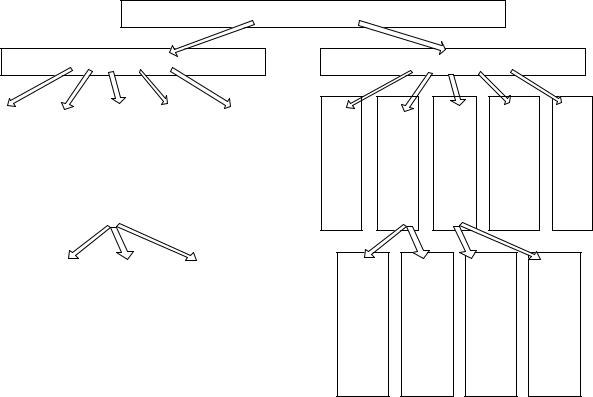
Problems of the international non-proliferation regime
Traditional problems
Threshold states |
|
|
Safeguards |
|
|
|
Enhancement of IAEA Safeguards System |
|
|
Export control |
|
|
NW-free zones |
|
|
|
|
|
|
|
|
|
|
|
|
|
|
|
|
|
|
|
|
|
|
|
|
|
|
|
|
|||
|
Extension of rights to and |
capabilities for NM inspection |
|
|
|
Improvement of inspection policy |
|
|
|
Provision of adequate financing |
|
|||
|
|
|
|
|
|
|
|
|
|
|
|
|
|
|
New problems
Consequences of USSR breakup |
End of ‘cold war’ |
Nuclear arms reduction |
Illegal circulation of NM, dual-purpose technologies and materials |
De-facto appearance of new NW states |
Total ban of nuclear tests |
Ban of fissile material production |
Conversion of nuclear |
military complex |
Control over released weapons-grade materials |
Fig. 1.1. Some problems of the international non-proliferation regime
15