Материал: Крючков Фундаменталс оф Нуцлеар Материалс Пхысицал Протецтион 2011
10.Plutonium disposition in special storage facilities.
11.Final disposal of RW in geological repositories.
C. Closed NFC with use of regenerated uranium and plutonium
1.Uranium ore mining.
2.Production of U3O8.
3.Conversion of U3O8 to UF6.
4.Enrichment of UF6.
5.Fabrication of nuclear fuel (fuel elements and assemblies).
6.Use of nuclear fuel in reactors.
7.On-site INF storage.
8.INF reprocessing with separation of uranium, plutonium and RW.
9.Return of regenerated uranium to conversion and enrichment stages.
10.Fabrication of mixed uranium–plutonium oxide fu el (MOX fuel) based on regenerated uranium and plutonium.
11.Final disposal of RW in geological repositories.
INF reprocessing capabilities are available in seven countries: USA, UK, France, Russia, China (nuclear-weapons states), Japan and India. One of the main objectives pursued in development and use of nuclear technologies is control over NM at all NFC stages to prevent their diversion for military purposes.
There are three possible ways of diverting NM from energy uses to military applications:
1.Forcible theft following an external terrorist attack at a nuclear facility or a vehicle carrying NM.
To prevent such events, physical protection systems are created.
2.Non-forcible, covert theft by site personnel.
To prevent it, NM accounting and control systems are set up. 3. Covert diversion authorized by the national government.
This is prevented by a system of international safeguards and agreements on peaceful use of NM:
a)Treaty on the Non-Proliferation of Nuclear Weapons (NPT);
b)regional agreements on non-proliferation of nuclear weapons;
c)Zangger Committee (Nuclear Suppliers Group) for control over export of nuclear materials, technologies and components.
Periodic inspections of nuclear sites by IAEA experts are the main mechanism of control at the governmental level.
Let us consider the main factors making NM theft attractive at various NFC stages.
1. NM quantity and quality required for producing nuclear explosives:
26
∙critical mass of 100 % 235U – 50 kg;
∙critical mass of 100 % 239Pu – 15 kg;
∙critical mass of 100 % 233U – 17 kg.
The critical mass values are given for a metal sphere without a reflector (which almost halves the critical mass). The IAEA introduced the unit of Significant Quantity (SQ). Detection of stolen 1 SQ calls for a special investigation and for notification of the UN Security Council. The SQ value is roughly half that of the critical mass (metal sphere minus reflector):
1 SQ (239Pu, 233U) = 8 kg; 1 SQ (235U) = 25 kg.
2.Simplicity of stealing NM, with low probability of detection.
3.Simplicity of turning NM into a nuclear charge.
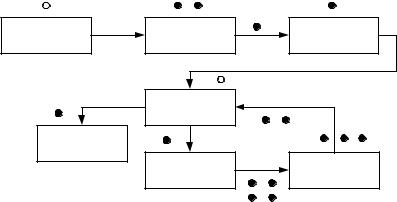
The attractiveness of NM diversion at various NFC Stages is qualitatively assessed in Fig. 2.2.
ДобычаU ore  miningU-руды U3O8
ОЯТINF
ХранилищеINF storageОЯТ
ОбогащениеU |
|
ИзготовлениеFA |
урана |
UF6 |
ТВС |
enrichment |
fabrication |
|
MOX fuel |
|
|
МОХ-топливо |
|
ЯР |
|
|
NR |
|
|
INF |
|
|
ОЯТ |
|
|
ХимическаяINF |
Pu |
ИзготовлениеMOX fuel |
переработка ОЯТ |
|
МОХ-топлива |
reprocessing |
|
fabrication |
Fig. 2.2. NFC stages in terms of their attractiveness for NM diversion.
The number of dots corresponds to the attractiveness of a stage. The most attractive stages are those of INF reprocessing, plutonium separation, fabrication of mixed uranium-plutonium fuel and its recycling in reactors.
The main NFC stages will be now regarded from the viewpoint of proliferation resistance (Table 2.1).
27
|
|
|
Table 2.1 |
|
|
Relative hazard of NFC stages |
|
|
|
|
|
|
|
|
NFC stage |
Vulnerability to |
Vulnerability to |
Proliferation risk |
|
|
theft |
diversion |
|
|
Ore mining |
Low |
High |
Low |
|
Conversion to UF6 |
Low |
H – L (IAEA)* |
Low |
|
Enrichment |
High |
H – L (IAEA) |
High |
|
Fuel fabrication |
Low |
H – L (IAEA) |
H – L |
|
|
|
|
(enrichment) |
|
Use at NPPs |
Low |
H – L (IAEA) |
H – L |
|
|
|
|
(enrichment) |
|
Storage of IFAs |
Low |
H – L (IAEA) |
H – L |
|
|
|
|
(enrichment) |
|
INF reprocessing |
High |
H – L (IAEA) |
High |
|
RW disposal |
Low |
Low |
Low |
|
*H – L (IAEA): High to low, depending on monitorin g by the IAEA.
1.Uranium ore mining and primary processing
Vulnerability to theft (VT): low. For 25 kg of weapons-grade plutonium to be produced, it is necessary to have about 5000 kg of natural uranium or 5000 t of uranium ore. It is difficult to steal such a quantity of uranium ore without being noticed.
Vulnerability to diversion by personnel (VDP): high. Uranium mines and primary processing facilities are not covered by the IAEA safeguards.
Proliferation risk (PR): low. Natural uranium is not suitable for making nuclear explosive devices.
2.Conversion to nuclear fuel (unenriched uranium for CANDU reactors) or to uranium hexafluoride for enrichment.
VT: low, as in uranium mining.
VDP: dependent on whether the processes are covered by the IAEA safeguards.
PR: low. Natural uranium is unusable in nuclear explosives.
3.Uranium enrichment in 235U.
VT: high. A nuclear explosive device would only take 25 kg of weapons-grade uranium. Such a weight can be carried by one person.
VDP: dependent on whether the process is covered by the IAEA safeguards.
PR: high. The Nuclear Suppliers’ Group placed an unofficial embargo on export of enrichment technologies.
28
4. Fabrication of nuclear fuel (fuel elements and assemblies).
VT: low. One FA weighs 300 to 500 kg and would take special transport for conveyance.
VDP: dependent on whether the processes are covered by the IAEA safeguards.
PR: between low and high depending on the fuel enrichment.
5. Use of nuclear fuel in reactors.
VT: low, due to FA weight, radioactivity and location inside the reactor vessel.
VDP: dependent on whether the reactor is covered by the IAEA safeguards.
PR: between low and high depending on fuel enrichment and on availability of reprocessing facilities.
6. INF storage.
VT: low, due to FA weight, radioactivity and residual heat.
VDP: dependent on whether the storage facility is covered by the IAEA safeguards.
PR: between low and high depending on the availability reprocessing facilities.
7. INF reprocessing.
VT: high. INF reprocessing relies on remotely controlled equipment standing between personnel and NM. Though there are areas where Pucontaining materials are accessible for theft.
VDP: dependent on whether the reprocessing facility is covered by the IAEA safeguards.
PR: high. Reprocessing facilities generate plutonium, which can be used in nuclear explosives. The Nuclear Suppliers’ Group placed an unofficial embargo on export of reprocessing technologies.
8. Radioactive waste disposal.
VT: low, due to high radioactivity and heat release, with low content of fissile materials.
VDP: low, due to small percentage of fissile materials.
PR: low, due to high radioactivity and heat release, with low content of fissile materials.
Reactors of different types differ in the attractiveness for NM theft. There are two characteristics determining such attractiveness (Table 2.2):
1)quantity and quality of nuclear fuel loaded;
2)quantity and quality of nuclear fuel produced.
29
|
|
|
Table 2.2 |
|
|
Reactor fuel loaded and produced |
|
|
|
|
|
|
|
|
Reactor type |
Loaded fuel |
Produced fuel, |
Note |
|
|
|
kg/GW×year |
|
|
IRT |
5–10 kg |
– |
Low power |
|
|
(90 % 235U) |
|
|
|
HTGR–770 |
8.1 t 232Th |
200 |
– |
|
|
0.7 t 235U (93 %) |
|
|
|
VVER–1000 |
100 t UO 2 |
200 |
– |
|
|
(3–5 % 235U) |
|
|
|
RBMK–1000 |
150–180 t UO 2 |
250 |
Continuous |
|
|
(1.8–2 % 235U) |
|
refueling |
|
CANDU–600 |
100 t UO 2 |
350 |
Continuous |
|
|
(0.7 % 235U) |
|
refueling |
|
LMFBR–1000 |
10–15 t UO 2 |
1500–ONFC |
– |
|
|
(15–25 % 235U) |
250–CNFC |
|
|
1. Research reactors
Some research reactors still run on highly enriched uranium fuel. But their thermal power being low (several megawatts), the 235U inventory is no greater than 5–10 kg.
Following the IAEA resolution, research reactors are being converted to fuel of medium enrichment, with 235U content making no more than 20 %. The critical mass of such uranium is 830 kg.
Secondary fuel is not produced in research reactors as their fertile material quantities are small and neutron fluxes are low.
2. High-temperature gas-cooled reactors
These reactors use highly enriched dispersion fuel (93 % 235U) and thorium as fertile material. Fuel particles clad in pyrolytic carbon and silicon carbide are dispersed in a graphite matrix to be subsequently
fabricated into spherical or rod-type fuel elements.
The starting charge of a 770 MWe HTGR contains 8.1 t of 232Th in the form of ThO2 and 0.7 t of 235U as UC. By the end of in-pile irradiation, the inventory will include: 7.5 t of 232Th, 40 kg of 235U and about 180 kg of 233U,
which means that HTGRs generate ~ 200 kg of 233U/GWe×year.
3. Light water reactors
Vessel-type reactors (PWR, BWR, VVER). Such reactors using water as moderator and coolant run on low-enrichment (3–5 % 235U) uranium
30