Материал: Крючков Фундаменталс оф Нуцлеар Материалс Пхысицал Протецтион 2011
Внимание! Если размещение файла нарушает Ваши авторские права, то обязательно сообщите нам

accounting and control procedures, arrange for maintenance and control of the system operations and so on. Said NM A&C system components are expected to be present in the model such that to make the system meeting the defined tasks to the highest extent possible.

It is at the closing work phase that it is decided on to what extent the developed NM A&C system version meets the tasks it is assigned to. The purpose of this design stage is to estimate the efficiency of the system operations to the selected criterion. It is a general knowledge that efficiency is the property of a system showing to what extent it fits the tasks at hand. Different approaches are under consideration for use to estimate NM A&C system efficiency. Thus, confidence of data on NM attributes is considered to be the efficiency index.

It should be however noted that NM A&C system efficiency is not easy to estimate universally. It is normally estimated on computer models with estimates relating to the quality of NM balances in the MBA (say, requirements to the accuracy of NM balances in the MBA).

The NM A&C system functional efficiency can be also indicated by how credibly the MBA NM accounting and control system presents data on identifiers of items, TID identifiers and locations of items. This indicator value should not be below 99%. If a system model estimate fails to satisfy to the criterion chosen, it is to be changed. So, if the share of erroneous data on attributes exceeds 1%, respective automated procedures may be used instead of manual data entry/processing. Therefore, building the final NM A&C system model version is an iterative process. The number of iterations depends on how rigid the adopted design estimator is.

421

CHAPTER 10

CONTROL OF NUCLEAR MATERIAL

Hereinabove, attention was focused on the NM accounting system. This serves to ensure the knowledge and the integrity of nuclear material. Balance closing is the procedure which helps getting the required confidence of the knowledge. In the context of accounting, however, confidence and integrity of NM are verified exclusively through physical inventory takings which are quite periodic (e.g., annual for NM of category IV). So control of nuclear material is undertaken as a complement to accounting. NM control includes control of the NM inventory and movement; control of access to NM, equipment and information; surveillance of NM, and check of authorizations for disposition and movement of NM. Control of NM supports the integrity and proper handling of NM, as well as the confidence of our knowledge about NM [1]. The following levels of NM control will be looked at hereinafter:

Control of NM at enterprises, including organizational measures and engineered NM control features;

State control of NM through inspections by Rostekhnadzor of Russia; International control of NM.

10.1. NM control at enterprises

Localization of NM and identification (labeling) of NM-containing objects as prerequisites of efficient control of NM

Enterprises have NM controlled involving largely the two following controls:

∙Control of NM inventory. The binding requirement here is identification of facilities with NM;

∙Control of access to NM. The binding requirement in this is localization of NM.

With identification aspects having been dealt with in Chapter 9, we shall take a closer look at localization of NM.

Relative inaccessibility of NM (instructions on how to produce a primitive nuclear charge can be found in Internet) is believed to be the basic reasoning behind the efforts to curb the spreading of nuclear weapons. Localization, which supports this inaccessibility, means disposition of nuclear material inside special areas and facilities. Engineered features in these enable access to NM to be controlled. Secure

422

areas and material access areas (MAA) are specific examples of such special areas.

Secure areas. A secure area may be a protected, an inner and a vital area. Secure areas include barriers to delay intruders into the area (security perimeter). Barriers are formed by fencing, structural elements and so on. Each secure area also includes an access control point and is equipped with respective access controls.

NM and nuclear facility physical protection regulations prescribe that:

∙NM of categories 1 and 2 should be used and stored in the inner or the vital area;

∙nuclear facilities should be deployed within the inner or the vital area;

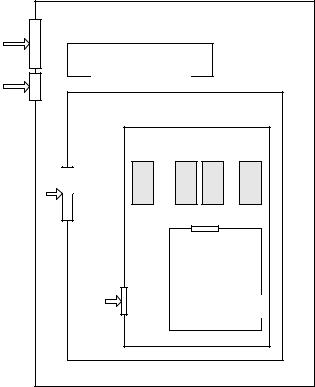
∙NM of category 3 should be used and stored within any secure area. Fig. 10.1 shows an example of localization areas layout for NM of

different categories.

Material access areas. Material accessibility areas are process department and NM storage areas.

A process department is where nuclear material is subject to physical and chemical changes. Most NM quantitative changes take place within process departments. Being where nuclear material is accessible directly, process departments are subject to special security regulations. This includes the requirement of permits to enter a process department to be granted only to personnel involved in running the process. The amount of the material within a department is normally limited to the quantity needed for one-day routine operations. Access control logs are kept at each process department with entries made therein on all persons granted access to the given department. This makes a starting point for anomalies to be investigated. In the absence of personnel, the intrusion detection system is active.

Apart from security features, it is important that process departments enable reliable control of the NM therein, including by way of localizing material.

423

ProtectedЗащищенная зонаarea

Category III NM

Хранилище ЯМ категории III

storage facility


Внутренняя зона


Inner area


Особо важная зона


Vital area


1

2

3

4


NM storage


ХранилищеfacilityЯМ


Fig. 10.1. Nuclear material localization areas: 1, 2, 3, 4 – process departments

For process departments, localization of NM suggests that NM should remain in equipment, pipelines, glove boxes, safes and containers. Therefore, material stays in these facility components when the process is run, thus making it harder to remove it in an unauthorized manner. Fig. 2.1 (Part II, Chapter 2) shows process departments for fabrication of lowenriched fuel. Each of these has nuclear material localized in equipment, safes and containers. Containers are commonly used to store NM and ensure efficient localization of bulk material (Fig.10.2). Practically, different container types are used (metal drums, cans, assemblies, packages, tanks, vessels and others).

424
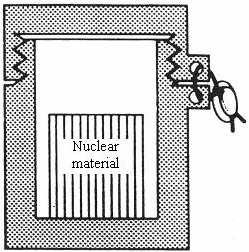
Fig. 10.2. NM localization container

Safes, stores and containers are kept locked unless immediately watched by an authorized person. The material contained therein is accessible to the smallest reasonable number of personnel. The lock codes are updated whenever situation with NM changes within the department. Thus, this is done when a container is initially received or a personnel member who knows the code is transferred or dismissed.

It is also important that nuclear security measures, which are of a prime significance to any process department with NM, have also the goal of localizing nuclear material contributing so to better NM control conditions.

Localization in storage areas. Nuclear material may be also kept in storage areas at the facility or at NM storage points outside the facility. An NM storage point is a fixed standalone installation. Fig. 10.3 shows an example of how NM can be localized in a storage facility.

425

Источник: https://studfile.net/preview/16708779/