Page 790 |
DICOM PS3.17 2020a - Explanatory Information |
•Tracking/extracting details of Performed Protocol such as timestamps, execution sequence and technique for QA, data mining, etc. (Using Performed Protocols)
•Making more detailed protocol information available to radiologists reviewing a study and priors, or comparing similar studies of different patients (Using Performed Protocols)
AAAA.1.2 Workflow
Using non-Patient-specific Protocols
In most cases, the scanner uses any protocol details in the modality worklist item to present to the technologist a list of matching Defined Protocols on this scanner.
Preparing and executing Patient-specific Protocols
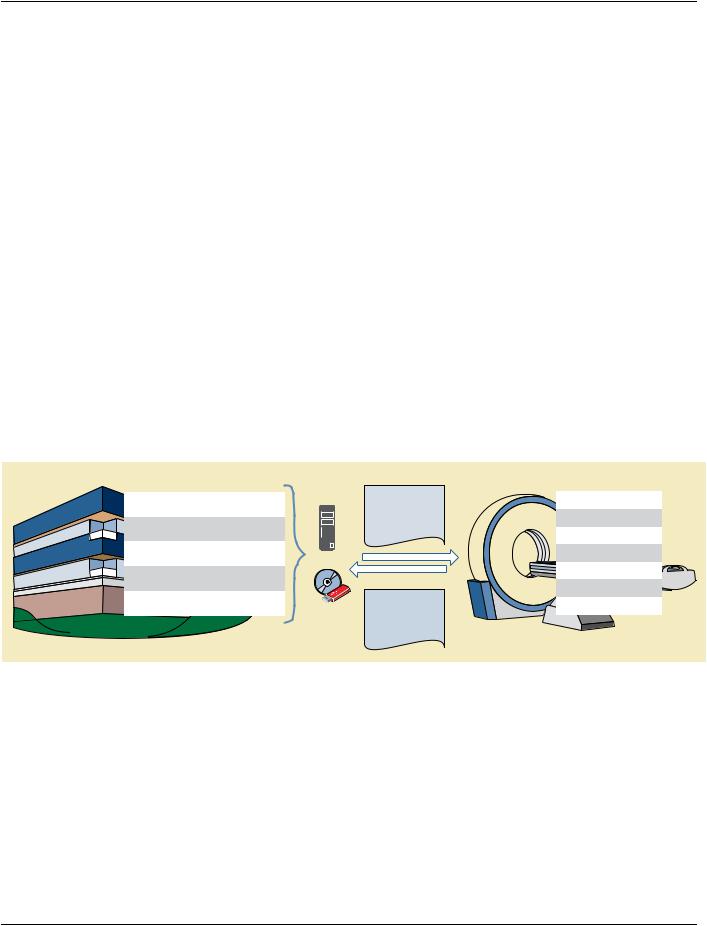
In the simplest form, this process could be driven with a combination of the Modality Worklist and Defined Protocols.
Radiologist at the RIS:
•Selects a patient procedure on the upcoming Modality Worklist
•Adds tech notes to the Worklist entry (e.g., "Use Defined Protocol X; Decrease parameter Y…")
Technologist at the modality:
•Selects the patient procedure on the upcoming Modality Worklist
•Reads the tech notes
•Selects the identified Defined Protocol and adjusts as described
Modality
•Executes procedure
•Stores the Performed Protocol to study folder on PACS
Radiologist
•(Optionally) Reviews the Performed Protocols
In special cases, the radiologist might attend the scan and modify the protocol directly on the console.
Note that the primary record of adjustments is the Performed Protocol object (which can be compared to the referenced Defined Protocol object).
A new Defined Protocol is not typically saved unless the intent is to have a new Defined Protocol available in the Library.
AAAA.2 Routine Adult Head Protocol
The examples in this Annex are intended to illustrate the encoding mechanisms of the DICOM CT Protocol Storage IODs, not to suggest particular values for clinical use. Further, these examples do not contain the many detailed Attributes one would expect from a fully executable defined protocol generated by a CT scanner, but they do demonstrate the usage of many common Attributes.
This section includes Defined Protocol examples of a Routine Adult Head Protocol for several different scanner models. The protocol is presented as adjusted by a fictitious Mercy Hospital from a reference protocol referenced in the Predecessor Protocol Sequence. AlthoughtheexamplesinthissectionwereoriginallyderivedfromprotocoldocumentspreviouslypublishedbytheAAPM,somevalues here were modified and are likely out of date. Parties interested in the current AAPM protocols are encouraged to visit ht- tp://www.aapm.org/pubs/CTProtocols/

 %item
%item