Page 962 |
DICOM PS3.17 2020a - Explanatory Information |
•The metadata attributes of the DICOM composite objects should be mapped from the DICOM-RTV metadata flows; attributes ap- plicable to all frames (e.g., included in the Current Frame Functional Group Sequence) should be mapped from the static part of the DICOM-RTV metadata; attributes applicable to a single frame (e.g., Per-frame Functional Group Sequence) should be mapped from the dynamic part of the DICOM-RTV Metadata;
•The "Cine" and "Multi-frame" modules, as well as the "Number of Waveform Samples" attribute, not present in the DICOM-RTV Metadata, are built from the values of the RTV Meta Information (e.g., Sample Rate) , the dynamic payload of the relevant flows (e.g., Frame Numbers) and the external decisions (e.g., Start Time) ;
•Based on the choice of the application and on the possible presence of a DICOM-RTV Rendition flow, the DICOM composite object to be stored may gather or not the individual essences of the DICOM-RTV flows (e.g., video and audio contents in a single SOP instance using a MPEG2 Transfer syntax).
PPPP.8.2 Streaming DICOM-RTV From Stored IOD
Regarding initiating a DICOM-RTV stream from a stored instance, the application should be able to regenerate the different DICOM- RTV flows, with the same synchronization characteristics, in compliance with SMPTE ST 2110-10.
•Subcase 1 is conventional video IODs e.g., ultrasound video/multi-frame or angio video/multi-frame.
•Subcase 2 is one or more video IODs that were previously DICOM-RTV, e.g., stored like PPPP.8.1.
•If the multiple stored IOD of the subcase 2 contain synchronization information extracted from DICOM, it should be possible to playback them with a good synchronization.
PPPP.9 Example of Engineering Implementation
AnexampleofimplementationoftheVideo-to-DICOMconverterpresentedintheusecasesPPPP.2abovecouldrespectthefollowing approach:
•The metadata are sent from the Departmental System to the Video-to-DICOM converter through TCP/IP using classical protocols as DICOM Worklist or HL7 ORM.
•The video/multi-frame is sent through coaxial cable using classical video protocol (e.g., uncompressed HD video over Serial Digital Interface SDI).
•The time ("timestamp") is sent through IP respecting PTP, for synchronizing all the senders and receivers, through "time alignment" mechanism described in SMPTE ST 2110-10.
•All this information is used to produce several RTP sessions over IP:
•SMPTE ST 2110-20 compliant video flow.
•SMPTE ST 2110-10 compliant DICOM Metadata Flow, including payload header (RTV Meta Information) as well as dynamic payload part (DICOM Current Frame Functional Groups Module) for every frame, and including additionally the static payload part (DICOM Real-Time Video Endoscopic/Photographic Image IOD Modules) at least every second.
•If sound is provided:
•SMPTE ST 2110-30 compliant audio flow.
•SMPTE ST 2110-10 compliant DICOM Metadata Flow, including payload header (RTV Meta Information) as well as dynamic payloadpart(DICOMCurrentFrameFunctionalGroupsModule)foreverysample,andincludingadditionallythestaticpayload part (DICOM Real-Time Audio Waveform IOD Modules) at least every second.
•SMPTE ST 2110-10 compliant DICOM Metadata Flow, including payload header and static payload part (DICOM Rendition Selection Document IOD Modules) , at least every second, in order to associate the two flows above.
Note
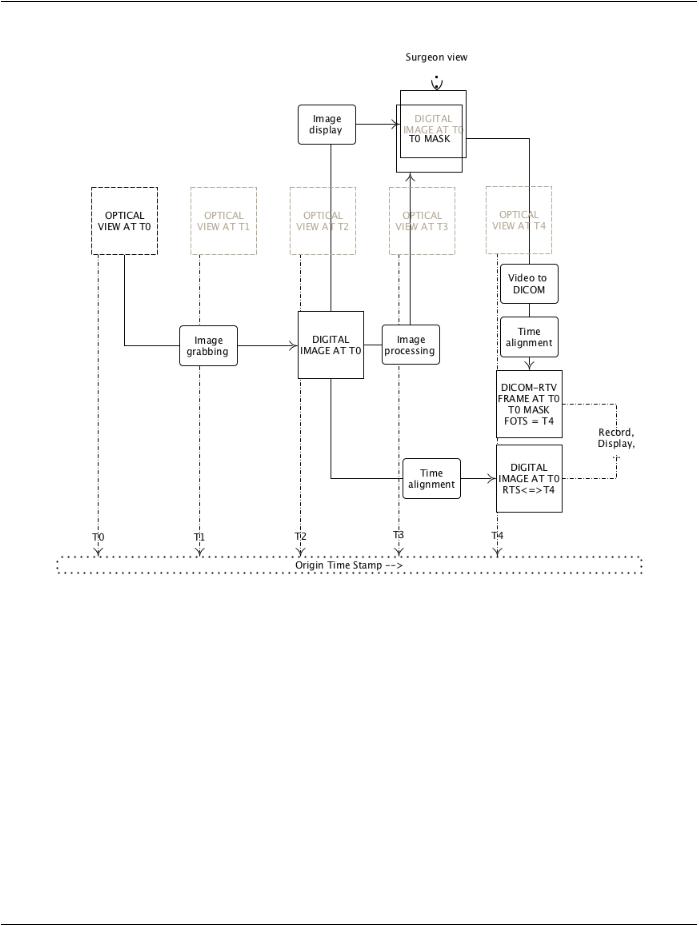
Eventually, the laparoscope systems will embed the Video-to-DICOM converter, as shown in the Integrated Product box of the Figure PPPP.2-1.