Материал: 2434



 Listen to the speaker and practise pronunciation of the words:
confirm |
|
concise |
refute |
|
generalizable |
broad |
|
researchable |
narrow |
|
measurable |
focus |
|
descriptive |
focused |
|
relational |
relevant |
|
causal |
issue [ |
] |
contradiction |
empirical |
|
mechanism |
theoretical |
|
structure |
urgent |
|
nature |
arguable |
|
reason |
target |
|
objective |
|
|
purpose |

 Here is a list of research areas at the Omsk State Siberian Automobile and Highway Academy. Which one do you consider to be your field of interests?
•resource-saving technologies of building materials manufacturing;
•mathematical modeling and system analysis, management and information processing in industry and transport;
•reliability and durability of machines and equipment in transport and machine engineering;
•theory of control and design of earth-moving, road and construction machines for increasing their effectiveness;
•methodical, technological and organizational problems of the development and implementation of the systems of educational process quality management in a technical university;
•transport systems of cities and regions;
•improvement of constructions, design methods, highway construction and maintenance in the Siberian conditions;
•improvement of operating data effectiveness for automobiles and internal combustion engines;
63
•development and analyses of effective structures, constructions and buildings;
•social and economical aspects of the region development;
•energy saving processes in construction;
•dynamics of social processes and transformation of social institutions.

 DiППОrОntiКtО ЛОtаООn tСО notions: “rОsОКrМС ПiОlН”, “rОsОКrМС topiМ” КnН “rОsОКrМС quОstion”. CСОМk вour iНОКs on rОКНinР tСО
following information. What is specific about the research question?
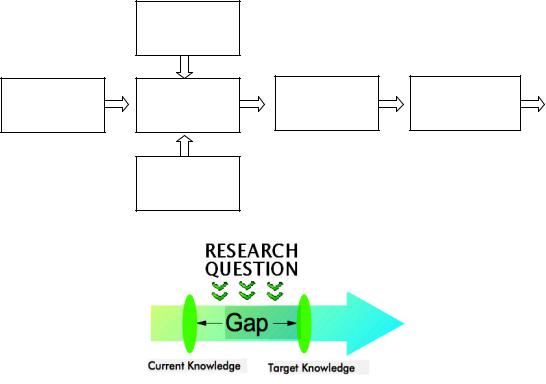
A research question is a statement that identifies the phenomenon to be studied, e.g. what are you trying to find out? It is one or two sentences stating what will be investigated, confirmed or refuted. A research questiondiffers from the research field or research topic (pic. 4, ).
The research field is broader and could cover multiple research ques-
tions. A topic is what the research paper is about.
Research questions can be more general or more specific, but should not
be too narrow or too broad.
The research question targets a specific area of the broader field which is currently not well understood, and thus targets a knowledge gap (pic. 4, b).
a)Context
Research |
Topic |
Research |
Hypothesis |
|
field |
question |
|||
|
|
Literature
From Punch, 1998 and Raedler & Bischoff
b)
Pic. 4
64


 Read the recommendations on choosing the research topic (subject) and answer the questions about your research.
Generally speaking, a good PhD thesis topic is interesting to you, to your advisor, and to the research community. If you pick a topic that you're not truly interested in simply because it's your advisor's pet area, it will be difficult to stay focused and motivated.
In order to do original research, you must be aware of ongoing research in your field. However, you'll never be able to read everything that might be relevant: new work is always being published. Try to become aware and stay aware of directly related research.
A good topic will address important issues. You should be trying to solve a real problem, not a toy problem (or worse yet, no problem at all); you should have solid theoretical work, good empirical results or, preferably, both; and the topic will be connected to existing research. It will also be significant yet manageable. Finding the right size problem can be difficult. One good way of identifying the right size is to read other dissertations. Your advisor will help you to identify a realistic size problem.
1.What is your research topic?
2.Are you interested in it? Why?
3.Are you trying to solve urgent practical problems? Account for your opinion.
4.Do you think you are aware of ongoing directly related r e- search in your field? Can you give any examples?

 Here are examples of broad research areas and research topics: a) in economics at the University of Manchester (UK); b) in materials science at the Ohio State University (USA). Which topic
do you find the most interesting (the most challenging, the most difficult)? Why? What does the аorН “topiМ” mОКn in tСis Мon-
text?
A. MACROECONOMICS, GROWTH AND DEVELOPMENT
Research within the Macroeconomics Group is both theoretical and empirical, and covers a wide range of topics within the broad areas of economic growth and development, business cycles, and mac-
roeconomic policy. These topics include the following:Poverty, inequality and income distribution
65

Financial markets, bankruptcy and regulation
Institutions, governance and corruption
Population change and demographic transition
Labour markets, human capital and unemployment
Foreign aid and international economics
Fiscal policy and public finance
Monetary policy, inflation and central banking
Imperfect competition and nominal rigidities
International macroeconomics and the world economy
Expectations, learning and agent heterogeneity
Quantitative economic history
http://www.manchester.ac.uk/
B. CORROSION
Corrosion, the environmental degradation of materials, is a major area of research in materials science and engineering. In the MSE department, research conducted at the Fontana Corrosion Center (FCC) focuses on the study of aqueous corrosion in our effort to develop better methods to pro-
tect materials from the adverse impacts of the environment. Topics of research at the FCC, which has earned an international reputation for excellence, include:
Mechanisms of localized corrosion
Fundamental studies of corrosion inhibition
Development of environmentally-friendly protective coating systems
Studies of coating adhesion and degradation
Predictive modeling of corrosion damage accumulation
Novel applications of scanning probe microscopy to corrosion
Corrosion and cracking of steel and H2S-containing environments
http://mse.osu.edu

 Build a mind map (see example below) to reveal the meaning of tСО pСrКsО “rОsОКrМС quОstion”. Вou mКв ПinН tСО ПolloаinР in-
formation useful.
A research question is a clear, focused, concise, complex and arguable question around which you center your research. It is generalizable, not too broad, not too short, non-trivial and interesting. Research questions help scientists focus their research by providing a path through the research and writing process. The specificity of a well-developed research
66

quОstТШЧ СОХps аrТtОrs КЯШТН tСО “КХХ-КЛШut” pКpОr and work toward supporting a specific, arguable thesis. Research questions are easily researchable, i.e. imply the possibility of empirical investigation. If you know a lot about the topic, you can develop a research question based on your knowledge. Do not forget, this is hard even for experienced scholars!
My definition |
|
Research question |
|
|
Definition |
|||
|
|
|
|
|
|
|
|
|
|
|
|
|
|
|
|||
|
Association |
|
Picture |
|
|
|||
|
|
|
|
|
|
|
|
|

 Scan the following extract from the article and answer some questions about its research question.
The Academy of Management Journal
Vol. 39, No. 5, Oct., 1996
IS SLACK GOOD OR BAD FOR INNOVATION?
Nitin Nohria, Harvard University
Ranjay Gulati, Northwestern University
Innovation and slack are concepts at the very core of organization theory. Innovation has been an outcome of central interest to organization theorists because it is vital for organizational adaptation and renewal. Organizational slack has long been used to explain diverse organizational phenomena, including goal conflict, political behavior, effectiveness, and innovation itself. Both constructs have received much attention in recent years. In an increasingly dynamic world, firms are being forced to become more innovative. At the same time, organizational slack has come under sharp scrutiny as organizations facing increasingly intense global competition feel pressured to eliminate all forms of slack. These two countervailing forces suggest a potential paradox. If slack is a form of inefficiency but also essential for innovation, organizations run the risk of eliminating slack to a point that undermines their capacity to innovate.
This dilemma raises the research question that is at the heart of this work: what is the relationship between organizational slack and innovation? The literature provides no clear answers because theorists stand
67