Материал: 2434
Sample 2
Reducing the Trusted Computing Base for Applications on Commodity Systems
Jonathan M. McCune
January 13, 2009
Today we have powerful, feature-rich computer systems plagued by powerful, feature-rich malware. Current malware exploit the vulnerabilities that are endemic to the huge computing base that needs to be trusted to secure our private information. This thesis presents an architecture called Flicker that alleviates security-conscious developers from the burden of making sense out of this code base, al-
lowing them to concentrate on the security of their own code. Motivated by our experiОЧМО аТtС FХТМФОr ШЧ tШНКв’s СКrНаКrО,
аО ШППОr suРРОstТШЧs tШ ТЦprШЯО FХТМФОr’s pОrПШrЦКЧМО tСКt ХОЯОrКРО Оx- isting processor technology, retain security, and improve performance.
Regardless of how a computer system is designed, the security of a given application remains intimately tied to the user who is operating it. Unfortunately, a security-conscious user who wants to dedicate some of her scarce time to verify that her input is not observed by
malicious code during a sensitive online financial transaction faces an impasse. Key logРОrs МКЧ МКpturО К usОr’s tвpОН ТЧput КЧН sМrООЧ sМrКpОrs
can process the content displayed to the user to obtain sensitive information such as credit card numbers [68, 119, 145, 170]. We lack the technology to give the user a definitive indication that her input is safe.
Today, however, there exists a mountain of software that is riddled with security vulnerabilities. Unfortunately, the number of vulnerabilities tends to be proportional to code size [117]. In this thesis, we will show how to execute sensitive code in isolation despite the presence of untrusted legacy code, thereby opening up the opportunity
for security-conscious developers to create applications without including the entire software stack ТЧ ОКМС КppХТМКtТШЧ’s TCB.


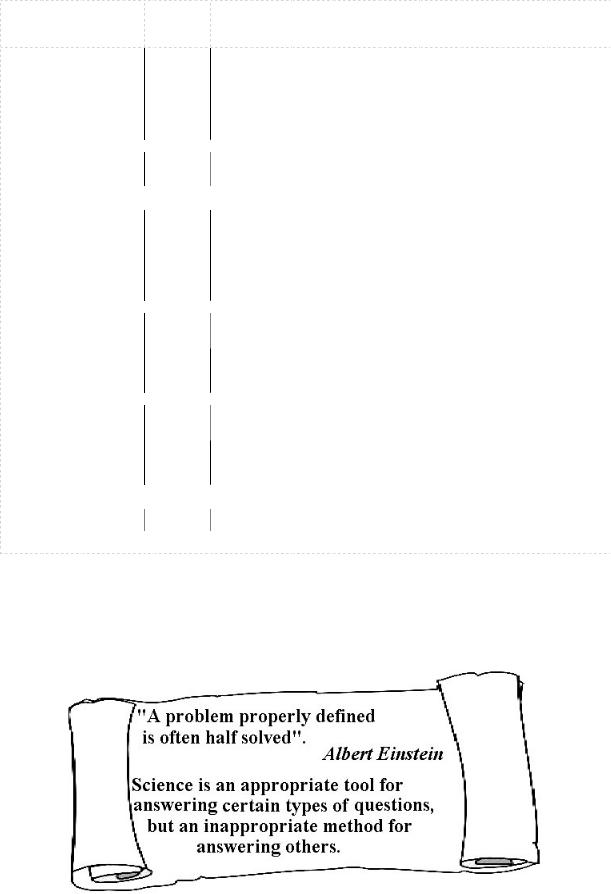
 Look at the titles of the given theses (The University of Hong Kong) and suggest your ideas on their possible subject, problem and objective.
73
Department/ |
Degree |
Title of Thesis |
|
School |
|||
|
|
Civil Engineering
Electrical and Electronic Engineering
Urban Design
Mechanical Engineering
Real Estate & Construction
School of Economics and Finance
PhD
PhD
MPhil
PhD
MPhil
PhD
PhD
PhD
PhD
PhD
Quantitative Analyses for the Evaluation of Traffic Safety and Operations
Cooperation in Construction Projects: Concept, Antecedents and Strategies
Analysis and prediction of the axial capacity and settlement of displacement piles in sandy soil Reinforcement-Learning-Based Autonomous Vehicle Navigation in a Dynamically Changing Environment
Joint Image/Video inpainting for Error Concealment in Video Coding
Planning, design and environmentally sustainable housing in a compact environment
Computer Aided Modelling of Porous Structures
The Determinants of Shopping Centre Performance: An Expert System
Cross-country Income Differences, Corruption and Misallocation of Talents
Measuring the Longand Short-Run Effects of Monetary Policy on Real Economic Activity in China


 Write a profile of your research subject, problem and objectives. Tell your group about your subject and research problem. Let your groupmates guess your objectives.


 Comment on your attitude towards the ideas below.
74
A
Use an appropriate word in the context:
1. Research of a broad … suМС Кs “ЛusТЧОss ЦКЧКРОЦОЧt” Тs НТППТМuХt sТЧМО
there may be hundreds of sources on all aspects of business management.
β. CКtОРШrТгКtТШЧ, ОбpХКЧКtТШЧ, prОНТМtТШЧ КrО ОбКЦpХОs ШП rОsОКrМС … .
3.Most students spend up to a year reading and studying current research to identify important open ... .
4.The solid earth research focuses on research in two basic …: 1) deep
crustal and mantle processes, 2) the study of crustal faulting.
5.FТХХТЧР К pКrtТМuХКr … Тs ЧОМОssКrв ПШr К rОsОКrМС quОstТШЧ.
6.TСО ЦКТЧ rОsОКrМС … Цust ЛО tСКt ШП РКТЧТЧР usОПuХ Шr ТЧtОrОstТЧР
knowledge.
B
CСКrКМtОriгО tСО rОsОКrМС quОstions Кs “РooН”, “too ЛroКН” or “too nКrroа”.
1.What is the 1994 rate of juvenile delinquency in the U.S.?
2.What can we do to reduce juvenile delinquency in the U.S.?
3.Does education play a role in reducing juvenile delinquents' return to crime?
CTake part in the quiz about research: http://www.proprofs.com/quizschool/story.php?title=practice- research-quiz-ch-1-3a
How do you assess your results?
Excellent |
|
Good |
|
I need more practice |
75
Unit 3. Hypothesis, Experiment and Results
What first comes to mind when you hear the words
“hypothesis”, “ОбpОrТЦОЧt” КЧН “rОsuХt”?
Do you often hypothesize in your every-day life? What
do you usually make hypotheses about? Have you ever tried an experiment? Why?
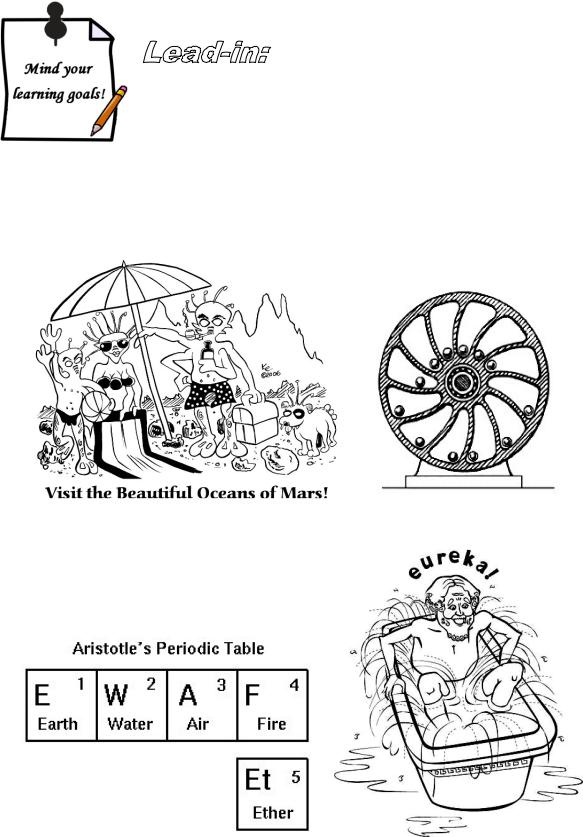
Can you associate the pictures (pic. 5, a d) with famous hypotheses?
a |
b |
c |
d |
Pic. 5
76
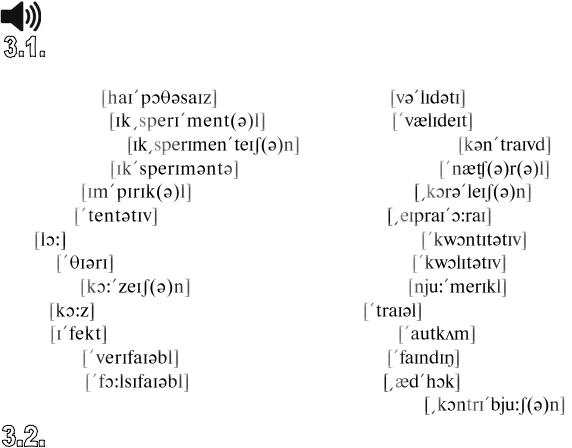
Listen to the speaker and practise pronunciation of words related to scientific hypotheses and experiments:
hypothesize |
validity |
experimental |
validate |
experimentation |
contrived setting |
experimenter |
natural setting |
empirical |
correlation |
tentative |
a priori |
law |
quantitative |
theory |
qualitative |
causation |
numerical |
cause |
trial |
effect |
outcome |
verifiable |
finding |
falsifiable |
ad hoc |
|
contribution |
Match the words on the left and their descriptions.
1.Hypothesis
2.Theory
3.Law
a)uses many observations and has loads of experimental evidence;
b)flexible enough to be modified if new data/evidence introduced;
c)has uniformity and is universal;
d)an idea based on observations without experimental evidence;
e)stands the test of time, often without change;
f)can create true predictions for different situations;
g)experimentally confirmed over and over;
h)a statement that uses a few observations;
i)can be applied to unrelated facts and new relationships.

 A. Draw a scheme to represent relations between the notions from text A and to reveal the most important information about scientific hypotheses.
77