Материал: 62. Bara, B.G. Cognitive pragmatics the mental processes of communication 2011
AUTHOR’S COPY | AUTORENEXEMPLAR
Cognitive pragmatics: The mental processes of communication 463
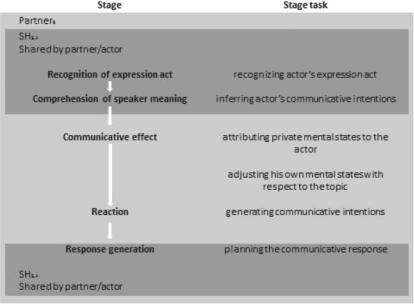
Figure 5. The five stages of comprehension and generation of a communication act. Source: Airenti, Bara & Colombetti 1993.
such rules are a convenient means for describing communicative interaction. This does not imply they actually exist in the mind or in the brain.
Comprehending the expression act (stage 1) and speaker meaning (stage 2) are managed by a limited number of specialized rules. The reason for this is that comprehension is a process that is shared and achieved by two people, with the result that the actor must, in principle, be able to predict how her partnerwillreconstructthemeaningofherutterance.Stateddifferently,sincecomprehension rules are constitutive of meaning, meaning’s construction is shared by all those who are taking part in the interaction.
In contrast to the two initial stages, the effect of the utterance on the partner is a question of private mental processing. In this case, individual motivation and general intelligence prevail over shared social norms. This means that it is impossible to formulate an exhaustive set of rules for stage 3.
Stage 4, the reaction stage, is again different. The task here consists in planning a communication act whose starting point is the private motivations activated by the flow of the dialogue. It should therefore be possible to identify a set of norms that describe cooperative interaction. Such norms are neither universal nor logically necessary. They depend on the specific culture the agents belong to and on the specific circumstances the dialogue takes place in: In our
AUTHOR’S COPY | AUTORENEXEMPLAR
AUTHOR’S COPY | AUTORENEXEMPLAR
464 Bruno G. Bara
terms, on the behavior game that is being played. This being the case, I do not introducebase-levelresponserules,butwillsimplypresentafewparadigmatic examples. The task of defining cultural and situational taxonomies of the rules for stage 4 must be left to the scholars of ethnicity.
Finally, response generation (stage 5) is based on a highly specialized type ofplanningandonasetofsharedandconstitutivelinguisticandextralinguistic rules.
4.1. Simplicity and complexity of a communication act
I define a simple communication act as that in which the passage from utterance to the behavior game of which the utterance may be considered to be a move is immediate, requiring only one single inferential step.
I define a complex communication act as that in which the passage from utterance to the behavior game of which the utterance may be considered to be a move requires an inferential chain of variable length.
This generalization allows us to distinguish not only between simple and complex communication acts in standard communication (as in the case of indirect speech acts), but also between simple and complex communication acts in nonstandard communication, as in the cases of irony and deception.
4.1.1. Simple and complex indirect speech acts. The problem of recognizingindirectspeechactsdoesnotexistincognitivepragmatics,sincethereisno primitivenotionofnonliteralspeechact.Thekeypointforthepartnerisalways that of recognizing the opening bid in a behavior game, in whatever form that moveisexpressed.Oncethegamehasbeenidentified,inferringwhatmovethe actorisaskingherpartnertomakepresentsnoextradifficultieswhatsoeverfor indirect speech acts compared to direct speech acts.
Inbrief,theideaisthatthelocutionaryactisalwaysnecessaryasthestarting point, but is not enough, even in those cases that are classically defined as direct speech acts. My expression act is de facto the unavoidable departure point for the reconstruction of speaker meaning, through the identification of a valid behavior game.
5. Nonstandard communication
The theory outlined in the preceding section describes the process of comprehension and of the construction of the response in situations that may be classified as standard, that is, situations that trigger default rules. There are, however, a large number of interesting cases that go beyond the bounds of normality, which may be classified under four headings:
AUTHOR’S COPY | AUTORENEXEMPLAR
AUTHOR’S COPY | AUTORENEXEMPLAR
Cognitive pragmatics: The mental processes of communication 465
1. Nonexpressive interaction: the use of an utterance without there being any intention to express the mental state associated with that utterance.
2. Exploitation: the special use of a communication rule to obtain a communicative effect that is different from that normally associated with that rule (e.g., to create irony).
3. Deception:theattempttoconveyamentalstatethatisnotinfactpossessed. 4. Failure: unsuccessful attempt to achieve the desired communicative
effect.
The analysis of these cases is important not only in itself, but also because it provides independent evidence in favor of cognitive pragmatics, in the sense that the structural features typical of possible interactions that are nonexpressive,thatexploit,thatdeceive,andthatfail,overlapperfectlywiththedifferent representations on which the cognitive process of communication is based.An interruption in the standard inferential chain may be ascribed to one of two different reasons: either the actor wanted the interruption to come about, or else it comes about in the partner’s mind without the actor’s having wished it. Intentional interruption means that the actor intended to employ a form of exploitation or of nonexpressive interaction.
Alternatively,failurecomesabouteitherbecausethepartnerdoesnotfollow the inferential chain when he was meant to, or, conversely, because he follows thechainwhenhewasnotsupposedto,sincetheactorhadproposedanonstandardmode.Finally,anattemptatdeceptiontakesplacewhentheactoremploys false shared knowledge in order to achieve her objectives.
As we saw in section 3.6, it is the conversation game that governs the succession of the five stages in communication. Stated differently, the conversation game works at a metalevel — employing metarules — that ensures that at the base level all the standard inferences may follow smoothly in succession without any blocks occurring, simply by applying the base rules. The purpose of the conversation game is, on the one hand, to guarantee that each stage accomplishes its task in an adequate fashion, thereby enabling the successive stage to receive the information it requires to proceed, and, on the other hand, to intervene if a given stage fails to achieve its objectives.
Indeed,ifastagedoesnotrealizeitspredeterminedgoals,thentheconversation game intervenes at the metalevel in order to specify what has to be done abouttheproblemthathasoccurredatthebaselevel.Inthiscase,themetalevel blocks the default rules that are specific to that stage, activating an alternative inferential process that does not employ that particular type of automatic rules. Just as I have termed the communicative process utilizing default rules standard, so I will call nonstandard those processes that must have recourse to classic inferencing procedures since they cannot apply standard default rules because the latter are inappropriate to the context.
AUTHOR’S COPY | AUTORENEXEMPLAR
AUTHOR’S COPY | AUTORENEXEMPLAR
466 Bruno G. Bara
Each nonstandard situation has a logical place in the framework of the comprehension process I have outlined. Nonexpressive interaction, exploitation, and deception fall naturally into the first three stages of my model. In the first stage — understanding the expression act — the only nonstandard path the actor may have followed, and which the partner must therefore identify, is that of nonexpressive interaction. In the second stage — understanding speaker meaning — all nonstandard inferences are cases of exploitation. In both types of cases, the actor tries to ensure the partner will identify the nonstandard path and follow it correctly. Should this not happen, the outcome will be failure.
The third stage — communicative effect — is where deception occurs. Deception cannot be found in the comprehension stages because deception is not realized by any special form of communication. It concerns the relationship between what the actor communicates and her private mental states.
Finally, one has to analyze failures, which may occur at any stage. In order to recognize and possibly to repair a failure, one cannot use the default rules of communication: she has to fall back on classic inferential procedures.
In this paper I shall discuss only irony and deception, the two most interesting cases of nonstandard communication.
5.1. Irony
Let us suppose that B is telling A how his wife tried to use her car to knock down the woman whom he had decided to live with, and thatAcomments on the episode thus:
(11) “Your wife is definitely someone who does not take things badly!”
What makes utterance (11) ironic is the fact that both interlocutors share the view that the opposite of what was asserted is literally true. This blocks the application of the rule that lays down that, within the space of shared beliefs, if the actor expresses a belief, then by default she intends to communicate that this belief will be shared by herself and her partner, unless her partner denies the fact.
Example(11)illustratestheprincipalfeatureofexploitation:Itisonewayof playing with sharedness. In actual fact, utterance (11) could have been interpreted as a serious confirmation by a third person who had arrived after the initial description of the events furnished by B. The point is that an ironic intention does not alter the standard sequence in which the rules are applied, but onlythewayinwhichtherulesareused.Ihavealreadystatedthattherulesare usually exploited by taking the reverse of the literal meaning conveyed by the utterance.This,forGrice(1989),istheessenceofirony:sayingpandmeaning non-p (~p). For an extensive semantic and pragmatic analysis of irony, see Attardo (2001).
AUTHOR’S COPY | AUTORENEXEMPLAR
AUTHOR’S COPY | AUTORENEXEMPLAR
Cognitive pragmatics: The mental processes of communication 467
Grice, of course, is formalizing the traditional analysis of irony: a trope based on antiphrasis, which is, quite simply, an utterance to be intended as its opposite. However, two kinds of argument have been advanced against equating irony exclusively with the opposite of literal meaning. The first was propounded by Sperber and Wilson (1995 [1986]), who demonstrated that ironic statements do not necessarily correspond to the opposite of literal meaning. Take the following excerpt from Voltaire’s Candide (1947):
(12) When all was over and the rival kings were celebrating their victory with Te Deums in the respective camps. . . .
According to Sperber and Wilson, irony is a case of echoic interpretation. An echoic utterance is one that echoes the thought, and the attitude toward the thought, of someone who is not the speaker herself. It echoes the thought of anotherpersonwhenitsimplyreportswhatthatotherpersonsaid.Itmay,however, echo traditional thoughts, as when it reports an obvious truth, a popular belief, or a proverb.
In the case of irony, the speaker produces an utterance that echoes another person’s thought, while concurrently manifesting a critical or disparaging attitude toward content p. In example (12),Voltaire is not suggesting that neither of the two kings won the battle and were celebrating victory, nor that both kings lost the battle and were bewailing their defeat. Instead, Voltaire is echoing the claims made by the two rivals. Since the two simultaneous claims of victorycontradicteachother,itisobviousthatbothpartiescannotberight.The irony stems from the fact that Voltaire highlighted the attitude of the rival kings, unveiling its vacuousness.
A second objection is advanced by Morgan (1990). He points out that no one — neither Grice, nor those such as Perrault (1990) who adopt Grice’s approach — everexplainswhyameaningpshouldbeinterpretedas~p,andnot as a lie. Morgan considers irony to be a transparent fiction: the speaker says something pretending to believe it while simultaneously making it obvious through the use of paralinguistic and nonverbal features that the utterance is indeed a fiction.
The vast majority of critics of the antiphrasis position are quite vehement in their censures. Morgan defines it as a perverse obscurity, while Sperber and Wilson declare that defining irony as implicating the opposite is a bizarre practice. As the criticisms leveled at the classical account demonstrate, Grice has solved one particular case, but not the general case: Sometimes in uttering p the speaker implicates ~p.
Mytheoryisbasedessentiallyonsharedknowledge,inordertoexplainhow interlocutors understand — without the aid of the stigmatized miracles of the classical approach — that a given utterance is not to be taken literally. With
AUTHOR’S COPY | AUTORENEXEMPLAR