Chapter 5 • The Brain Stem
Lateral Medullary (Wallenberg) Syndrome
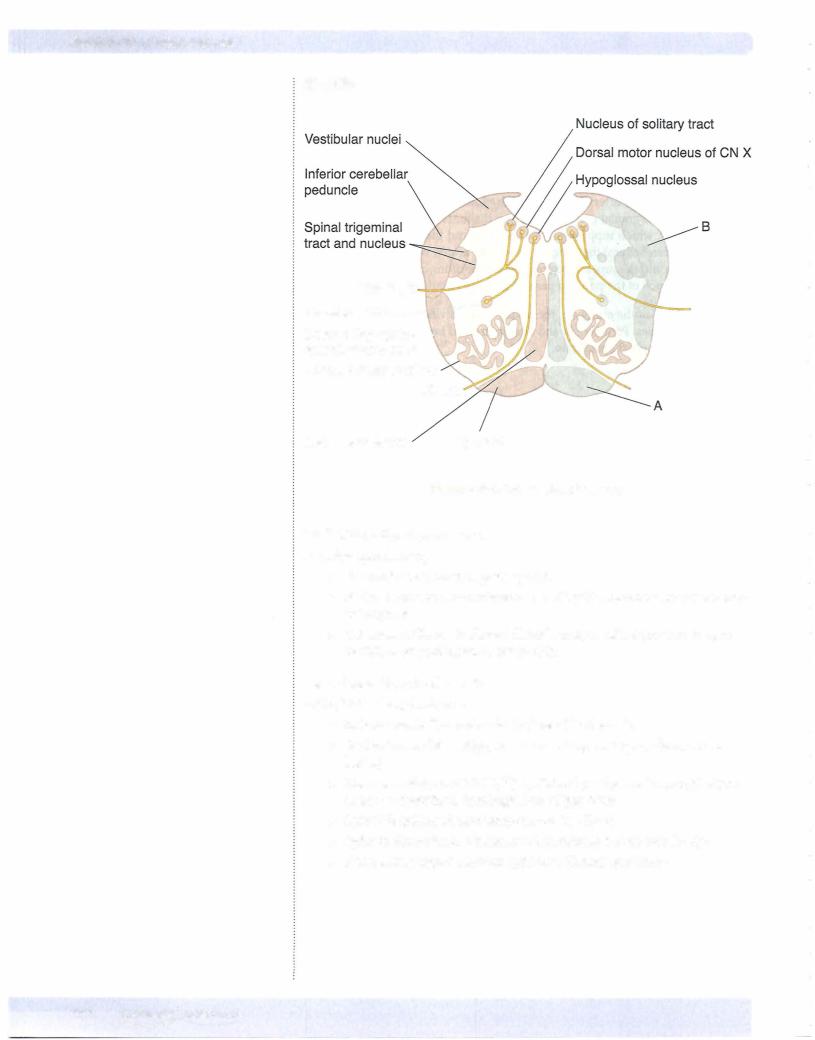
Lateralmedullarysyndrome results from occlusionofthe PICA (Figure IV-5-15).
Thecranial nervesornuclei involvedinthe lesion are thevestibularorthe cochle ar parts of CN VIII, the glossopharyngeal and the vagus nerves, and the spinal nucleus or tract ofV The long tracts involved are the spinothalamic tract and the descending hypothalamic fibers.
Spinothalamic tract lesions produce a pain and temperature sensation deficit in the contralaterallimbs andbody.
Lesions of descending hypothalamic fibers produce an ipsilateral Horner syn drome (i.e., miosis, ptosis, and anhidrosis).
Lesions ofthe vestibular nuclei and pathways may produce nystagmus, vertigo, nausea, and vomiting. Ifthere is a vestibular nystagmus, the fast component will be away from the side ofthe lesion.
Lesions of the vagus nerves exiting the medulla may produce dysphagia (diffi cultyin swallowing) orhoarseness. The palate willdroop onthe affected side, and the uvulawill deviate away from the side ofthe lesion.
Lesions ofthe glossopharyngealnerveresultin a diminished orabsentgag reflex.
Lesions ofthe spinal tract and nucleus ofthe trigeminal nerve produce a loss of just pain andtemperaturesensations on the ipsilateral side ofhalfthe face. Touch sensations from the faceandthe cornealblinkreflexwillbe intact. In lateral med ullary syndrome, the pain and temperature losses are alternating; these sensa tionsarelost fromthe face andscalp ipsilateral to the lesionbutarelost fromthe contralateral limbs and trunk.
Taste sensations maybe altered ifthe solitary nucleus is involved.
Medial Pontine Syndrome
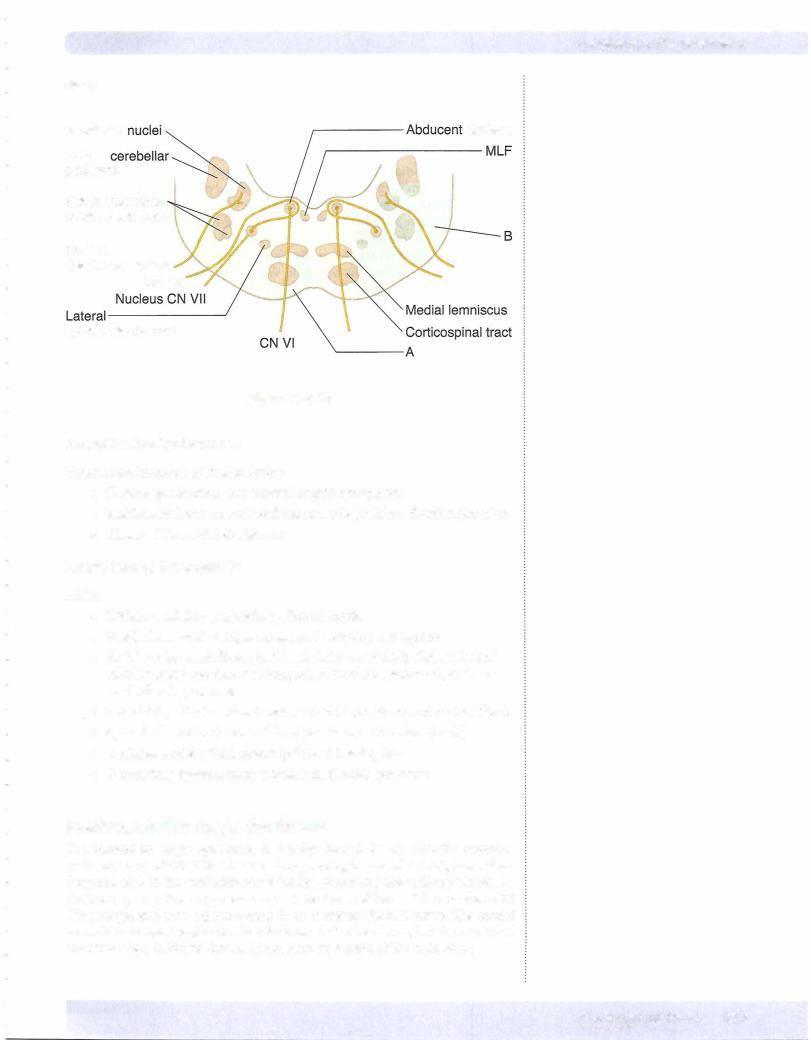
Medial pontine syndrome results from occlusion ofparamedian branches ofthe basilar artery (Figure IV-5-16).
At a minimum, this lesion affects the exiting fibers ofthe abducens nerve and the corticospinal tract. The medial lemniscus may be affected ifthe lesion is deeper into the pons, and the facial nerve maybe affected ifthe lesion extends laterally.
The long tract signs will be the same as in medial medullary syndrome, involving the corticospinal and medial lemniscus, but the abducens nerve and the facial nerve lesions localize the lesion to the caudal pons.
Corticospinaltractlesionsproduce contralateralspastichemiparesisofbothlimbs.
Medial lemniscus lesions produce a contralateral deficit of proprioception and touch, pressure, and vibratory sensations in the limbs and body.
Lesions of the abducens nerve exiting the caudal pons produce aninternal stra bismus ofthe ipsilateral eye (from paralysis ofthe lateral rectus). This results in diplopia on attempted lateral gaze to the affected side.