EPITHALAMUS
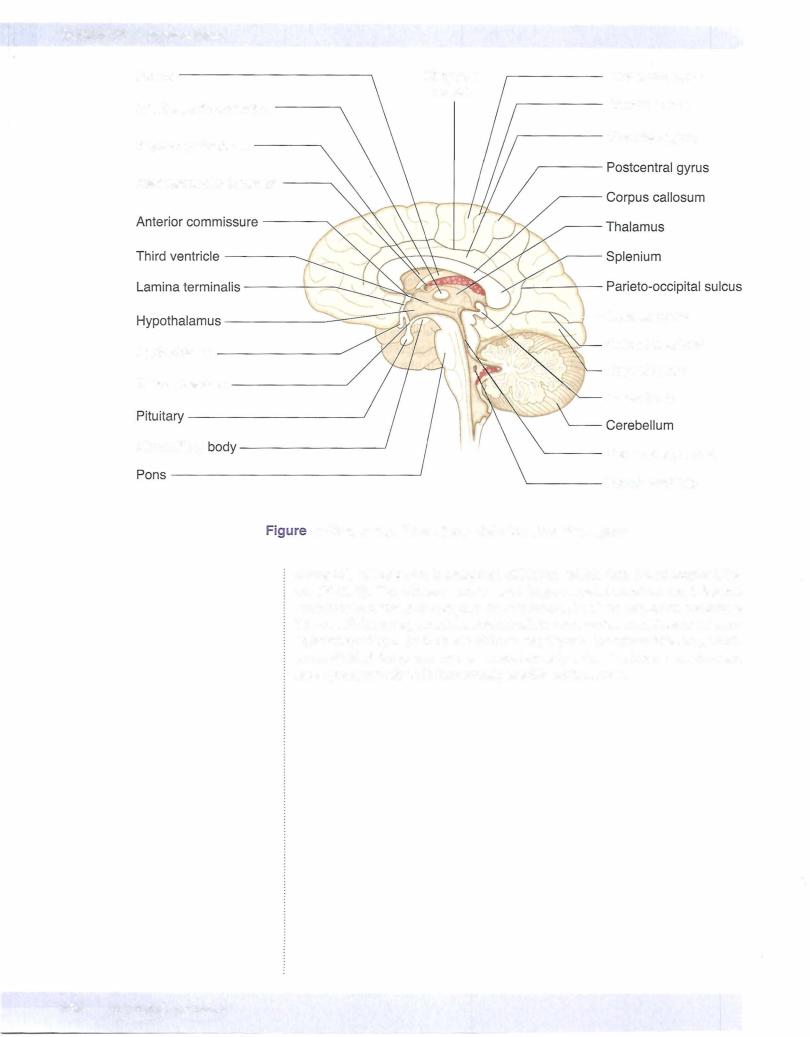
The epithalamus is the part ofthe diencephalon located in the region ofthe poste rior commissure that consists of the pineal body and the habenular nuclei.
The pineal body is a small, highlyvascularized structure situated above the poste rior commissure and attached by a stalk to the roof ofthe third ventricle.
The pineal body contains pinealocytes and glial cells but no neurons. Pinealo cytes synthesize melatonin, serotonin, and cholecystokinin.
The pineal gland plays a role in growth, development, and the regulation of cir cadian rhythms.
Environmental light regulates the activity ofthe pineal gland through a retinal-su prachiasmaticpineal pathway.
The subthalamus is reviewed with the basal ganglia.
ChapterSummary
•The diencephalon is divided into 4 parts: thalamus, hypothalamus, epithalamus, and subthalamus.
•The thalamus is the major sensory relay for many sensory systems. The long tracks of spinal cord and the trigeminal system synapse in the ventral posterolateral (VPL) and ventral posteromedial (VPM) nuclei, respectively. Auditory input is to the medial geniculate body, and the visual input is to the lateral geniculate body. Motor projections from the basal ganglia and cerebellum synapse in the ventral anterior and ventral lateral nuclei.
•The hypothalamus contains nuclei that have fiber connections with many areas ofthe nervous system, including the pituitary gland in the anterior and tuberal regions ofthe hypothalamus. Other areas control eating, drinking, body temperature, and provide connections with the limbic system.
•The epithalamus consists mainly ofthe pineal gland, which plays a major role in the regulation of circadian rhythms.
•The subthalamic projections are important circuits related to the basal ganglia.
Chapter 9 • Diencephalon
Clinical Correlate
Precocious Puberty
In young males, pineal lesions may cause precocious puberty.
Pineal Tumors
Pineal tumors may cause obstruction of CSF flow and increased intracranial pressure. Compression ofthe upper midbrain and pretectal area by a pineal tumor results in Parinaud syndrome, in which there is impairment of conjugate vertical gaze and pupillary reflex abnormalities.