Материал: Oxford American Handbook of Urology ( PDFDrive )
92 CHAPTER 3 Bladder outlet obstruction
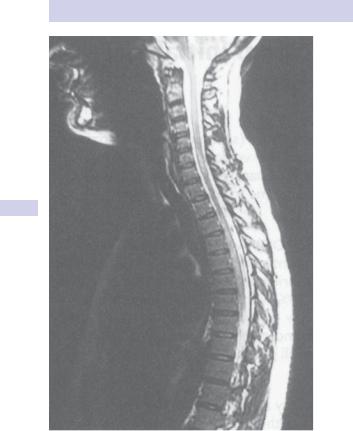
Figure 3.2 MRI of cervical and sacral cord in a young patient presenting with urinary retention. The patient had undiagnosed MS. Signal changes are seen in the cervical, thoracic, and lumbosacral cord.
This page intentionally left blank

94 CHAPTER 3 Bladder outlet obstruction
Acute urinary retention: initial and definitive management
Initial management
Urethral catheterization is used to relieve pain (suprapubic catheterization if urethral route not possible). Record the volume drained—this confirms the diagnosis, determines subsequent management, and provides prognostic information on outcome from this treatment.
Definitive management in men
Discuss trial without catheter (TWOC) with the patient. Precipitated retention often does not recur; spontaneous retention often does. Half of patients with spontaneous retention will experience a second episode of retention within the next week or so, and 70% within the next year.
A maximum flow rate (Qmax) <5 mL/s and low voiding detrusor pressure predicts subsequent retention. Thus, while most patients will require definitive treatment (e.g., TURP), a substantial minority will not need surgery.
Options to avoid TURP
•Prostate-shrinking drugs followed by a voiding trial several months later (5A-reductase inhibitors in those with benign-feeling prostates, LHRH agonists in those with malignant-feeling prostates on DRE, confirmed by TRUS-guided prostate biopsy)
•Prostatic stents
•Long-term urethral or suprapubic catheter
•Clean, intermittent self-catheterization (CISC) is not a realistic option for most men, but some will be able and happy to do this.
Definitive management in women
Use CISC either until normal voiding function recovers or permanently if it does not. For Fowler syndrome use sacral neuromodulation (e.g., Medtronic InterStim).
Risks and outcomes of TURP for retention
Relative risks of TURP for retention vs. TURP for lower urinary tract symptoms (LUTS) are as follows: postoperative complications 26:1; blood transfusion 2.5:1; in-hospital death 3:1.1
High retention volume, greater age, and low maximum detrusor pressure are predictive for failure to void after TURP; 10% of those with acute retention of urine and 40% of those with chronic retention fail to void after initial post-turp. Overall, 1% of men will fail to void after subsequent voiding trial and will require long-term catheterization.2
1 Pickard R, Emberton M, Neal D (1998). The management of men with acute urinary retention. Br J Urol 81:712–720.
2 Reynard JM (1999). Failure to void after transurethral resection of the prostate and mode of presentation. Urology 53:336–339.
This page intentionally left blank

96 CHAPTER 3 Bladder outlet obstruction
Indications for and technique of urethral catheterization
Indications
For relief of urinary retention and prevention of urinary retention, a period of postoperative catheterization is commonly employed after many operations where limited mobility makes normal voiding difficult.
Other indications for catheterization include monitoring of urine output (e.g., postoperatively); prevention of damage to the bladder during cesarean section; bladder drainage following surgery to the bladder, prostate, or urethra (e.g., TURP, TURBT, open bladder stone removal, radical prostatectomy); and bladder drainage following injuries to the bladder.
Technique
Explain the need for and method of catheterization to the patient. Use the smallest catheter—in practical terms, usually a 12 Fr., with a 10 mL balloon. For longer catheterization periods (weeks) use a silastic catheter to limit tissue reaction, thereby reducing the risk of a catheter-induced urethral stricture. If there is clot retention, use a three-way catheter (20 Fr. or greater) to allow evacuation of clots and bladder irrigation to prevent subsequent catheter blockage.
The technique is aseptic. One gloved hand is sterile; the other is “dirty.” The dirty hand holds the penis or separates the labia to allow cleansing of urethral meatus; this hand should not touch the catheter. Use sterile water or sterile cleaning solution to prep skin around meatus.
Apply lubricant jelly to the urethra. Traditionally, this contains local anesthetic (e.g., 2% lidocaine), which takes 3–5 minutes to work. However, a randomized, placebo-controlled trial showed that 2% lidocaine was no more effective for pain relief than anesthetic-free lubricant,1 suggesting that it is lubricant action that prevents urethral pain.
If using local anesthetic lubricant, warn the patient that it may STING. Local anesthetic lubricant is contraindicated in patients with allergies to local anesthetics and in those with urethral trauma, where there is a (theoretical) risk of complications arising from systemic absorption of lidocaine.
When instilling jelly, do so gently—a sudden, forceful depression of the plunger of the syringe can rupture the urethra! In males, milk the gel toward the posterior urethra, while squeezing the meatus to prevent it from coming back out of the meatus.
Insert the catheter using a sterile hand, until flow of urine confirms it is in the bladder. Failure of urine flow may indicate that the catheter balloon is in the urethra. Intraurethral inflation of the balloon can rupture the urethra. If no urine flows, attempt aspiration of urine using a 50 mL bladder syringe (lubricant gel can occlude eyeholes of the catheter).