Материал: Scientific Herald of the Voronezh State University of Architecture and Civil Engineering
Issue № 1(29), 2016 |
ISSN 2075-0811 |
6. Results and Analysis
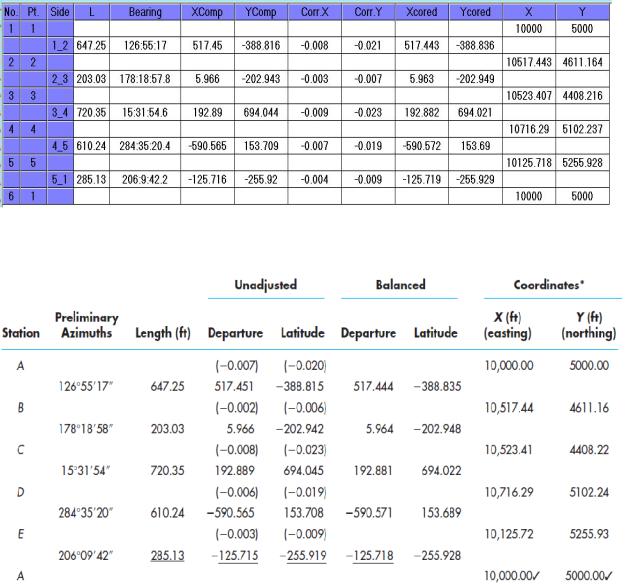
The results of TravCAD can be shown in Figure 6 a), 6 b) and table 1, while the textbook solution is shown in table 2. The solution of TravCAD is more precise because of the computed departures, latitudes and coordinates is in the format of (*.###) while Ghilani & Wolf, 2012 using the format of (*.##). The coordinates of the sample points were computed manually to check for the existence of significant difference or discrepancy between TravCAD.
Table 1
Example solution given by Ghilani & Wolf, 2012
Table 2
Example solution given by Ghilani & Wolf, 2012
7. Statistical Test
SPSS SW was used in testing whether the two sets of computed coordinates (TravCAD and Ghilani & Wolf, 2012) were from population with the same mean. The Student-T distribution
51

Scientific Herald of the Voronezh State University of Architecture and Civil Engineering. Construction and Architecture
test was carried out to determine the confidence interval of computed X and Y coordinate. The test was carried out to test if there is any significant difference. Both the null hypothesis and the alternative hypothesis were assumed. The Level of significance was chosen to be 95%. Since the population is < 30, the student-t distribution shall be used. The student-t distribution is expressed as:
t = |
|
|
|
(13) |
|
|
|
|
|||
/ |
/ |
||||
|
|
|
Where:
μ1, X1: is average mean error and sample mean of the solution given by Ghilani & Wolf, 2012.
μ2, X2: is average mean error and sample mean of the solution given by TravCAD. The both solutions can be seen identical; therefore, we accept the null hypothesis that there is no significant difference between the TravCAD and Ghilani & Wolf, 2012 in computing coordinates.
Conclusion
The research objective was achieved by developing and testing the developed system. TravCAD used equations that are commonly in the field of surveying computations. It can be obvious that all methods can be applied in TravCAD. TravCAD is reliable in traverse computations process depending on results comparison with solved example in famous textbooks. One can use TravCAD to have a facility and time reduction in traverse computations, in addition to avoid human errors. The integration of traverse computation and CAD system can be presented in TravCAD.
One must recommend making further steps in the field of development of self-made surveying SW. There are some important surveying operation had to be covered using a self-made SW in order to satisfy the needs of both engineers and students of civil engineering.
References
1.Adejare, Q. A. Comparative Package for Surveying Computations using Hot Sheet, Unpublished B.Eng. Thesis submitted to the Department of Surveying and Geoinformatics / Q. A. Adejare. –– Nigeria : University of Lagos, 2003.
2.Beek, K. J. Geoinformation: A world in motion. Paper presented on the occasion of the 40th Anniversary of Wuhan Technical University of Surveying and Mapping (WTUSM), 16––19 October / K. J. Beek, C. M. Paresi, 1996.
52
Issue № 1(29), 2016 |
ISSN 2075-0811 |
3.Ghilani, C. D. Elementary Surveying: An Introduction to Geomatics. Pearson Education Inc. 13th Edition / C. D. Ghilani, P. R. Wolf. –– New Jersey, USA, 2012.
4.Hashimi Sayed R. Hashimi. Traverse Adjustment Using Microsoft Excel Solver. ACSM/TAPS Conference April 19 –– 21, Nashville, TN, USA / Hashimi Sayed R. Hashimi, 2004.
5.Odumosu, J. O. Development of an Object Oriented Program for Traverse Computation / J. O. Odumosu, O. G. Ajayi, P. Ibrahim, V. C. Okorocha, F. F. Idowu // International Journal of Scientific Engineering and Technology. –– 2014. –– Vol. 3, issue 7. –– pp. 967––973.
6.Ruchel Jan Ruchel. Creating Applications for Geodetic Computations / Ruchel Jan Ruchel // Geomatics and Environmental Engineering. –– 2010. –– Vol. 4. –– pp. 81––89.
7.Serwa A. Serwa. Detailed Studies of on the Potentials of High Scanning Resolution and Different Types of Camera Lenses for Digital Photogrammetric Applications, MSc Thesis, Faculty of Engineering, Assiut University, Egypt, March 2003.
8.Serwa A. Serwa. Automatic Extraction of Topographic Features from Digital Satellite Images, PhD. Thesis, Faculty of Engineering in Cairo, Azhar University, Egypt, Sept. 2009.
53

Scientific Herald of the Voronezh State University of Architecture and Civil Engineering. Construction and Architecture
DESIGNING AND CONSTRUCTION OF ROADS, SUBWAYS,
AIRFIELDS, BRIDGES AND TRANSPORT TUNNELS
UDC 625.768
A. G. Belykh1, V. V. Volkov2, L. A. Kukarskikh3
INFLUENCE OF THE REMAINING LIFE OF CONCRETE AIRDROME AND HIGHWAY PAVEMENTS ON THE FORMATION OF ELASTIC ACOUSTIC EMISSION WAVES
Air Force Academy Named after Prof. N. Ye. Zhykovsky and Yu. A. Gagarin Russia, Voronezh, tel.: +7-951-553-10-90, е-mail: sunstroke-777@mail.ru 1Senior Research Fellow of the 4th Dept. of the Research and Development Centre (Battle Application and Security of Military Air Force)
2PhD in Physics and Mathematics, Assoc. Prof. of Dept. of Engineering and Airfield Maintenance 3PhD in Physics and Mathematics, Senior Research Fellow of the 4th Dept. of the Research
and Development Centre (Battle Application and Security of Military Air Force)
Statement of the problem. While determining the characteristics of operated cement concrete airfield pavements and highways, there is a problem of their service life for them to be used further. Results. Determining the characteristics of a pavement is possible based on the evaluation their remaining life, measurement of the acoustic emission occurring in different stages of damage process related with specific physical structure and propeties of material, which influence the formation and distribution of elastic waves. While measuring the speed and attenuation passing through the multicomponent medium waves, the serviceability needs to be evaluated. The modeling allows for the above component to be connected with physical and mathematical character of material. Conclusions. A physical and mathematical model of the formation of elastic acoustic emission waves of failing concrete material to make well-timed decisions based on its further operational suitability.
Keywords: airfield pavement, elastic waves, speed, acoustic emission, remaining life.
Introduction
One of the urgent issues faced by construction these days is improving strength and reliability of building structures. Their limit states are the result of accumulation of microdefects in the process of operation which causes macrocracks, degrading performance and failure [3].
© Belykh А. G., Volkov V. V., Kukarskykh L. А., 2016
54
Issue № 1(29), 2016 |
ISSN 2075-0811 |
Therefore this paper looks into the evaluation of the development of internal wear and its effect on deformative characteristics of composites. This is dealt with in two aspects:
1)designing a physical and mathematical model of damage susceptibility and describing mechanical behavior of media in wave processes;
2)developing an effective and viable method of identifying and assessing defects.
Most artificial airfield pavements these days are made of concrete cement with a great emphasis on viable structures, high quality and strength of the base course to secure safe takeoff and landing of aircraft. Throughout its service life pavements are subjected to incomplete failures that affect flying safety. For credible and hands-on information on the current operational condition of pavements and predicting its behavior further into their service lives, it is necessary that methods of monitoring complying with the specific criteria are applied [9].
Loads and impacts affecting stress strain, durability, maintainability of airfield pavements can be classified according to their physical nature: climatic and hydrogeological, industrial and technological, mechanical, technogenic (operational and technological), emergency and specific ones [3]. The bearing capacity of pavements is mostly impaired by mechanical loads, they are caused immediately by landing gears on pavements with vertical (takeoff, landing, taxiing and parking) and horizontal (taxiing) loads. Mechanical loads are certain and major initial parameters in construction [4].
1. Formation of elastic waves of acoustic emission in microfailure of the structure of an airfield pavement material. In order to provide flying safety, airfield pavements must withstand the following set of force impacts influencing the stress strain of their construction elements.
Firstly, loads emerging during the takeoff, landing, taxiing and parking of aircrafts. These statistical calculation loads correspond with the complete weight of calculation aircrafts. For most aircrafts these days the calculation load on a pavement is transmitted with a three-axle landing gear consisting of two major and one nose support, most of the load (80—90 %) is evenly distributed onto two major supports and the nose support takes up the rest. Besides vertical forces, horizontal forces also act on airfield pavements during touch-down on uneven surfaces and friction of pneumatic tires during taxiing. Taxiing gives rise to frictional forces which causes the wheel to start rolling until the peripheral velocity equals the forward speed of an aircraft. Sliding friction ad then rolling friction are applied to the lower compressed propellant opposite to the aircraft flying path. The counter force is a reaction force which is a horizontal longitudinal load that causes wear and damage of the upper pavement and a shear of cement concrete slabs [3].
55