Материал: Scientific Herald of the Voronezh State University of Architecture and Civil Engineering
Issue № 1(29), 2016 |
|
|
|
|
|
|
|
ISSN 2075-0811 |
|||||||
|
|
|
|
|
|
|
|
|
|
|
|
|
|
|
|
|
Grains of cement |
|
Gel envelope ( ≈ 10 mkm, C/S ≈ 1,6) |
|
|
|
|||||||||
|
|
|
|
|
|
|
|
|
|
|
|
|
|
|
|
|
|
|
|
|
|
|
|
|
|
|
|
|
|
|
|
|
|
|
|
|
|
|
|
d ≈15 mkm |
|
|
|
|
|
|
|
|
|
|
|
|
|
|
|
|
|
|
|
|
|
|
|
|
|
d > 60 mkm |
|
|
|
|
|
|
|
|
|
|
|
||
|
|
|
|
|
|
|
|
|
|
|
|
|
|
|
|
|
|
|
|
|
|
|
|
|
|
|
|
Newly formed substances in the vo- |
|
|
|
|
|
|
|
|
|
|
|
|
|
|
|
|
lume: ultramicrocrystals CSH |
|
|
|
|
|
|
|
|
|
|
|
|
|
|
(C/S ≈ 2,5); ettringite crystals and |
|
|
|
|
|
|
|
|
|
|
|
|
|
|
|
alumoferrite phase l ≈ 2––10 nm, |
|
|
|
|
|
|
|
|
|
|
|
|
|
|
|
|
Ca OH d ≈ 10––100 nm |
|
|
|
|
|
|
|
|
|
|
|
|
|
|
|
|
||
|
|
|
|
|
|
|
|
|
|
|
|
Gap ( ≈ 0,5 mkm) between a cement |
|
||
|
|
|
|
|
|
|
|
|
d ≈30 mkm |
||||||
|
|
|
d ≈20 mkm |
|
|
|
|
|
|
|
|
grain and gel envelope CSH |
|
||
|
|
|
|
|
|
|
|
|
|
|
|
||||
|
|
|
|
|
|
|
|
|
|
|
|
|
|
|
|
Capillary pores d = 100––100 nm |
|
Nanopores d = 5––20 nm |
|
|
|
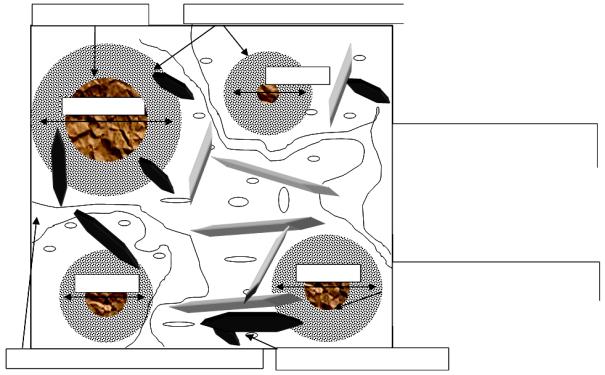
Fig. 5. Cement stone during slowing down of hydration, = 12 h. … 7 days
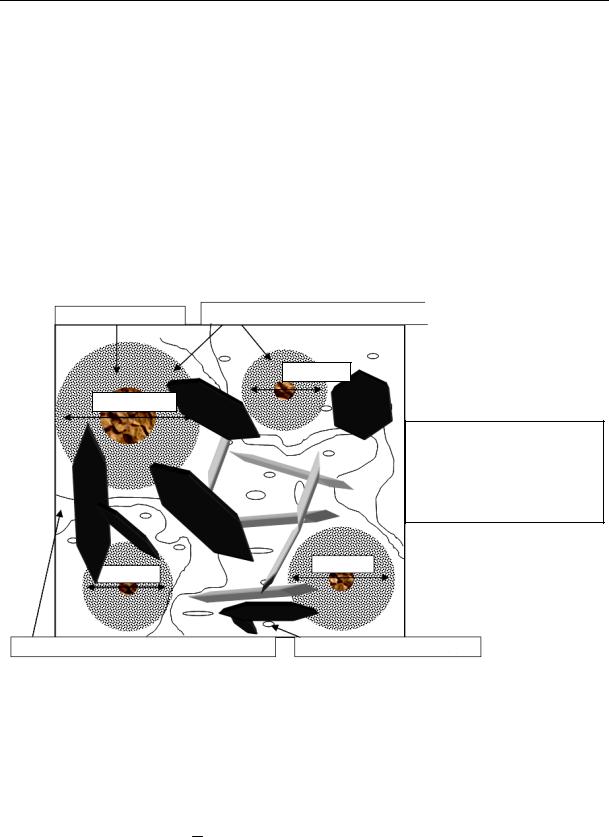
During slow interaction also associated with self-organizing structural forming after 7 days of hardening the gaps between the envelopes and surface of the grain are filled, peripherial areas of the cement grain are replaced with calcium silicate hydrogel and the reaction shifts to the centre of the grain (Fig. 6).
In the cement stone and in the rest of large and completely involved grains there are three areas C-S-H:
а) outside layer of about 1 mkm thick formed in the solution in the space originally filled with water;
b)an intermediate layer of about 8 mkm thick that is also precipitated using the solution on the inside layer of the envelope, i.e. the space taken up by the cement grain;
c)a central part formed topochemically.
As hydration and structure formation evolve, the structure of the porosity of the cement stone changes. As hydration progresses, the volume of capillary pores reduces and so does their radius and the total volume of gel pores increases. As a result of hardening the total porosity of the cement stone drops. As the radius of the pores decreases, there is less free water in the system respectively and liquid phase of the cement stone is now dominated by capillarly connected and absorption water.
21
Scientific Herald of the Voronezh State University of Architecture and Civil Engineering. Construction and Architecture
Therefore the original intergranular volume during hydration is filled by newly formed substances by 50…60 % in relation to the solid phase in the original “water –– cement” system. In the resulting structure of the cement stone the solid phase takes up 65…82 % depending on the water-cement ratio. The remaining grains of cement take up 12…23 % in the solid phase, hydrosilicate gel — 50…60 %, Са(ОН)2 — 20…25 %, calcium hydrosulphoaluminate — 15…20 %. The structure of the porosity is presented by capillary pores (20…30 % of the total volume of the pores), gel pores and crystal joints (70…80 %). The proportion of free water in the resulting structure of the cement stone is not over 1…2 % of the mass of the solid phase.
Grains of cement |
|
Amorphous crystal CSH, C/S ≈ 1,7––2,0 |
|
|
|
d ≈15 mkm
d > 60 mkm
Newly formed substances in the volume: outside fiber needleshaped CSH (C/S ≈ 2,6––2,7), ettringite crystals and alumoferrite phase l ≈ 2––10 nm, Ca OH
d ≈ 50––100 nm
|
|
d ≈30 mkm |
d ≈20 mkm |
|
|
|
|
Capillary pores d = 100––1000 nm |
|
Nanopores d = 5––20 nm |
|
|
|
Fig. 6. Cement stone during slow interaction, ≥ 7 days
2. Requirements for the structure of a cementing substance. In developing the technology of nano modification one must keep in mind the above qualitative and quantative changes of the structure of the cement stone at different stages of hydration and hardening. Nano effects should be produced by obtaining the structure of the cement stone meeting the requirements for the strength performance R . According to the general approaches to improving the failure resistance performance mentioned using nano modification of individual crystals, crystal joint (crystallite) and cementing substance mentioned in 6 and considering the characteristics of
22
Issue № 1(29), 2016 |
ISSN 2075-0811 |
structural elements of a cementing substance, requirements for the structure of the cement stone in its different scope levels can be specified.
For individual crystals according to the requirements for improving the strength limit of a structural unit sized d, crystal chemical and morphological characteristics and number of defects are corresponded by the phases CSH(II), CSH(I), С3А·3СŜН32.
For crystal joint (crystallite) when the effect of individual crystals on its strength is implemented through a spatial and geometric construction of a joint, failure resistance performance can also be achieved by forming hydrosilicate phases of jelly-like and fiber needle-shaped morphology and АFt-phase as they provide as many as possible strong contacts in a volume unit.
For a cementing substance improving the failure resistance of a structure is associated with optimization of volumetric ratios of the components of the solid phase:
––hidden crystal (С5S6Нх5, CSH(I)) improving the viscocity of failure of the material due to plastic deformation capacity and thus providing extra energy costs to generate plastic deformations;
––fiber needle-shaped CSH(II), CSH improving the energy costs of the failure energy due to a lot of chaotic contacts and boundaries in the volume;
––plate prismatic (АFmand АFt-phases) for extra “self-microreinforcement” of a cementing substance.
Improving the strength characteristics is also achieved by increasing the volume of crystal and gel pores.
3. Factors of management and outcomes of nano modification during evolution. Summing the results of theoretical considerations of evolution of the structural formation of cement systems, factors of management can be identified and outcomes of nano modification at each stage are assumed.
At the stage of the generation stage (at the initial and pre-induction hardening stage) the
major factors of management are degree of oversaturation ( кр) of the original solution influencing the rate and parameters of the structure of an emerging crystal. Hence nanotechnology can make use of regulating oversaturation, e.g., by introducing into a system of nanoparticles with a similar crystal chemical structure to change emerging centres of crystallization (Ic) and (or) regulating the solubility by thermal or other effects on the system. As a result spontaneous dispersion of the cement system can be expected to accelerate as well as the structuring of hardening water followed by a reduction in Gibbs energy of the generation of the solid phase and molecular cluster of an emerging principal hydrate.
23

Scientific Herald of the Voronezh State University of Architecture and Civil Engineering. Construction and Architecture
At the stage of the growth of particles (induction period of hardening) such parameters of the system as the coefficient of a crystal shape, number of possible point defects in a volume unit of a crystal can be changed by and as a result of nano modification. Structure forming involvement and modifying effect of additives of nano modifiers at the growth stage and accumulation of particles are associated with a catalytic role of nano-sized particles as centres of crystallization with the corresponding effect of reducing an energy threshold of this process (Еact) and its acceleration (dV). It should be noted that the major factor of management at this stage is creating extra centres of crystallization and that can be done by introducing a specified dosage of nano-sized additives of an optimal size and appropriate crystal chemical structure.
Therefore due to the introduction of nano-sized additives at these stages there might be a shorter induction period, a reduction in the radius of emerging crystals of principal hydrates, which might boost ultra micro grain structure of a cementing substance thus having a lower degree of defects of individual crystals.
The driving force behind agglomeration (acceleration of hydration) is the system seeking to reduce the area of the boundary of phases (Sreduc), which causes changes in the number of particles making up an aggregate (Np) and the total area of the boundary of the phases ( S). As the original emerging particles become smaller during nano modification, there is more energy coming out (Еaggl), which promotes intensification of agglomeration and makes it shorter. These parameters can be considered major factors of management during nano modification at this stage. The outcome of nano modification will be the formation of a structured liquid phase, which is normally achieved by introducing plasticizers and superplasticizers as tools of nano modification. Structure forming involvement of plasticizing additives is due to mechanisms providing changes in thermal dynamics and kinetics of the process making it possible to regulate the size and shape of an agglomerate, joint, number of crystals and contacts in them. A combination of effects of nano additives and superplasticizers might predominantly cause hydrosilicate phases of fiber and needle shaped morphology as providing the most joint and growth contacts in a volume unit.
At the stage of self-organizing structural formation (slowing down and slow interaction), a cementing substance is modified as it is emerging, the same applies for a volumetric ratio of the crystal and amorphous phases, i.e. a volumetric ratio of morphological differences of hidden crystal, fiber and needle-shaped, plate and prismatic. It also changes a specific volume of crystal and gel pores.
24

Issue № 1(29), 2016 |
ISSN 2075-0811 |
The following can be expected as the outcome of a modifying effect:
1)changes in the state of the intergranular surface of the system;
2)formation of extra types of the boundary area;
3)arranged structures of hardening with a dense envelope of crystals with corresponding changes in the porosity of a crystal joint.
At this stage the outcomes of nano technological modification from the previous stages will be mediated. E.g., this might apply for zoning of a hardening structure.
Conclusions
1. Systematization and analysis of major periods of inhomogeneous structural forming of cement systems (hydration hardening systems) provided insight into the generation of the phase, growth of particles, their agglomeration, spontaneous and self-organizing transformation in time as an object and objective of nanotechnological management.
2. A spatial and geometric setting of the transformation of the “cement –– water” system in all the traditional stages of hydration has been described both at the initial and induction period, acceleration, slowing down and slow interaction. As a result qualitative and quantative changes in the structure of the cement stone are presented as an object of nano modification which must be carried out on condition of obtaining a cement stone to meet the strength per-
formance criterion R .
3. Factors of directly nano modified structural elements of the system at the stage of the generation and growth of crystals have been justified and they are a combination of nano-sized additives of an optimal size and appropriate crystal chemical structure in combination with superplasticizers. Their use enables the regulation of the morphology of individual crystals, sizes and shapes of an agglomerate, joint, number of crystals and their contacts. It is also indicated that at subsequent stages of agglomeration and self-organizing structural formation of the structure of a cementing substance their effect is mediated and what it does is that it changes a volumetric ratio in its morphological differences, zoning and clustering of microstructure.
The authors extend their gratitude to the academician of the Russian Academy of Architecture and Building Sciences, PhD. in Technology, Prof. Ye. M. Chernyshov for his incredible contribution and consultancy.
25