Материал: Scientific Herald of the Voronezh State University of Architecture and Civil Engineering

Issue № 1(29), 2016 |
|
ISSN 2075-0811 |
If procedures do no t have to b e combined, a sequenc method is used (Fig. а). At each particular point in time the re is only one procedure being per formed and all of them are sequenced.
If proce dures have to be combined, the l inear sche uling meth od is employed (Fig. 2c). The entire construction period is t ypically div ided into t he commencement or particular flows and their es ablishment.
For parallel construction procedures (Fig. 2b) in different areas parallel m ethods are applied. Howev r as each g roup of pa allel proce dures in relation to any other grou p of parall el procedures ca n either be combined o r parallel procedures are always one of these:
––parallel method without combining procedures of the same type;
––parallel method combining procedure of the same type.
The way procedures are connected is cr ucial as it defines a range of organizing construction and ass embly.
Proced res are connected in t e followin g ways which are temp orary (Fig. 3):
–– resource (organ ization) that determine how continuously resources are used. If t he team moves on to another set of procedures o ce they have been do ne with the previous one, there is no str etch of resource connections (it is zero);
–– frontal (technological) det rmining ho w continuo usly particular procedures are performed. If once the previo s team hav e been don e with a p ocedure, a nother team take over, there is no stretch of frontal connection (it is zero);
–– ranking (labor connection ) determining how continuously equally ran ked proced ures are
performed that ma ke up a round. Rankin |
is its number from the longest (p rior to this one) or- |
|||||||||||||||||
ganizational and technological chain (connection bet ween proce |
ures). If following the end of a |
|||||||||||||||||
similar procedure of the same round, there is no stretch of ranking connections (it is zer o). |
||||||||||||||||||
|
А |
|
|
|
|
|
|
|
А |
|
|
|
|
А |
|
|
|
|
|
|
|
|
|
|
|
|
|
|
|
|
|
|
|
|
|
|
|
|
|
|
B |
|
|
|
|
|
|
|
|
|
|
|
|
|||
|
|
|
|
|
|
|
|
B |
B |
|||||||||
|
|
|
|
|
|
|
|
|
|
|
|
|
|
|
|
|
||
|
|
|
|
|
C |
|||||||||||||
|
|
|
|
|
|
|
|
C |
|
C |
||||||||
|
|
|
|
|
|
|
|
|
|
|
|
|
|
|
|
|
|
|
a) |
b) |
c) |
Fig. 2. Metho ds of organizing of constru ction and assembly perfor med with con stant intensity: а) sequenced, b) linear scheduling, c) parallel
31
Scientific Herald of the Voronezh State University of Architecture and Civil Engineering. Construction and Architecture
|
RESOURCE |
|
(organization) |
CONNECTIONS |
FRONTAL |
(technological) |
|
|
RANKING (labour |
|
connections) |
|
|
DIRECT |
|
|
|
|
REVERSE |
|
|||||||
|
|
|
|
|
|
|
|
|
|
|
|
|
|
|
|
|
|
|
|
|
|
|
|
|
|
|
|
|
|||
|
|
|
|
|
|
|
|
|
|
|
|
|
|
|
|
|
|
|
|
|
|
|
|
|
|
|
|
|
|
|
|
Final-start |
|
|
Start |
|
|
Final |
|
|
Start-end |
||||||
|
|
|
|
|
|
|
|
|
|
|
|
|
|||
|
|
|
|
|
|
|
|
|
|
|
|
|
|||
|
|
|
|
|
Fig. 3. Types of connections |
||||||||||
Connections joining the previous procedure to the following are direct. If they are opposite (i.e. connect the previous procedure to the following one) are reverse.
The presented definitions are those when dependencies are between the end of the previous and start of the following procedure, i.e. connections are final-start.
Connections may join the start of one type of procedures (and be start) or end (final). Equally ranked procedures joining the start of the following and the end of the previous one are startfinal.
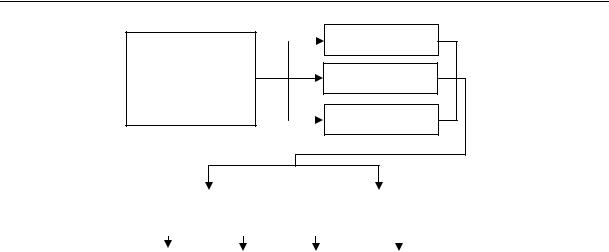
Considering a range of connections, there can be different methods of organizing construction procedures (see Fig. 1).
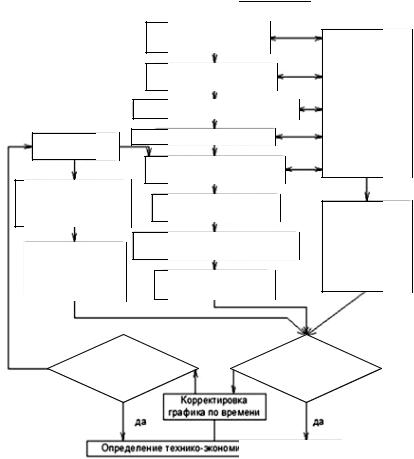
A sequence of developing a calendar plan using the linear scheduling method considering organizational and technological connection between procedures and sets is illustrated as an algorithm (Fig. 4). Details of procedures and accuracy of calculations depend on the type of a project undertaken.
A construction line is an industrial process developing in time and space. If each component of the line is assumed to be particular, a construction line can be regarded as a combination of included and parallel particular flows.
The major law of a particular flow is given by the dependence
t nk. |
(1) |
32
Issue № 1(29), 2016 |
|
ISSN 2075-0811 |
Correction of
teams
C alculation of t e characteristics of p rocedures of a linear graph
Technologica l connection of fl ows, designing a l near graph
Identifying the amo unt of work to be undertaken
Calculation of lab r costs and machine time
Forming particul ar flows
Calcula ion of construction teams
Calculation of the time of particular flows
Designing typolo gy of a net graph
Calculation of a determining card of the net gr ph
Calculation of the parame ters of the net graph
Justification of the accepted me thods of technolog y and organizatio n of procedures. Choosing machines and mechanism s
Determining regulated (directed) time of construc tion
D esigned time |
|
|
|
Designed time |
|||||||
are satisfying |
|
|
|
are satisfying |
|||||||
|
|
|
|
|
|
|
No |
||||
|
|
|
|
|
C |
orrecting the g |
raph |
|
|
|
|
|
|
|
|
|
a |
ccording to the |
time |
|
|
|
|
|
|
|
Yes |
|
Yes |
||||||
|
|
|
|
|
|
|
|
|
|||
|
|
|
|
|
|
|
|
|
|
|
|
|
|
Determining t |
chnical and |
economical indicators |
|
||||||
|
|
|
|
|
|
|
|
|
|
|
|
Fig. 4. A lgorithm for sequencing o developing |
|
calendar schedule using linear scheduling method considering |
|||||||||
or ganizational and technological connection between pr ocedures and sets
The law of a const ruction flow is given by the dependence
T k n m 1 k,
but usin g the depe ndence (1) we determi ne k = t/n, then
T m 1 t / n t,
where is th num ber of com onent processes inclu ded in a technological process (w rk); n is the amo unt of divi sions on a site; k is a step of flow.
The obtained law of a construction flo w is a linear fractiona l function whose graph is an equal-si ded hyperbola with asymptotes parallel to the coordinate axes.
In this case the total time of a flow is reversely pro portionate to the amount of divis ions. At n = 1 is a sequenced way of p erforming construction procedures and T = m ax; at n is parallel method of performing constru ction proce dures and T→min = t. Hence the sequenced a nd parallel way are particular cases of linear scheduling of pr ocedures.
33
Scientific Herald of the Voronezh State University of Architecture and Civil Engineering. Construction and Architecture
As was stated above, the consumption of resources in the linear scheduling method is directly proportionate to the amount of divisions (particular frontal procedures), i.e. R = n×r. As the number of divisions in a flow increases, more resources are used till the amount of divisions equals the amount of procedures in a flow, i.e. Rmax = m×r. As particular frontal procedures keep increasing, the consumption of resources does not.
As seen from the obtained expressions, the time of a construction flow and consumption of a resource depend on the amount of frontal procedures (divisions) where a flow is performed. If these dependencies intersect, let us determine these points.
In this case the following equations hold true:
а) t (m 1) t |
n r, if there is a non-established and unfinished flow. |
|
||||||||
n |
|
|
|
|
|
|
|
|
|
|
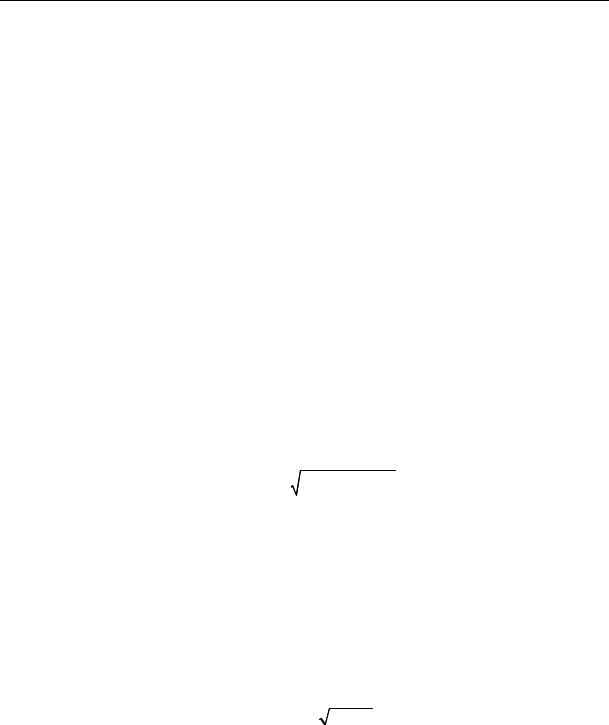
Let us solve the equation in relation to n: |
|
|
|
|
|
|
|
|||
|
|
n r |
m 1 t t 0, |
|
|
|
||||
|
|
|
|
|
n |
|
|
|
|
|
|
|
n2 r t n m 1 t 0, |
|
|
|
|||||
|
|
|
n |
t t2 4r m 1 t |
; |
|
(2) |
|||
|
|
|
|
|
2r |
|
|
|||
|
|
|
|
|
|
|
|
|
|
|
b) (m 1)t / n t mr, if a flow is established or finished. |
|
|
|
|||||||
In this case |
|
|
|
|
|
|
|
|
|
|
|
|
(m 1)t |
t mr 0, |
n |
(m 1)t |
. |
|
|||
|
|
|
|
|
||||||
|
|
n |
|
|
|
mr t |
|
|||
Let us accept the time of a particular flow and consumption of resources with single units, then |
|
|||||||||
|
|
|
n 1 |
4m 3 , |
|
|
(3) |
|||
|
|
|
|
0 |
|
2 |
|
|
|
|
|
|
|
|
|
|
|
|
|
|
|
|
|
|
|
n |
m 1 1. |
|
|
(4) |
||
|
|
|
|
0 |
m |
1 |
|
|
|
|
|
|
|
|
|
|
|
|
|
||
Thus in (4) we have a sequenced way of performing construction procedures. If a flow is organized properly, the amount of particular frontal procedures must be smaller than for involved procedures, i.e. m > n.
34

Issue № 1(29), 2016 |
ISSN 2075-0811 |
We argue that the obtained expression for the division of the total frontal procedures into particular ones depending on the time of procedures, consumption of resources and amount of work involved in the construction allows a rational use of the linear scheduling method.
At the designing stage if no data is available on the consumption of resources and time for each procedure, the number of particular frontal procedures can be determined if the time of work and number of resources are one, i.e. nor depending on the amount of work involved in the construction:
n |
1 |
4m 3 . |
0 |
|
2 |
|
|
Hence a non-established flow occurs in the linear scheduling of work. An optimal number of particular frontal procedures is within the dependencies (2) and (3).
Each particular flow is characterized by a number of members involved (workers, chains, building machinery) which are given by the following expression:
N |
P |
|
Q |
, |
|
t s |
t |
||||
|
|
|
where P is the amount of work involved in n frontal procedures х; s is the work input of one member per time unit in units of amount of work; Q is the workload of each flow.
Then the average number of members of a construction flow is given by the following expression:
|
m |
|
m |
|
|
m |
|
m |
|
Nср |
Qi |
|
Qi |
|
|
n Qi |
|
Qi |
|
i 1 |
i 1 |
|
i 1 |
i 1 |
. |
||||
T |
(m 1)t |
|
t(m m 1) |
m |
|||||
|
|
t |
|
|
Ti tm |
||||
|
|
|
n |
|
|
|
|
i 2 |
|
|
|
|
|
|
|
|
|
||
Flow construction is associated with production. The amount of production is the major indicator of a flow. This is its intensity expressing the amount of production per time unit. Intensity of a particular flow can be given by the expression i = Pn/t and intensity of a construction flow by the following expression:
|
m |
|
m |
|
m |
|
I |
Pni |
|
Pni |
|
Pni |
. |
i 1 |
i 1 |
i 1 |
||||
T |
m 1 t t |
Ti P tm |
||||
|
|
|
|
|
m |
|
|
|
|
n |
|
i 2 |
|
35