Материал: Scientific Herald of the Voronezh State University of Architecture and Civil Engineering

Scientific Herald of the Voronezh State University of Architecture and Civil Engineering. Construction and Architecture
There are the following characteristics to evaluate the quality of a construction flow: а) homogeneity of a flow:
|
T " |
|
n m 1 |
; |
|
||||
|
T |
n m 1 |
|
||||||
|
|
|
|
|
|
|
|||
b) productivity of a flow: |
|
|
|
|
|
|
|
|
|
|
n |
|
|
|
n2 |
|
|
; |
|
T |
|
t(n m 1) |
|||||||
|
|
|
|
||||||
c) time per a production unit: |
|
|
|
|
|
|
|
|
|
|
T |
|
t(n m 1) |
; |
|||||
|
n |
|
|
|
n2 |
|
|
|
|
d) rate of consumption of resources:
n . n m 1
If all of these are in a correlation dependence on δ, i.e.:
|
m 1 |
|
; n |
; |
|
1 |
|
t |
, |
|
n m 1 |
|
n |
||||||||
|
t |
|
|
|
|
|||||
there is no need to recommend it for the evaluation of their quality as a construction flow. Thus in order to evaluate a construction flow, we should use δ which is the rate of consumption of resources and time of a flow
m |
m 1 t |
|
T P Ti P i |
, |
|
i 2 |
i 1 n |
|
which can be recommended for the evaluation of ways of organizing a flow.
For that optimal points are determined. If there is only one such point, the functions should intersect in it. Then the following expression holds true:
|
n |
|
|
t |
. |
|
n m 1 |
|
|||
|
|
n |
|||
Let us solve the equation in relation to n: |
|
|
|
||
n2 tn m 1 t 0,
n t t2 4t (m 1) , 2
i.e. the previous law is confirmed (2).
36
Issue № 1(29), 2016 |
ISSN 2075-0811 |
Hence in a construction flow there are optimal options for the number of frontal procedures (divisions) which depend on the number of particular flows involved in a construction flow as well as timing and resources.
Conclusions
According to the studies of planning of low-rise construction, the following is concluded:
––analysis of the features of low-rise buildings and their construction makes it necessary to get new perspectives on construction planning. The criteria are technological effectiveness, cost, customer’s demands and wishes driven by the current property market;
––theoretical findings are formulated on choosing viable options for organizational and technological solutions for the low-rise construction using the algorithms for sequencing the development of a calendar scheduling using the linear scheduling method;
––the dependences are found of the effect of organizational and technological factors on the final indicators of technological processes and their sets;
––linear scheduling methods of organizing construction procedures are challenging to use if there are no repetitive works, structures, sites as well as when an individual structure cannot be divided;
––a non-established flow is the major factor of linear scheduling of construction;
––more divisions reduce the total timing without affecting the number of members involved;
––optimal number of divisions in a flow depends on the amount of work, time and consumption of resources.
References
1.Afanas'ev, V. A. Potochnaya organizaciya stroitel'stva / V. A. Afanas'ev. — Leningrad: Strojizdat, 1990. —
160s.
2.Bolotin, S. A. Imitaciya kalendarnogo planirovaniya v programmax imitacionnogo modelirovaniya zdanij i regressionnaya detalizaciya norm prodolzhitel'nosti stroitel'stva / S. A. Bolotin, A. X. Dadar, I. S. Ptuxina // In- zhenerno-stroitel'nyj zhurnal. — 2011. — № 7 (25). — S. 20—24.
3.Gorbaneva, E. P. Organizaciya remontno-stroitel'nyx rabot pri provedenii sanacii kvartalov zhiloj zastrojki: avtoref. … kand. texn. nauk / E. P. Gorbaneva. — Voronezh, 2008. — 16 s.
4.Matreninskij, S. I. Metodologicheskij podxod k ocenke komfortnosti territorij massovoj zhiloj zastrojki / S. I. Matreninskij, V. Ya. Mishhenko, I. E. Spivak // Promyshlennoe i grazhdanskoe stroitel'stvo. — 2008. — № 12. —S. 54—57.
5.Mishhenko, V. Ya. Problemy soderzhaniya i obnovleniya zhilishhnogo fonda / V. Ya. Mishhenko. — Voronezh, 2004. — 168 s.
6.Mishhenko, V. Ya. Optimizaciya raspredeleniya resursov v zadachax po sozdaniyu i soderzhaniyu ob'ektov nedvizhimosti / V. Ya. Mishhenko, E. P. Gorbaneva // Aktual'nye problemy stroitel'stva i nedvizhimosti: mezhvuz. sb. nauch. tr. — Voronezh, 2004. — S. 81—86.
37

Scientific Herald of the Voronezh State University of Architecture and Civil Engineering. Construction and Architecture
7. Mishhenko, V. Ya. Geneticheskie algoritmy v reshenii mnogokriterial'nyx zadach optimizacii raspredeleniya resursov pri planirovanii e'nergosberegayushhix meropriyatij / V. Ya. Mishhenko, E. P. Gorbaneva, A. Yu. Manukovskij, A. O. Safonov // Nauchnyj vestnik Voronezhskogo GASU. Stroitel'stvo i arxitektura. — 2014. — № 3 (35). — S. 77—82.
8. Mishhenko, V. Ya. Povyshenie e'nergoe'ffektivnosti v byudzhetnoj sfere Voronezhskoj oblasti / V. Ya. Mishhenko, E. P. Gorbaneva, A. Yu. Manukovskij, A. O. Safonov // Nauchnyj vestnik Voronezhskogo GASU. Stroitel'stvo i arxitektura. — 2014. — № 3 (35). — S. 71—76.
9.Mishhenko, V. Ya. Metodologiya proektirovaniya organizacionnyx struktur upravleniya zhiloj nedvizhimost'yu / V. Ya. Mishhenko, E. P. Gorbaneva, E. A. Zhdamirova // Nauchnyj vestnik Moskovskogo gos. gornogo un-ta. — 2005. — № 2. — S. 40—43.
10.Mishhenko, V. Ya. Analiz sovremennogo sostoyaniya zhilishhnogo fonda i inzhenernoj infrastruktury Vo-
ronezhskoj oblasti / V. Ya. Mishhenko, E. P. Gorbaneva // Izvestiya Tul'skogo gos. un-ta. Ser.: Stroitel'stvo, arxitektura i restavraciya. — 2006. — № 9. — S. 229—235.
11. Mishhenko, V. Ya. E'nergeticheskoe obsledovanie (e'nergoaudit) ob"ektov social'noj sfery / V. Ya. Mishhenko, V. N. Barinov, E. P. Gorbaneva, A. N. Nazarov / Nauchnyj vestnik Voronezhskogo GASU. Stroitel'stvo i arxitektura. — 2012. — № 1. — S. 77—84.
12. Mishhenko, V. Ya. Stoxasticheskie algoritmy v reshenii mnogokriterial'nyx zadach optimizacii raspredeleniya resursov pri planirovanii stroitel'no-montazhnyx rabot / V. Ya. Mishhenko, D. I. Emel'yanov, A. A. Tixonenko, R. V. Starcev // Nauchnyj vestnik Voronezhskogo GASU. Stroitel'stvo i arxitektura. — 2012. — № 1. — S. 92—97.
13.Golovinskij, P. A. Matematicheskie metody prinyatiya upravlencheskix reshenij v stroitel'stve: ucheb. posobie / P. A. Golovinskij, V. Ya. Mishhenko, E. M. Mixajlov. — Voronezh, 2008. — 180 s.
14.Enin, A.E. Problemy gradostroitel'nogo razvitija malyh istoricheskih gorodov voronezhskoj oblasti: retrospektivnyj analiz i prognozirovanie / A.E. Enin, I.S. Surovcev, T.A. Litvinova // Nauchnyj vestnik Voronezhskogo gosudarstvennogo arhitekturno-stroitel'nogo universiteta. Stroitel'stvo i arhitektura. –– 2011. –– № 4. –– S. 188––195.
15.Kashkarov, V. M. Khimicheskaya modifikatsiya poverkhnosti poristogo i profilirovannogo kremniya v rastvore akrilovoy kisloty / V.M. Kashkarov, A.S. Len'shin, P.V. Seredin, B.L. Agapov, V.N. Tsipenyuk // Poverkhnost'. Rentgenovskie, sinkhrotronnye i neytronnye issledovaniya. –– 2012. –– № 9. –– S. 80.
38

Issue № 1(29), 2016 |
ISSN 2075-0811 |
UDC 69.05 |
|
|
A. Serwa1, Hossam H. El-Semary2 |
INTEGRATION OF TRAVERSE COMPUTATIONS AND CAD BY DEVELOPING
OF TRAVCAD SW PACKAGE
Helwan University
Egypt, Cairo, e-mail: Dr.A.Serwa@m-eng.helwan.edu.eg 1Dr., Asst. Prof. of Surveying, Faculty of Engineering in El-Mataria
Benha University
Egypt, Cairo, e-mail: hossam.elsemary@feng.bu.edu.eg 2Dr.,.Asst. Prof. of Surveying, Faculty of Engineering in Shoubra
Statement of the problem. Traversing is one of plane surveying operations which is a traditional methodology that can be used to map the earth. The rapid development in instrumentation and computer dependency led to the need to develop plane surveying SW. Civil Engineering students suffered from the lack of illustration when the study of traversing is coming out. One can not fly to view the traverse but SW can show a planemetric view. SW gives the better solutions with feasible budget instead of manual and practical one. The integration between observations, computations and illustration made development of educational SW is an optimized solution.
Conclusions. This research work is providing free software’s as well as traversing data at absolutely free of cost. Initiatives of the educationist, researchers and software developers in the field of plane surveying may be benefited from this research work. An effort has been made to review the main components of the developed SW.
Key words: Educational, Civil Engineering, Plane Surveying, Web, Traverse, CAD interface, SW Development.
Introduction
As plane surveying is an important branch of surveying, the need of development plane surveying SW comprised. In present scenario, where the educational techniques are becoming more interactive and attractive with the aid of geomatics tools, the role of developed SW is noteworthy. Civil engineering students need to apply the integration between surveying, SW development, CAD and web. These new integrating tools and techniques have been complementing or replacing established surveying techniques and geoinformation production process [Beek et al, 1996].
© Serwa A., H. El-Semary Hossam, 2016
39
Scientific Herald of the Voronezh State University of Architecture and Civil Engineering. Construction and Architecture
Computer programming is the iterative process of writing or editing source code. Editing source code involves testing, analyzing, and refining, and sometimes coordinating with other programmers on a jointly developed program. (Adejare, 2003) also wrote a similar algorithm using Microsoft Excel Spread Sheet [Odumosu, J. O, et. al, 2014]. Ruchel, 2010, developed software package caries out geodetic computation. The main objective of this research work is to develop a comparative SW that can be expressed as self-developed SW. Hashimi, 2004, used Microsoft Excel Solver to apply traverse Adjustment. The integration between traverse computations and CAD is an important part of the research. The developed system is called TravCAD. One must develop a self-developed SW in order to fulfill some research requirements [Serwa, 2003]. Some of existing SW has enigmatic tasks that prevent researchers from make some improvements [Serwa, 2009]. This research aims to develop object oriented software with friendly GUI (Graphical User Interface) for traverse computations concerned with course of plane surveying.
1. Types of traverses
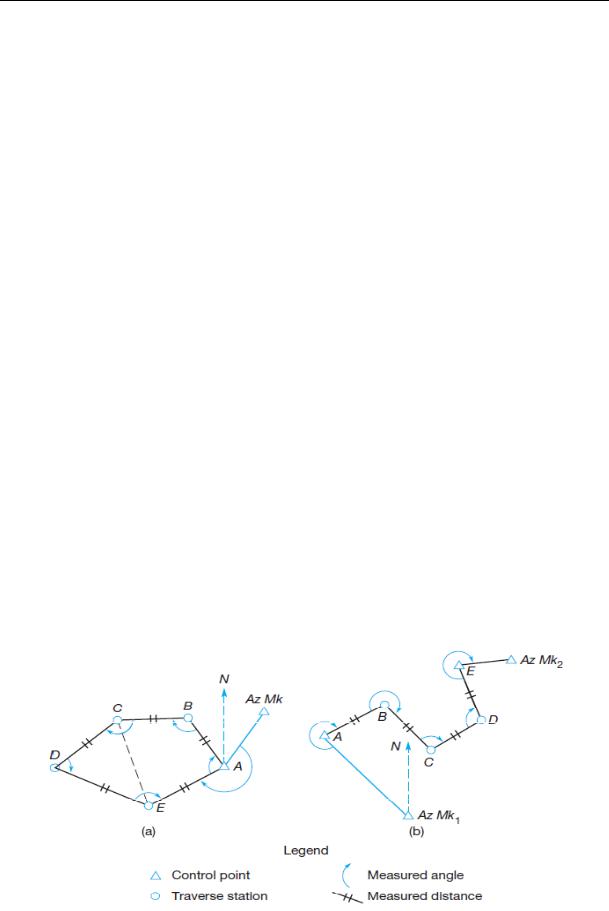
There are two kinds of traverses: closed and open (depending on the information constraints). Two categories of closed traverses exist: polygon and link. In the polygon traverse, as shown in Figure.1 (a), the lines return to the starting point, thus forming a closed Figure that is both geometrically and mathematically closed. Link traverses finish upon another station that should have a positional accuracy equal to or greater than that of the starting point. The link type (geometrically open, mathematically closed), as illustrated in Figure 1(b), must have a closing reference direction, for example, line E-Az Mk. Closed traverses provide checks on the observed angles and distances, which is an extremely important consideration. They are used extensively in control, construction, property, and topographic surveys [Ghilani & Wolf, 2012]. Figure 2 shows an example of open traverse.
Fig. 1. Examples of closed traverses [after Ghilani & Wolf, 2012]
40