Материал: The_Future_of_Hydrogen-IEA-2020
The Future of Hydrogen |
Chapter 5: Opportunities for hydrogen in transport, buildings and power |
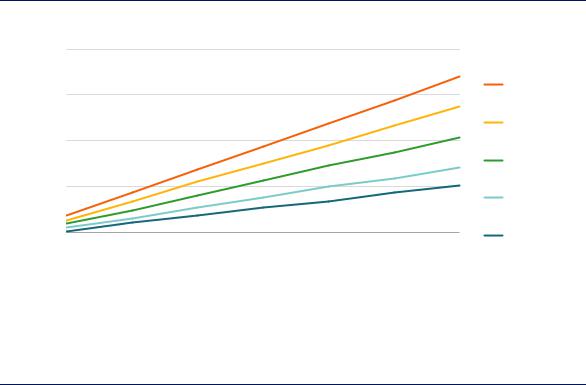
Currently hydrogen fuel cell cars are generally more expensive than battery electric cars, owing to the high cost of the fuel cell and fuel tanks and to the fact that they are generally designed to have a longer range (Figure 54). The competitiveness improves if one assumes the same range for FCEVs and BEVs, although such range would be only possible today for a limited number of BEV models. If cost reductions through economies of scale were to bring down fuel cell costs to USD 50/kW and those of batteries fall to USD 100/kWh, then FCEVs become competitive with BEVs at a range of 400 km. If fuel cell costs were only to fall to USD 75/kW, for example because of the need for durability requirements as discussed earlier in this chapter, then FCEVs would become competitive with BEVs at a range of 500 km (Figure 55). This underscores the fact that FCEVs can be economically attractive for consumers who prioritise driving range.
Utilisation of refuelling infrastructure is another determinant of the future competitiveness of FCEVs. In the initial roll-out phase, the cost of hydrogen fuel can be expected to range from 12% (at USD 9/kgH2) to 22% (at USD 18/kgH2) of the total cost of ownership. As discussed above, the additional cost accounted for by the hydrogen refuelling station depends on size and utilisation: stations with a capacity of 200 kgH2 per day that dispense fuel at 10–33% of capacity add a margin of USD 4–13/kgH2, and that margin declines with station size and higher capacity utilisation. The risk of underutilised hydrogen refuelling stations highlights the importance of securing high utilisation to bring down costs in the initial stages of FCEV deployment, even in cars, the mode where fuel costs are least determinant.
It is worth noting that in California it took around two years to increase the average utilisation of the network from 5% to 40%; the average station size is now around 200 kgH2/d (CEC and CARB, 2018) and some stations are still operating at below 10% utilisation (NREL, 2019). The high cost of synthetic fuel, however, suggests that transitioning to alternative powertrains – whether battery or fuel cell electric – is likely to be a lower-cost strategy for reducing CO2 and local pollutant emissions from cars and trucks, also considering the significant energy consumption and need for biogenic CO2 this route would require.
Figure 55. Break-even fuel cell cost to be competitive with BEV in the long term
(USD/kW) |
200 |
|
|
Battery price |
|
|
|
||
|
|
|
|
|
cell cost |
150 |
|
|
USD 150/kWh |
|
|
|
||
|
|
|
USD 125/kWh |
|
fuel |
100 |
|
|
|
-even |
|
|
|
USD 100/kWh |
Break |
50 |
|
|
USD 75/kWh |
|
|
|
||
|
|
|
|
|
|
0 |
|
|
USD 60/kWh |
|
100 |
300 |
500 |
700 |
Vehicle range (km)
Note: More information on the assumptions is available at www.iea.org/hydrogen2019.
Source: IEA 2019. All rights reserved.
Fuel cell electric cars are most competitive on a total cost of ownership basis with BEV cars over longer driving ranges. To break even with battery costs below USD 100/kWh could require achieving fuel cell costs below USD 60/kW.
PAGE | 136
IEA. All rights reserved.
The Future of Hydrogen |
Chapter 5: Opportunities for hydrogen in transport, buildings and power |
The above analysis suggests that BEVs and FCEVs could complement each other as alternative options satisfying different consumers, with FCEVs offering the best opportunities for vehicles driven at long ranges, with fast refuelling requirements and in regions with access to cheap hydrogen. Furthermore, it suggests that once a hydrogen refuelling infrastructure has been built out, light-duty FCEVs with different configurations (e.g. fuel cell range extenders) could take advantage of cost and performance improvements in both fuel cells and batteries.
Total cost of ownership of mediumand heavy-duty vehicles
The heavy-duty long-haul segment, including trucks and intercity buses (or “coaches”), offers strong prospects for hydrogen FCEVs because it calls for long range and high power requirements. As a result, heavy-duty FCEVs tend to be more immediately competitive against BEVs than in the case of cars. The direct electrification of regional bus operations and heavyduty trucking for long-distance freight both face major challenges with larger battery capacity, long charging times and high power requirements that translate into payload loss and additional recharging infrastructure costs. Fuel cellelectric trucks overcome some of these challenges.
In the case of heavy-duty long-haul trucks, fuel cell costs are higher than light-duty vehicle applications, mainly as a result of high durability requirements. This currently necessitates increased catalyst loading, translating into higher costs. Future fuel cell system costs for heavyduty trucks are estimated at USD 95/kW (for a production volume of 100 000 units per year) (US DOE, 2019). Even with current fuel cell costs, FCEVs could in general be competitive against BEVs in heavy-duty applications at ranges of more than 600 km if hydrogen could be delivered at less than USD 7/kgH2, although the exact hydrogen price at which they become competitive depends on overall annual mileage and other operational characteristics.
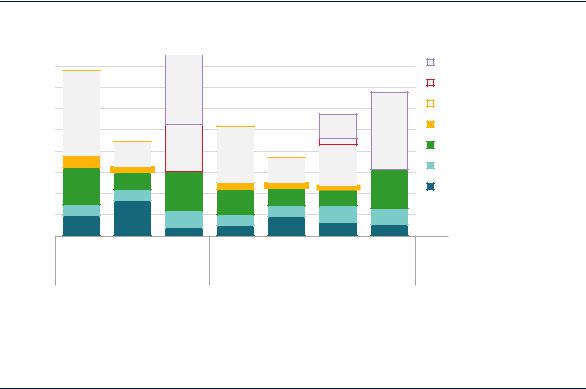
Figure 56.
(USD/km) |
1.8 |
|
|
||
|
1.6 |
|
ownership |
1.4 |
|
1.2 |
||
|
||
of |
1.0 |
|
|
||
cost |
0.8 |
|
Total |
0.6 |
|
|
0.4
0.2
Current and future total cost of ownership of fuel/powertrain alternatives in long-haul trucks
|
|
|
|
|
|
Synthetic fuel (air capture) |
|
|
|
|
|
|
Synthetic fuel (best case) |
|
|
|
|
|
|
Low utilisation of infrastructure |
|
|
|
|
|
|
Refuelling, charging |
|
|
|
|
|
|
Electricity, fuel |
|
|
|
|
|
|
Operations and maintenance |
|
|
|
|
|
|
Battery, fuel cell |
|
|
|
|
|
|
Base truck cost |
FCEV |
BEV |
Diesel ICE |
FCEV |
BEV |
Hybrid |
Diesel |
|
|
|
|
|
catenary |
Hybrid |
|
Today |
|
|
Long term |
|
|
Notes: The y-axis intercept of the figure corresponds to base vehicle “glider” plus minor component costs. Infrastructure covers stations, charging points and catenary lines. More information on the assumptions is available at www.iea.org/hydrogen2019.
Source: IEA 2019. All rights reserved.
Fuel costs make up about half of the total cost of ownership for heavy-duty trucks, so the focus for making them competitive should be on bringing down the delivered price of hydrogen.
PAGE | 137
IEA. All rights reserved.

The Future of Hydrogen |
Chapter 5: Opportunities for hydrogen in transport, buildings and power |
Powertrain and fuel options for decarbonising heavy-duty long-haul trucking include FCEVs, battery electric trucks, dynamic charging (catenaries are the most commercially advanced and lowest-cost option on existing roads)49 and conventional diesel hybrids using synthetic fuels (or advanced biofuels). Figure 56 considers diesel hybrids with 25 km of electric range on catenaries. A range of low-carbon powertrain options could conceivably co-exist: plug-in hybrid electric vehicles, BEVs with or without fuel cell range extenders and FCEVs of different configurations could be designed and ordered to cater to different mission profiles.
Bringing down fuel cell costs to USD 95/kW could make hydrogen fuel cell trucks in the heavy-duty segment competitive with diesel hybrid trucks at a hydrogen price of around USD 7/kgH2, compared with the price of USD 5/kg currently needed to make them competitive with an ICE truck running on diesel. For fuel cell electric trucks to be competitive with electric road systems or battery electric trucks at a range of less than 500 km, however, the hydrogen price would need to be less than USD 5/kg H2. Because of the limited size of the truck market, reaching this fuel cell cost target may not be feasible by deployment of fuel cells in trucks alone and will most likely rely on substantial deployment of fuel cells in cars. Fuel cell production for small mobile equipment, such as forklifts, may also help to bring down costs, but since the power requirements of this equipment is typically less than onethird that of a car, high production volumes of roughly 3 000 units per year would be needed to achieve cost reductions below USD 80/kW.
In the case of trucks (and also buses), the cost contribution from the infrastructure could be reduced by the operation of a “hub-and-spoke” model: a dedicated fleet operating on fixed routes could refuel at a single centralised hydrogen refuelling station. Since refineries and industrial clusters are often co-located at ports, port operations (and handling equipment) offer further attractive initial markets. The efficiency of these strategies has been demonstrated by the rapid adoption of hydrogen fuel cell electric buses and trucks in China, where the business case for intensive mediumand heavy-duty operations has been strengthened considerably by success in accessing low-cost hydrogen and achieving high utilisation rates of refuelling stations.
The maritime sector: Ships and ports
The maritime sector is an important consumer of oil products, accounting for around 5% of global oil demand. This section of the report focuses on international shipping, which is the cheapest way to move long-distance freight. By volume around 90% of global physical trade in goods is by sea, of which one-third is energy products, in particular oil products (IMO, 2014). About 80% of fuel use in the maritime sector is in international shipping, of which 90% is used for maritime freight. As a result, international shipping is an important contributor to climate change: it is responsible for around 2.5% of global energy-related CO2 emissions. As it uses heavy fuel oil, it also has large detrimental effects on air quality, notably around ports. Hydrogen, mostly in the form of hydrogen-based fuels, is a leading option for tackling these challenges in international shipping. One advantage of these applications is that they offer the opportunity to address not only emissions during sea transport, but also those arising from port operations, making use of synergies with forklifts, trucks and goods movement in
49 Catenary lines could provide energy to a diverse range of powertrains, including diesel hybrid electric vehicles, FCEVs and BEVs. However, they require the installation of substations and overhead catenary lines as well as retractable pantographs on trucks, increasing the investment risk. It is not clear how these costs would compare with the costs of fuel cell trucks or indeed battery electric trucks. Much like hydrogen, with a high enough utilisation rate of energy provision infrastructure, these costs can be offset by the cost and operational benefits of smaller batteries.
PAGE | 138
IEA. All rights reserved.
The Future of Hydrogen |
Chapter 5: Opportunities for hydrogen in transport, buildings and power |
and around ports (see Chapter 6). Opportunities also exist to use hydrogen and fuel cells for shorter routes within national jurisdictions, especially those operated by ferries.
How is hydrogen used in the maritime sector today?
Oil products currently dominate the shipping sector, and the use of hydrogen-based fuels in shipping is accordingly very limited. There is, however, one project in Belgium for co-firing hydrogen with diesel in maritime internal combustion engines, and more than 20 projects for fuel cells of up to 300 kW, mostly for auxiliary power units (DNV GL, 2017). Projects using fuel cells, often in combination with batteries, are planned in California (GGZEM, 2018), Ireland, Norway (AirClim, 2018) and for some Europe-wide operations.
Ships do not use ammonia as fuel today, but ammonia containing the equivalent of around 3.5 MtH2/yr is traded in ships. Several research and demonstration projects are looking at the firing of ammonia as fuel for ships (Brown, 2018). Satisfactory combustion of ammonia in existing engines would generally require ignition promotors (to overcome its lower ignition energy) and engine modifications.
Potential for hydrogen-based fuels in the maritime sector
The volume of international shipping is expected to more than triple by 2050 under current trends. In the absence of climate change mitigation policies, this could lead to a 50% increase in demand for oil products in the sector, to around 6 mb/d. Action to reduce the emissions associated with this oil use could open a pathway to the use of hydrogen-based fuels. The International Maritime Organization (IMO) has put in place strategies for reducing both sulphur and greenhouse gas emissions.
Possible measures to address the challenge of reducing sulphur emissions are the installation of scrubbers, fuel switching to LNG and the use of very low sulphur fuel oil (VLSFO), although these measures will only make a partial contribution to the 50% greenhouse gas reduction target by 2050 compared to 1990. As described in Chapter 4, limitations on sulphur emissions are likely to stimulate demand for hydrogen at refineries rather than as shipping fuel. To achieve the greenhouse gas emissions target, advanced biofuels, hydrogen and ammonia are all options, as well as hydrogen-based synthetic liquid fuels. The choice of fuel switching relies on infrastructure deployment outside the direct control of ship owners. LNG, hydrogen and ammonia would require the development of bunkering facilities, while both LNG and ammonia could build upon the existing distribution network. Availability and costs of advanced biofuels are uncertain as there is demand competition from other sectors for a limited supply of sustainable biomass.
Targets are also in place in some countries for low-carbon alternatives in domestic shipping. Sweden and Norway are two examples of this, while the European Commission is developing a strategy to set CO2 reduction targets for maritime transport based on monitoring, reporting and verification of CO2 emissions from large ships. Shipping may be incorporated into the European Emission Trading System from 2023.
Among businesses, Maersk, the world’s largest maritime company, announced in 2018 that it aims to become carbon neutral by 2050. To achieve this, it recognises that low-carbon vessels will need to be commercially viable by 2030 (Jacobsen, 2018). Industry leaders have also drafted an action plan to decarbonise the shipping sector, which includes demonstration projects, technology adoption, transparency and knowledge sharing (UNFCCC, 2017).
PAGE | 139
IEA. All rights reserved.
The Future of Hydrogen |
Chapter 5: Opportunities for hydrogen in transport, buildings and power |
Cost competitiveness of hydrogen-based fuels in the maritime sector
Ships have high per-kilometre energy intensity and large power needs (up to 130 MW for the largest container ships), and therefore pose demanding fuel requirements. The main cost components for ships are the same as for road transport: infrastructure (bunkering facilities), on-board equipment (fuel cell/engine and storage) and fuel.
Information on the costs of using liquid hydrogen for international shipping is uncertain. One estimate for the additional cost of bunkering facilities suggests that liquid hydrogen infrastructure could be 30% more expensive than LNG (Taljegard et al., 2014). However, this estimate is likely to omit the upfront costs associated with developing a new infrastructure for hydrogen that does not currently exist. The main cost components are the storage and bunker vessels, which would need to be scaled in parallel with the number of ships serviced. On-site or nearby hydrogen would be needed for small ports given the smaller flows and the high cost of dedicated hydrogen pipelines. Conversely, ship and infrastructure costs are a relatively small component of total shipping costs over a 15-year lifetime, with fuel costs being a much larger factor.
Among hydrogen-based fuels, ammonia is already globally traded and some of the infrastructure that would be needed to use it as a fuel already exists (distribution to ports and storage tanks). However, new bunkering facilities would need to be built; massive scale-up of ammonia production, port and distribution facilities and storage tanks would also be needed. As an indication, satisfying shipping demand in the long term would require 500 Mt of ammonia, almost three times the level of current global production and around thirty times the volume of ammonia currently traded.
A switch to low-carbon fuels seems unlikely to occur in the absence of policy, whether mandates, direct carbon pricing, and/or more flexible and potentially more palatable measures such as low-carbon fuel standards (LCFS) (ITF, 2018). Charterers, who currently oversee more than half of container fleet operations and who hire vessels from ship owners on a lump-sum or per-tonne basis, are likely to operate much shorter payback periods.
Ships serving long-distance maritime trade routes may offer the best potential scope for hydrogen, ammonia and other hydrogen-based fuels. This is because fuel cell system and hydrogen storage costs have a comparatively lower impact when compared to fuel costs (Figure 57). In addition, the space requirements of fuel cells could be an issue, especially for smaller ships (< 2 MW), as they need almost double the space of an ICE (Minnehan and Pratt, 2017; van Biert et al., 2016). Storage of liquid hydrogen requires at least five times more volume than conventional oil-based fuels, and ammonia requires three times more volume. In the longer term this could require the redesign of ships, shorter distance trips and more frequent refuelling, reduced cargo volumes, or a mix of these operational factors, depending on ship and cargo types and routes (UMAS, 2018).
Low-carbon fuels are expensive today compared with fuel oil and LNG (Figure 57). Fuel prices are the key to cost competitiveness; the share of total cost that comes from infrastructure is much lower for ships than for other transport modes, currently accounting for about 3% of the total cost of using hydrogen in shipping on the basis of a hydrogen price of USD 10/kgH2. This would rise to 17% if hydrogen prices were to decrease to USD 2/kgH2, and could be significantly higher (up to 40%) if bunkering facilities were oversized or underutilised. As for road transport, risks of underutilisation of bunkering facilities can be hedged by: rolling out smaller vessels; using smaller storage tanks (which can be expanded as the capacity grows);
PAGE | 140
IEA. All rights reserved.