Материал: The_Future_of_Hydrogen-IEA-2020
The Future of Hydrogen |
Chapter 5: Opportunities for hydrogen in transport, buildings and power |
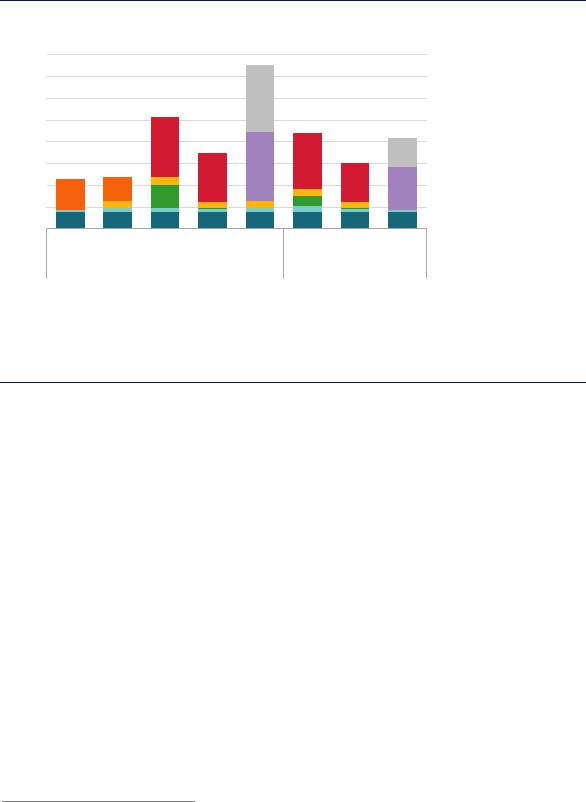
using tank trucks to fuel ships; and using a smaller refuelling station. However, to lower fuel costs, larger facilities would be needed for more widespread deployment.
Figure 57. Current and future total cost of ownership of fuel/powertrain alternatives in a bulk carrier ship
Total cost of ownership (USD/km)
80
70
60
50
40
30
20
10
0
 Synthetic fuel (air capture)
 Synthetic fuel (best case)
 Delivered hydrogen / ammonia
 Fossil fuel
 Infrastructure
 Storage
 Fuel cell / engine
 Base ship
VLSFO |
LNG |
ICE |
ICE |
Synthetic |
FC |
ICE |
Synthetic |
|
|
Hydrogen Ammonia |
fuels |
Hydrogen Ammonia |
fuels |
||
|
|
Today |
|
|
|
Long term |
|
Note: More information on the assumptions is available at www.iea.org/hydrogen2019.
Source: IEA 2019. All rights reserved.
Due to the cost of liquefying and high storage costs, hydrogen is likely to be more costly than other low-carbon alternatives for long-distance maritime transport.
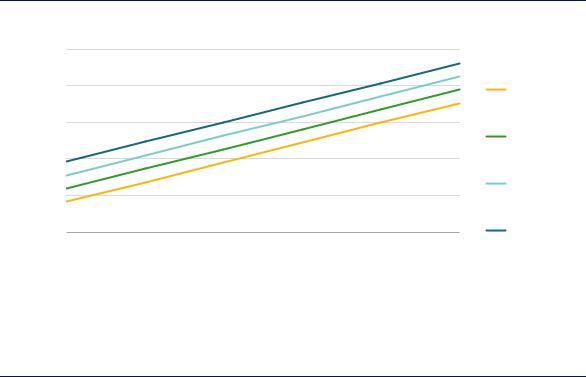
In a 15-year first-owner lifetime calculation, a CO2 price of USD 40–230/tCO2 would be required to make ammonia cost-competitive with fossil-based fuels, depending on the delivered cost of ammonia, which will vary by region (Figure 58). The break-even carbon prices for hydrogen are USD 35–45/tCO2 higher than ammonia, mainly due to the higher storage cost resulting from its lower energy density.50 It would represent a substantial cost increase for the ship owner and the switch would require policies that have an effect equivalent to these CO2 prices across competing fleets, for example mandates or low-carbon fuel standards. However, the impact of passing these costs on to the final consumer would be limited because transport costs represent a small share (often less than 1%) of the total price of shipped goods (ETC, 2018a).
50 This value would be higher for a charterer looking for three-year payback (charterers currently oversee more than half of container fleet operations (Global Ship Lease, 2019).
PAGE | 141
IEA. All rights reserved.
The Future of Hydrogen |
Chapter 5: Opportunities for hydrogen in transport, buildings and power |
Figure 58. Break-even carbon price for ammonia to be competitive with fossil fuels
(USD/tonne)price |
250 |
|
|
||
|
200 |
|
carbon |
150 |
|
100 |
||
-even |
||
|
||
Break |
50 |
|
|
||
|
0 |
20 |
35 |
50 |
65 |
80 |
95 |
Electricity price (USD/MWh)
Note: More information on the assumptions is available at www.iea.org/hydrogen2019. Source: IEA 2019. All rights reserved.
Oil price
USD 100/bbl
USD 80/bbl
USD 60/bbl
USD 40/bbl
For a bulk carrier, policies equivalent to a carbon price of USD 40–230/tCO2 would be needed to make ICE engines running on ammonia competitive with fuel oil. The break-even carbon price is highly sensitive to both the oil price and electricity price.
Rail
Rail is already the most electrified mode of transport. Although the percentage share of electrified tracks is still expanding in most countries, further electrification of rail networks is likely to come up against diminishing returns on investment, since highly utilised lines are the first to be electrified (IEA, 2019b). In France and Germany, for example, electrified lines now carry over 80% of traffic, even though less than half of the railway network has been electrified (European Commission, 2016). Beyond bi-mode diesel-electric options, several technologies offer zero tailpipe emissions on non-electrified tracks and the industry seems set to move towards these in the coming decades. The most innovative of such technologies are battery electric trains and hydrogen fuel cell trains. Battery electric trains with smaller batteries can also be used on partially electrified lines, enabling electrification costs to be sharply reduced by missing out those portions of track that are most difficult to electrify (such as bridges or tunnels).
Plans involving hydrogen trains already exist in a number of countries, with at least three companies working to supply them. Germany intends to expand the fleet of hydrogen trains to 14 by 2021 and 5 federal states have signed a letter of intent to purchase 60 trains from Alstom, with 27 ordered as of May 2019 (Schmidt, 2017). Two hydrogen trains that can travel almost 800 km a day on a single refuelling already operate in Lower Saxony in Germany (Alstom, 2018). Austria’s Zillertalbahn plans to deploy five hydrogen trains by 2022 for a total investment of almost USD 175 million. The UK government is supporting development of the first hydrogen trains by 2022 (Wiseman, 2019). The French government is similarly considering 2022 as the target for the first hydrogen train to be on the rails. Japan Rail East also has a project underway, in partnership with Toyota (Kyodo ,2018).
Under optimistic assumptions about fuel cell cost reductions, hydrogen trains could become competitive against other passenger services options with low frequency of utilisation
PAGE | 142
IEA. All rights reserved.

The Future of Hydrogen |
Chapter 5: Opportunities for hydrogen in transport, buildings and power |
(IEA, 2019b). Hydrogen fuel cell technology is most competitive for services requiring longdistance movement of large trains with low-frequency network utilisation, a common set of conditions in rail freight. The use of hydrogen in rail could be combined with its use for forklifts, trucks and other railyard and logistics hub machinery to decrease costs and improve flexibility.
Aviation
Aviation accounted for almost 2.8% of global energy-related CO2 emissions in 2017, and air passenger traffic is expected to more than double to almost 16 000 billion km/yr by mid-century under current trends. Efficiency improvements should reduce energy consumption and slow the increase in energy demand, but alternative fuels will eventually be needed to avoid increases in emissions from the sector. Advanced biofuels and hydrogen-based fuels are leading options.
While there have been feasibility studies and demonstration projects testing the scope for using hydrogen in small planes (DLR, 2016; Schilo, 2009; Airbus, 2000), the use of pure hydrogen as an aviation fuel requires significant further R&D. Hydrogen’s low energy density and the need for cryogenic storage would require changes in aircraft design, as well as new refuelling and storage infrastructure at airports. More projects – 130 in total in 2018 – are in development for the direct use of electricity than for pure hydrogen, mostly for urban air taxis (Thomson, 2018). However, direct electrification also faces challenges, specifically relating to battery weight and costs.
In contrast, hydrogen-based liquid fuels would require no changes to design or refuelling infrastructure at airports. Synthetic fuels based on electrolytic hydrogen (so-called power-to- liquid) are estimated to be four to six times more expensive than conventional jet fuel currently (see Chapter 2 for more information on the cost factors underpinning hydrogen-based fuels). Fuel represents a large share of the total costs of operating aircraft so this would significantly increase the operating costs and, presumably, ticket prices.51 This would be the case regardless of the cost of conventional jet fuel, which could itself become more expensive due to carbon pricing or other policies to reduce emissions. Estimates of the CO2 price that would be needed to encourage a shift to power-to-liquids in aviation in the long term vary widely, from USD 115/tCO2 to USD 660/tCO2, with the lower value accounting for the possible value provided to the wider energy system via the electricity grid (ETC, 2018a; Malins, 2017). Given the lack of other alternatives, most estimates place these costs among the higher abatement costs to complete the transition to a low-carbon energy system.
As with biofuels, the use of hydrogen-based fuels in aviation could be promoted through a target for blend shares. Even a modest target could help to demonstrate feasibility and support the scaling up of production. The standards development organisation, ASTM, currently sets blending limits for alternative fuels that vary by fuel from as low as 10% to up to 90%. These might provide a helpful reference point for public and private decision makers to set upper bounds, and could be updated as new engine technology emerges.
Besides on-board use of hydrogen in aviation, hydrogen is already used today in a few auxiliary power units that generate electricity when the jet engine is not running. Such units, which usually run on natural gas, can account for up to 20% of ground aircraft emissions (Baroutaji et al., 2019).
51 This could also help to decrease demand through price elasticity or shift between transport modes. It has been estimated that a fourfold increase in fuel prices in Europe could result in almost 60% higher ticket prices and 30% less demand (Murphy et al., 2018).
PAGE | 143
IEA. All rights reserved.

The Future of Hydrogen |
Chapter 5: Opportunities for hydrogen in transport, buildings and power |
Hydrogen as a fuel for heat in buildings
The global buildings sector accounts for 30% of global final energy use, nearly three-quarters of which is used for space heating, hot water production and cooking. Including traditional use of solid biomass in developing countries, related energy demand was around 2 200 Mtoe in 2017. Nearly half of this was produced directly from fossil fuels, with natural gas accounting for 620 Mtoe. Most of the rest came from conventional electric equipment (for example electric resistance radiators and cookstoves) and commercial heat (e.g. district heating), around 85% of which was produced using fossil fuels in 2017. Overall, nearly 28% of global energy-related CO2 emissions result from energy use in buildings.
Replacing heat provision with low-carbon alternatives and reducing heat demand through improving buildings is challenging. Decision-making for energy use in buildings is complex and depends on building type, location, ownership, customer preferences, equipment costs, energy prices and overall convenience, amongst other factors. This plurality of variables means that various energy sources and technologies are likely to co-exist in the future, from natural gas boilers to electric heat pumps, district heating and solar thermal heating. Hydrogen has the potential to contribute to the energy transition (e.g. through blending or methane production) and to long-term strategies for decarbonising heat (e.g. pure hydrogen production from renewables) (Table 6). In doing so, it can make use of existing building and energy network infrastructure to provide both flexibility and continuity.
Table 6. |
Potential routes to use hydrogen for buildings heat supply |
|
|
|
|||||||
|
|
|
|
|
|
|
|
|
|
|
|
|
Strategy |
|
|
Advantages |
|
|
Requirements |
|
|
Examples |
|
|
|
|
|
|
|
|
|
|
|
|
|
|
|
|
|
Low-cost solution |
|
|
Blending ratios to around 5– |
|
|
GRHYD project (2017) in |
|
|
Blending |
|
|
compatible with most |
|
|
20% in most instances. |
|
|
France. |
|
|
|
|
existing gas infrastructure |
|
|
Additional efficiency measures |
|
|
HyDeploy (2019) in the |
|
|
|
|
|
|
|
|
|
|
|
|||
|
|
|
|
and equipment |
|
|
to further abate CO2 |
|
|
United Kingdom |
|
|
|
|
|
|
|
|
|
|
|
|
|
|
|
|
|
|
|
|
|
|
|
STORE&GO (2016) |
|
|
Methane |
|
Full decarbonisation of gas |
|
Investment in methanation |
|
European project with |
||||
|
|
if low-carbon hydrogen |
|
plants. |
|
catalytic and biological |
|||||
|
produced |
|
|
|
|||||||
|
|
and low-carbon CO2 inputs. |
|
R&D to improve the efficiency |
|
methanation |
|||||
|
from clean |
|
|
|
|||||||
|
|
|
Utilisation of existing gas |
|
of methanation. |
|
(demonstration projects |
||||
|
hydrogen |
|
|
|
|
||||||
|
|
|
networks and equipment |
|
Carbon source, such as CO2 |
|
between 200 kW and |
||||
|
|
|
|
|
|
||||||
|
|
|
|
|
|
|
|
|
|
1 MW) |
|
|
|
|
|
|
|
|
|
|
|
|
|
|
|
|
|
|
|
|
Investment to upgrade gas |
|
|
The H21 Leeds City Gate |
|
|
|
|
|
Full decarbonisation of gas |
|
|
|
|
(> 2025) and the H21 |
|
|
|
|
|
|
|
|
network and equipment. |
|
|
|
||
|
100% |
|
|
if low-carbon hydrogen. |
|
|
|
|
Network Innovation |
|
|
|
|
|
|
|
Co-ordination between gas |
|
|
|
|||
|
hydrogen |
|
|
Lower efficiency losses |
|
|
|
|
Competition (NIC-2018) |
|
|
|
|
|
|
|
suppliers and distributors if |
|
|
|
|||
|
|
|
|
than synthetic methane |
|
|
|
|
projects in the |
|
|
|
|
|
|
|
|
various networks coexist |
|
|
|
||
|
|
|
|
|
|
|
|
|
United Kingdom |
|
|
|
|
|
|
|
|
|
|
|
|
|
|
|
|
|
|
|
|
|
|
|
|
|
|
|
|
|
Multiple energy services |
Investment in fuel cell or co- |
|
ENE-FARM programme in |
|||||
|
Use of fuel |
|
|
Japan (2009).* |
|||||||
|
|
(e.g. heat and electricity). |
generation technology. |
|
|||||||
|
cells and co- |
|
Energy Efficiency Incentive |
||||||||
|
Demand-side response |
R&D to improve the efficiency |
|
||||||||
|
generation |
|
|
Programme in Germany |
|||||||
|
|
potential |
of equipment |
|
|||||||
|
|
|
(2016)** |
|
|||||||
|
|
|
|
|
|
|
|
|
|
||
*Current ENE-FARM installations are running on natural gas or liquefied petroleum gas, mainly targeted at cost reduction.
**The programme includes fuel cell applications in buildings.
PAGE | 144
IEA. All rights reserved.

The Future of Hydrogen |
Chapter 5: Opportunities for hydrogen in transport, buildings and power |
How does the buildings sector use hydrogen today?
Hydrogen is very little used as a source of energy in the global buildings sector today, although various potential uses are now being trialled. There are currently 37 demonstration projects examining hydrogen blending in the gas grid (see Chapter 3 for more information). In the United Kingdom, where high heating demands have focused attention on heating solutions, H21 North of England is the largest project and is proposing to supply 100% hydrogen by pipeline to buildings. This project targets hydrogen supply of 180 ktH2/yr by 2025 and 2 MtH2/yr by 2035, following studies in 2016 confirming the feasibility of reusing the existing pipeline network (Northern Gas Networks, 2018).
There are in addition micro co-generation and fuel cell hydrogen demonstration projects in Europe and Asia, notably the ENE-FARM project in Japan (Box 14). In Europe, the ene.field demonstration was launched in 2012 and has installed more than 1 000 small stationary fuel cell systems for residential and commercial buildings in 11 countries, with plans to increase this to 2 800 units (Ravn Nielsen and Prag, 2017). In Germany, consumers can access government funding to offset the extra cost for fuel cell appliances in buildings (KfW, 2018). Projects are also being prepared for the demonstration of digital systems to facilitate renewables integration with the storage and supply of electricity and heat in one or multiple buildings, for example in the United Kingdom.
Box 14. The ENE-FARM programme in Japan
ENE-FARM is a large scale fuel cell demonstration and commercialisation programme aiming to deliver efficient and affordable fuel cell technologies for building applications. The first system was introduced in a residential building in 2009 and close to 300 000 units are expected to be in operation by 2020. The programme aims to install 5.3 million units by 2050. At present ENE-FARM units reform natural gas or liquefied petroleum gas in situ to feed a fuel cell with hydrogen. The use of fossil fuels leads to limited CO2 reduction benefits, but aids delivery of cost reductions that will help to pave the way for low-carbon hydrogen distribution once it becomes economically attractive. The initial cost per unit has come down by 75% in almost 10 years (from more than USD 35 000 to around USD 9 000 in 2018 (Nagashima, 2018).
Source: Nagashima (2018), Japan’s Hydrogen Strategy and Its Economic and Geopolitical Implications.
Potential for future hydrogen demand in buildings
Hydrogen will not make sense for all building applications, and numerous factors will influence eventual hydrogen demand in buildings, including existing natural gas infrastructure, heat densities, other building energy needs and safety considerations. There are barriers related to cost and consumer acceptance, and a variety of policy design challenges, which is why hydrogen use is currently limited to localised operations and larger-scale demonstrators such as those programmes described above. But there are lots of opportunities as well, which are centred around two main options. The first is hydrogen blending in existing natural gas networks. The second is direct use of hydrogen for heat production in buildings. Hydrogen could also be used indirectly to heat or cool local district energy networks that then supply buildings.
PAGE | 145
IEA. All rights reserved.