Материал: Uchebnik_dlya_sud_expertov
TEXT
BUSINESS ENGLISH
Within the past decades the popularity of Business English has increased enormously. There is hardly a specialist who can function effectively if he doesn’t know English; there is hardly a company that doesn’t use English as the language of business communication. A large number of international companies have set up their representative offices in our country, offering new positions and challenging opportunities. But Business English is used not only by specialists on the job; ordinary people often find themselves in different situations when it’s almost impossible to do without Business English.
What is Business English? Traditionally Business English was referred to English for Specific Purposes together with English for Academic Purposes and English for Science and Technology. Within this classification Business English was naturally viewed as the language for trade and commerce. This traditional understanding of the word “business” was and still is reflected in modern dictionaries, which define it first of all as “the activity of buying and selling goods and services”.
However, life changes and attitudes do too. In the first place these changes have affected the meaning of the word “business”. Thus computer dictionary ABBY Lingvo defines “business” as any occupation, trade or activity, which is opposed to “doing nothing, being idle”. This last definition proves that Business English may have a very wide sphere of application and people may use it not only at work where they have to communicate with foreign colleagues, partners and customers but out of work as well. Being an active member of a society and living according to its laws we always get involved into various situations which require from us a good command of Business English. We meet with different people, apply for a job, book tickets, order and buy overseas goods through the Internet, get and transfer money, arrange trips, go abroad on business or just have a rest. It is almost impossible to cope with these situations if you don’t have at least elementary business communication skills.
Traditionally Business English is divided into General Business English and Professional Business English. General Business English may be used both by professionals and nonprofessionals in various contexts and circumstances. As a rule people speaking General Business English use common words and word combinations but in a new business context. There are a lot of examples when familiar words acquire new meanings when we start using them for business communication. Thus, “to run a company” means to manage a company, “to be short of time or money” means not to have enough time or money.
Phrasal verbs are also rather frequent in the language of business communication. It is very important to learn and understand their meaning not to get into embarrassing situations. For example phrasal verb “to look forward to” which is often used in business correspondence, means that you’ll be happy to receive a reply; the verb “to get through”, which appears in telephone talks, means to reach somebody by phone. Prepositions having both lexical and grammar functions play a rather important part in Business English. Failure to use a correct preposition may not only mislead your partner but ruin the act of communication. For example, we say “to advise on” when we ask our partner to give us advice on a subject he or she knows very well (He advises us on tax matters). If we say “to advise of” we will mean that we want to inform somebody about something. (We’ll advise you of any changes in delivery).
The sphere of application of Professional Business English is usually narrower than of General Business English as it is used only by professionals who work in a particular area. The main peculiarity that differentiates Professional Business English from General one is the use of terms. Thus people who work in finance will definitely come across such expressions as interest rates or cash flow which may not be clear enough to an ordinary person. Professional legal English known as “legalese” employs a lot of Latin borrowings (e.g. actus reus, mens rea) which are also considered to be terms. All these examples prove that it’s impossible to be fluent in Professional Business English without being an expert in the particular sphere.
91

7. ! .
1. language of business communication |
a. " & |
|
||
2. to do without Business English |
b. $ |
|
||
3. to be reflected in modern dictionaries |
c. $ |
|
||
4. to define |
d. |
$ |
|
|
5. attitude to smth |
e. $ |
|
||
6. to affect the meaning of the word |
f. $ |
"- |
||
|
|
|
|
|
7. to have a wide sphere of application |
g. |
|
||
8. to require a good command of English |
h. & - |
|
||
9. to apply for a job |
i. $ |
|
||
10. to book a ticket |
j. $ " |
|||
11. to order overseas goods |
k. ) - |
|
|
|
12. to arrange trips |
l. $ |
|
||
13. to have business communication skills |
m. |
|
|
|
14. to acquire a new meaning |
n. $ |
|
||
15. to get into an embarrassing situation |
o. $ |
|
||
16. business correspondence |
p. $ ) # |
|||
17. to mislead smb. |
q. $ |
|
|
|
8..
1.How did Business English use to be defined?
2.How is Business English defined nowadays? What does this definition prove?
3.How is Business English used in our everyday life?
4.What are the subdivisions of Business English?
5.What are the peculiarities of General Business English?
6.What is the sphere of application of Professional Business English?
9.% ! ! & . , &
! . !" -
& ! & -
. - $# . + - #' :
•It will give you a good chance – ' ) " )
•You will have a wonderful opportunity – $ &-
$
• You will be able to… - &
•Moreover – /
•In addition - ( , &
•It goes without saying – "
•It’s a proven fact that… - ' " # , …
92
10., “Business English” . * '
( ? - ( -
.
11., ! ' . ( & ! .
1.I have put your name down on the list.
2.They have decided to put off the meeting till next week.
3.He has to put up with a lot of unfair criticism.
4.Hello, this is Mark from Finance department. Could you put me through to the Sales department, please?
5.It’s difficult to get on with our new Boss; he is so bad-tempered.
6.These talks are useless, let’s get down to business.
7.I’ m looking forward to seeing you soon.
8.I’ve looked through your report; some important information is missing.
9.I can’t make out what you are talking about. Could you speak up, please?
10.The wonderful food in the restaurant made up for the uncomfortable seats.
11.- Will you tell your boss about your plans?
– Only if the subject comes up in the conversation.
12.Recently I’ve come across someone who has done an almost identical study, so I have to come to the decision: do I want to go on making research on this subject or shall I choose anything else?
12.11, -
#' # # .
1.Frank: I thought you were at the presentation yesterday.
Ken: I was intending to go, but right at the last minute something urgent __________.
2.The other day I have _________ some shocking fact about government corruption.
3.As soon as I saw the manager of the project I knew we were not going to ________ well.
4.We have too many urgent things to do. If we want to meet the deadline, we have to
______________ business immediately.
5.Since I sent my CV to this company I have been ___________ their reply.
6.You don’t have to read the whole description, you may ________ it _______ to get the general idea.
7.I can’t _________ why my computer won’t save this document.
8.We are late, so we have to work hard to ___________ the lost time.
9.I think people won’t __________ this policy any longer. They will take some measures soon.
10.If you don’t know his extension number, call directly to the company he works for and ask to _______ you__________.
13., .
1.A & $, ) , & -$ $ .
2.$ . > " " .
3. |
- ) , . |
4. |
A $ - , & " , &$ . 3 - |
|
& $ ) . |
5. |
# % . |
93
6.@, & &$ ) ..
7. - , " & $.
UNIT 2. TYPES OF BUSINESS COMMUNICATION
1. % ! ! & , !", #'
.
Communication |
Business |
|
Communication |
||
|
Business
English
Non-verbal
Communication Cross-cultural
Communication
2. . -
. .
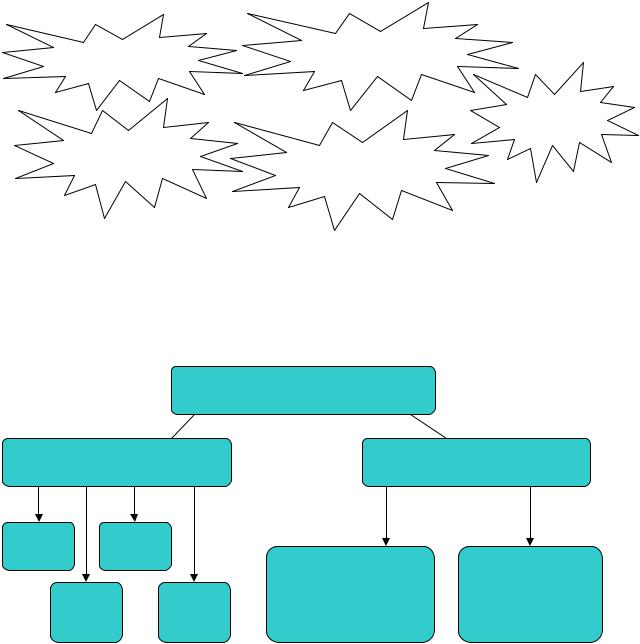
Types of Business Communication
_____________?___________ |
_____________?___________ |
memo |
fax |
|
|
|
|
|
_________?_______ |
Communication |
|
|
|
1. |
meetings |
by phone |
___?__ |
___?__ |
2. |
negotiations |
|
|
|
3. |
presentation |
|
94
TEXT
In the business world, communication is the oil that keeps corporate machines running. It is the glue that holds small businesses together. Business is all about building and maintaining relationships with partners, employees, or customers. Everything from employee satisfaction to productivity and efficiency relies on good communication. In business there is hardly any room for errors in communication. A miscommunication at high levels of a company can make a huge loss. That is why it is important for everyone from top management to the lowliest employee to understand how to communicate his or her ideas, instructions and expressions with the utmost clarity. There are some types of communication that are used in business.
Oral communication is probably the most important form of communication in business. Information is passed on, feedback is received and relationships are formed using spoken words. Spoken communication often combines verbal communication and non-verbal communication, such as tone of voice, body language, etc. Sometimes the meaning of what someone says can change completely when a different tone of voice is adopted. In customer relations, especially, it is important to be aware that tone of voice, intonation, and body language play an important part in communicating. In customer service, the words must be accurate, clear, leaving no room for ambiguity and the tone of voice, body language, and intonation need to communicate confidence and understanding. Oral communication is divided into face-to-face communication and communication by phone.
According to the survey conducted among business professional face-to-face communication is considered to be the most important and essential type of communication in business. Face- to-face meetings build stronger, more meaningful business relationships. It is also easier to read body language and facial expressions and interpret non-verbal communication signals. Respondents agreed that face-to-face communication is best for persuasion, engagement, inspiration, decisionmaking, and reaching a consensus.
When face-to face communication is impossible the easiest and the most convenient way to contact your business partner is by phone. But as telephone communication lacks the visual element present in face-to-face communication, the auditory element becomes the principal conveyor of meaning. For this reason, effective telephone use requires greater attention to speaking clearly and listening attentively than in case of face-to-face communication.
Business writing is a critical aspect of how people can share information with each other in an efficient, professional manner. Formality is an important element of how business writing is conducted today. In fact, each document is considered to be a legal document, which you can always refer to. There are a few types of business writing that people may come across at work: emails, letters sent by post, faxes, memos, minutes, taken at the meetings, summaries, etc. People use business writing to ask for a job, to make inquiries, to order some goods, to make complaints, etc. The main feature of business writing that unites all forms (memos, emails, letters, documents, etc.) together is the style. No matter what kinds of documents you are writing, you have to be concise, clear, and to convey information in an effective way.
3. . + .
Models:
In my opinion – #
I think (believe) – # (#)
I’m sure that … – 6 , …
1.Non-verbal communication doesn’t play an important part in doing business.
2.Oral communication often combines elements of verbal and non-verbal communication.
3.Communication by phone is the best way of decision-making and reaching a consensus.
95