Материал: Uchebnik_dlya_sud_expertov
MODULE 7
LAW OF RUSSIA
UNIT 1. TRAVELLING AND SIGHTS.
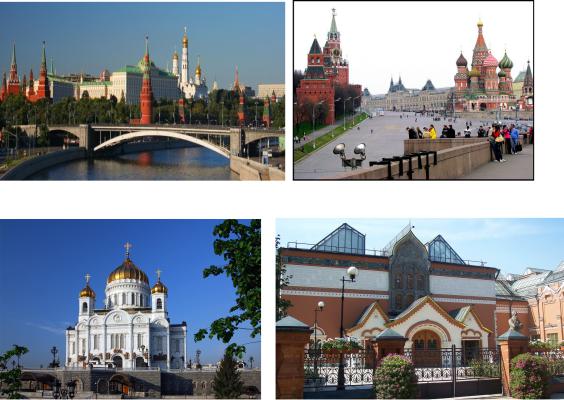
The Kremlin |
Red Square |
The Cathedral of Christ the Savior |
The State Tretyakov Gallery |
1..
1.Do you like travelling?
2.Do people travel much nowadays?
3.Why do people travel?
4.How can people travel?
5.Is Russia attractive for foreigners? Why?
6.What is the capital of Russia?
7.What famous sights of Moscow do you know?
8.What do you know about the history of Moscow?
2., ( -
, . .
176
Russian customs and traditions, ancient architecture, Russian orthodox cathedrals, churches and monasteries, icon painting, the Bell Tower of Ivan the Great, the State Kremlin Palace, the Tsar Cannon and the Tsar Bell, old mansions and monuments, a huge gilded dome, redbrick walls, museums.
3. .
-Is it your first visit to Moscow?
-Yes, and unfortunately I haven't got much time.
-So what are you going to do while you are here?
-Well, I don't know much about Moscow, you know. Just the Kremlin and Red Squire.
-You've just got two days, haven't you? You are going to be pretty busy if you want to see all the sights.
-I'm planning to start early tomorrow morning. What should I do first?
-I think you should start with the Kremlin. The Kremlin is in the center of Moscow. It is an outstanding historical and architectural monument that serves as a symbol for the whole Russia. You have to do that.
-It sounds great. I'll definitely do that. Tell me where Red Squire is.
-It is located in front of the Kremlin's western wall. The square is fenced in the State Historical Museum building, the GUM building, and St. Basil Cathedral. For many centuries Red Square has served as the place for important historical events. Red Square was founded at the end of the 15th century.
-What else do you recommend?
-Well, it depends on what you like - art, shopping, theatre?
-Well, not shopping particularly. But I'd like to see an art gallery or two.
-Oh, then you must go to the State Tretyakov Gallery. It is the most important storehouse of Russian art in the world. It is renowned for its collection of famous Russian icons and masterpieces by Russia's artistic geniuses, including Repin, Vrubel, Kandinsky, Malevich and others. It is situated on two territories, separated from each other by several city districts. It gives the opportunity to represent the whole history of Russian art from the ancient period to our contemporaries.
-Right.
4.% ! . !$ &
.
5.. . , - # $# #.
.
1.‘Kremlin’ is actually the term given for the fortified stronghold of any city, and many other kremlins exist in large towns throughout Russia and acted as seats of power for local rulers.
2.Italian architects were brought in to build new fortified walls and a number of cathedrals - including the Cathedral of the Assumption.
3.Constructed from the 15th century right up to the 20th, you will find a number of different architectural styles in these edifices.
4.Unfortunately the government buildings and palaces can only be seen from the outside, but several hours can still be spent touring the site, admiring the various cathedral interiors and soaking up a profound sense of history.
5.The Cathedral of the Archangel was the burial place of the Tsars until 1712 when the capital was moved to St. Petersburg. Forty-six tombs are found in this cathedral, including those of Ivan the Terrible and his young son Dmitry.
177
6.The Granovitaya Chamber designed by Marco Fryazin and Pietro Antonio Solari in 1487-1491, served as a gala throne hall of Ivan III.
7.Moscow captured by French troops in 1812 was looted and burnt, and the Kremlin was badly damaged.
8.The complex consisted of the Great Kremlin Palace, constructed on the site of the Winter Palace, the building of Apartaments and the new Arsenal building that was more solemn than the previous one.
6.( .
Johnny Manglani is the owner and president of Uomo Collezioni. In 1998 he started developing a network of multi-brand boutiques of luxury menswear under the trade name Uomo Collezioni. Today, Uomo Collezioni network consists of six boutiques in Moscow and one in Saint-Petersburg.
Interviewer: 3 , 3 " ?
J. M.: In 1983. Then I came to the capital of the Soviet Union to carry out a market research on my own.
Interviewer: ( ) ? + $.
J.M.: When I came in Moscow for the first time the city seemed dark to me — that is the feeling I had then as I remember it. As for now, the city has greatly changed.
Interviewer: ( $ ? (in your household)
J.M.: Bathhouse, strong friendship and traditional Russian meals, e.g. beetroot and cabbage soup (borsch).
Interviewer: ! $ $ ?
J.M.: Russians are very sincere: they either understand you with all their heart and become your friends, or they reject you without making any pretence of being interested in you. I have a lot of friends in Moscow and in Russia, I have a wonderful family, I love local culture and ethnic cuisine.
Interviewer: $ 3?
J.M.: The life itself is a challenge and if you take difficulties as a part of your life, then you can easily accept and overcome them.
Interviewer: " " $ $ 3?
J.M.: Road traffic management. It’s very difficult to drive around Moscow.
Interviewer: @ , # «- 3 …»
J.M.: I love Moscow for its being a very dynamic city. It always makes me want to move on!
7.% ! # # .
1.It's possible to travel all over the city inexpensively and easily (used, using) the metro.
178
2.(Decorated, decorating) in fine materials by master craftsmen, the Moscow metro stations are a unique and impressive aspect to Russia's transit system.
3.With Red Square and the Kremlin (formed, forming) the very centre, the innermost ring road is the Boulevard Ring (Bulvarnoye Koltso), (built, building) in the 1820s.
4.The recently (constructed, constructing) Third Ring is not much use for tourists but is a heavily (used, using) motorway which absorbs a bit of Moscow's traffic.
5.Tverskaya Street is lined with cafes, restaurants, coffeehouses, a couple of theaters, and several hotels, (included, including) two locations of the Marriott Hotel.
6.Moscow remains the educational center of Russia. There are 222 institutes of higher education, (included, including) 60 state universities & 90 colleges.
UNIT 2. STATE INSIGNIA
: Complex Subject. *$ « - '».
2 |
1 |
2 |
3 |
|
|
|
( % 1 1,-,91 |
|
|
|
|
/012)311 |
*) 41 1 |
+,-+,+ +( |
:01,9 |
%1/0 21,+6 |
|||
|
|
|
|
|
|
|
|
2 |
1 |
2 |
3 |
The State |
is expected |
to ratify |
the treaty. |
$ & „ " (& „ "),& & &
&, |
# % . |
|
|
1 |
2 |
2 |
3 |
#, |
|
$ |
. |
@ # # (to V, to be + V3# - , to
be + Ving – $ ; to have + V3 – ) " $ ",& &, & & -).
1. . $# Complex Subject.
, & . ,
.
1.Moscow is known to be the capital of the Russian Federation.
2.The three-colour flag is considered to have become the state flag of Russia in 1993.
3.From the middle of the 19th century the tricolor was meant to symbolize the unity of the three East Slavonic nations.
4.The white stripe was meant to symbolize freedom and independence.
5.The red colour was thought to be a symbol of power and sovereignty.
6.The three crowns originally were thought to symbolize the three great khanates conquered by Russia.
179
7.The national anthem of the Russian Federation is known to have been composed by Alexander Alexandrov on lyrics of Sergey Mikhalkov.
8.The new anthem is known to have been adopted in late 2000.
9.The new anthem is reported to be liked by 81% of the population.
2.. $# Complex Subject.
, &. , -
, : appear ( ), seem ( ), happen ( ), prove ( ), -
, : - , ,
.
1.This classification appears to be similar to that used by foreign jurists.
2.She seems to be preparing a report about the state insignia of the Russian Federation.
3.The results presented here appear to support the views described above.
4.This politician seems to be losing his popularity.
5.These ideas proved to be ignored by society.
6.The anthem happened to be amended again in 1977 to introduce new lyrics written by S. Mikhalkov.
7.With more international business and travel and a growing awareness that many socioeconomic and environment problems need global solutions, the future of the world of law appears to be one of internationalization.
3.. $# Complex Subject.
, & . , -
, to be likely to be unlikely .
1.The Cathedral of Christ the Savior is likely to be the highest Orthodox cathedral in the world.
2.The Tretyakov Gallery is likely to have the largest collection of icons.
3.The situation with road traffic in Moscow is unlikely to be better in the near future.
4.The Moscow underground is likely to be one of the most beautiful in the world.
5.This law is unlikely to be passed.
4.& , $# Complex Subject.
1.It is known that Peter the Great was proclaimed tsar in April 1682.
2.It is said that Peter the Great was one of enormous strength and energy.
3.It is supposed that Peter the Great was seven feet tall and powerfully built.
4.It appeared that he had been in a constant state of restless activity, taking on himself tasks normally done by several men.
5.It is certain that Peter the Great had some remarkable qualities of mind and character in addition to his extraordinary physical attributes.
6.It seemed that Peter the Great had participated personally in all kinds of state affairs: diplomacy, administration, justice, commerce, industry, education, etc.
180