Материал: Апсе ENVIRONMENTAL PROTECTION 2014
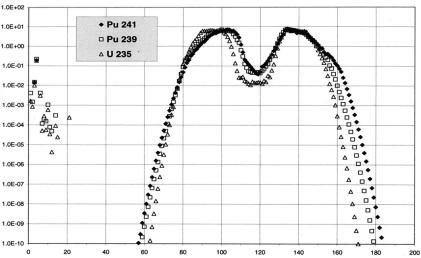
Fig. I.1. Dependency of FP yields on their atomic mass
Fission products consist of about 200 radioactive isotopes belonging to 36 chemical elements including daughter products of their radioactive decays. Half-lives of these radionuclides cover the very broad time range: from several milliseconds up to several million years. Depending on half-lives, the following FP categories can be marked out: shortlived, middle-lived and long-lived nuclides. Main type of FP radioactivity is a β-decay. Each radioactive FP is a starting isotope for decay chain consisting of 4-5 consecutive decays and ending by a stable nuclide.
Besides fission products, spent nuclear fuel contains also transuranium isotopes, intense emitters of α- and β-radiation. A particular attention should be given to minor actinides (MA) consisting of 237Np (neptunium fraction), 241Am and 243Am (americium fraction), 244Cm and 245Cm (curium fraction). Chemical properties of minor actinides are very close to those of rare-earth fission products. Therefore, at the stage of SNF reprocessing and FP extraction, minor actinides and rare-earth FP are removed together. As a consequence, a special RAW category is being formed, namely MA-containing RAW. All minor actinides are fissile or fertile nuclides. That is why minor actinides must put under
16
strict control in order to prevent proliferation of weapon-suitable nuclear materials.
Main channels for MA generation in nuclear reactors are as follows: 1) 235U(n,g)236U(n,g)237Np;
2) 241Pu(b-, 14 лет)241Am(n,g)242mAm(n,g)243Am(n,g)244Cm(n,g)245Cm; 3) 242Pu(n,g)243Am(n,g)244Cm(n,g)245Cm.
MA generation rates are presented in Table I.2 for LWR loaded with traditional uranium oxide (UOX) fuel and with advanced mixed ura- nium-plutonium (MOX) fuel.
|
|
|
|
|
Table I.2 |
|
|
Generation rate of minor actinides in LWR |
|
|
|||
|
|
|
|
|
|
|
|
|
|
MA generation rate, |
|
||
Nuclide |
|
Т1/2, years |
kg/GWe×year |
|
||
|
|
|
UOX |
|
MOX |
|
237Np |
|
2,1×10⁶ |
20,4 |
|
15,1 |
|
241Am |
|
432 |
1,3 |
|
6,0 |
|
243Am |
|
7380 |
2,5 |
|
21,8 |
|
244Cm |
|
18,1 |
0,9 |
|
15,6 |
|
245Cm |
|
8500 |
0,1 |
|
1,7 |
|
Total |
|
- |
25,2 |
|
60,2 |
|
Significant fraction of SNF b- and g-activity is caused by short-lived FP. Therefore, SNF radioactivity rapidly decreases with time after SNF withdrawal from the reactor core. Residual heat generated by spent FA in the cooling pool is mainly caused by FP and MA radioactive decays. Time dependency of residual heat generation rate is quite similar to the aforementioned time dependency of SNF radioactivity - rapid exponential slump just after withdrawal followed by gradual approach to a plateau level constituting several percents of nominal reactor power.
The induced radioactivity of steel in-vessel structures is mainly caused by the following radionuclides: 63Ni (Т1/2 = 100 years), 60Co (Т1/2 = 5,3 years) и 55Fe (Т1/2 = 2,7 years). These radionuclides are produced by neutron irradiation of stable chemical elements, components of stainless steels. Total radioactivity of steel LWR structures is equal to
17
50 MCi (BWR) and 5 MCi (PWR) at the reactor shutdown. Afterwards, the total radioactivity rapidly decreases and gradually (in the process of 20-30–year staying in the cooling pool) approaches to the plateau (1 MCi for BWR-type reactors and 0,1 MCi for PWR-type reactors), approximately 2% of initial radioactivity.
The induced radioactivity of metal NPP structures becomes more and more urgent problem as NPP lifetime expires.
Nuclear fuel, being involved into the processes of its fabrication, usage and reprocessing, passes a series of consecutive stages which can be united into a general concept of nuclear fuel cycle (NFC).
Main NFC stages
1.Mining of uranium ores and uranium extraction.
2.Nuclear fuel fabrication:
2a. Production of uranium concentrate in the form of uranium octaoxide U3O8.
2b. Conversion of uranium concentrate into uranium hexafluoride UF6.
2c. Uranium enrichment with 235U.
2d. Manufacturing of fuel rods and fuel assemblies.
3.The use of nuclear fuel in nuclear reactors of various types (pluto- nium-producing, power or research reactors).
4.Interim storage of spent fuel assemblies (SFA) in the cooling pools at NPP.
The following two options may be chosen for the next NFC stages, namely once-through, or open NFC and closed NFC.
If the open NFC option was chosen, then:
5.Transportation and ultimate disposal of SFA in deep geological formations. This stage is a final step of the open NFC.
If the closed NFC option was chosen, then:
6.Transportation of SFA to a spent fuel reprocessing plant.
7.Extraction of radioactive wastes, their treatment and ultimate disposal in deep geological formations.
8.Extraction of primary and secondary nuclear fuel for multiple uses (recycles) in re-fabricated fresh fuel rods and fuel assemblies. In reality, this is a return to point 2.
18
The following three NFC variants can be marked out:
A. The open NFC
Main stages of the open NFC:
1.Mining of uranium ore.
2.Production of uranium concentrate U3O8.
3.Conversion of uranium concentrate U3O8 into uranium hexafluoride UF6.
4.Isotope uranium enrichment.
5.Fabrication of nuclear fuel in form of fuel rods and fuel assemblies.
6.Use of nuclear fuel in nuclear reactors.
7.Interim SNF storing in the cooling pools at NPP.
8.Ultimate disposal of SNF in deep geological repositories.
B. The closed NFC with uranium recycle
Main stages of the closed NFC:
1.Mining of uranium ore.
2.Production of uranium concentrate U3O8.
3.Conversion of uranium concentrate U3O8 into uranium hexafluoride UF6.
4.Isotope uranium enrichment.
5.Fabrication of nuclear fuel in form of fuel rods and fuel assemblies.
6.Use of nuclear fuel in nuclear reactors.
7.Interim SNF storing in the cooling pools at NPP.
8.SNF reprocessing: separation of uranium, plutonium and radioactive wastes.
9.Recycle of extracted uranium to the stage 4, i.e. to the isotope uranium re-enrichment.
10.Plutonium storing in the dedicated warehouses.
11.Ultimate disposal of RAW in deep geological repositories.
C. The closed NFC with uranium and plutonium recycle
Main stages of the closed NFC:
1.Mining of uranium ore.
2.Production of uranium concentrate U3O8.
3.Conversion of uranium concentrate U3O8 into uranium hexafluoride UF6.
19
4.Isotope uranium enrichment.
5.Fabrication of nuclear fuel in form of fuel rods and fuel assemblies.
6.Use of nuclear fuel in nuclear reactors.
7.Interim SNF storing in the cooling pools at NPP.
8.SNF reprocessing: separation of uranium, plutonium and RAW.
9.Recycle of extracted uranium and plutonium to the stage 5, i.e. to the fabrication of mixed oxide fuel.
10.Ultimate disposal of RAW in deep geological repositories.
These variants of NFC schemes are sown in Fig. I.2.
Presently, only seven states are able to reprocess spent nuclear fuel: the USA, Great Britain, France, Russian, China (nuclear powers), India and Japan. But the US administrations decided to stop reprocessing of spent fuel assemblies discharged from commercial NPP till effective and proliferation-proof SNF reprocessing technology is developed.
Currently in the world there are the following two opposite and controversial viewpoints on reasonability of the NFC closure:
1. The NFC closure is an unreasonable action because it assumes radiochemical SNF reprocessing, extraction, transportation and application of primary fuel (mainly, regenerated uranium) and secondary fuel (mainly, plutonium) for re-fabrication of fresh nuclear fuel. Thus, the NFC closure creates a series of complicated technological and political problems, including:
a.Possibility for terrorist groups to steal fissile materials for manufacturing of nuclear explosive devices.
b.Complicacy and jeopardy of SNF reprocessing technologies.
c.Complicacy and jeopardy of RAW treatment and ultimate disposal in geological repositories.
This viewpoint is held by the US Government. The US Presidents Ford and Carter, in the late 1970s, prohibited radiochemical reprocessing of SFA discharged from commercial nuclear power reactors. However, scientific investigations of the problems related with SNF reprocessing and recycle were continued but within a reduced scope. Spent fuel assemblies are considered as a RAW form suitable for ultimate disposal in deep geological repositories. The RAW repositories must be equipped with some technical tools capable to retrieve SFA containers for further reprocessing, if target priorities in the US nuclear policy would be changed.
20