Материал: Крючков Фундаменталс оф Нуцлеар Материалс Пхысицал Протецтион 2011
Внимание! Если размещение файла нарушает Ваши авторские права, то обязательно сообщите нам

Client application

Win Form

Business logic

DataSet

Data

DataSet

XML

Data

Data


Web Form

adapter

connection


Data

Data


adapter

connection

DataSet


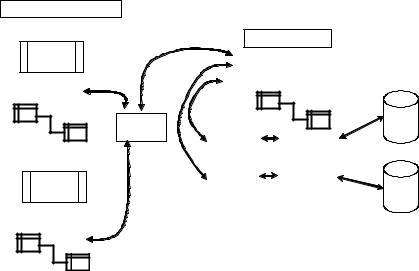
Fig. 7.8. ADO.NET data access model

7.4. Applied software

We shall further look at the state of the art in design of computerized NM A&C systems for nuclear material managing enterprises. Russia embarked upon modernizing its NM accounting, control and physical protection system in 1996 with the US funding and organizational support under an intergovernmental agreement. Russian parties to this collaborative effort were Russia’s fuel cycle enterprises (Siberian Chemical Combine, Mining and Chemical Combine, “Mayak” and others) an d top nuclear research institutes (the Institute of Physics and Power Engineering (IPPE) and the Kurchatov Institute). The specialist training capability for the project was provided by Moscow Engineering Physics Institute (MEPhI). The US participants were leading national laboratories, including LANL, SN, BNL, PNNL and ORNL.

Los Alamos National Laboratory (LANL) was the partner in the development and implementation of computerized A&C systems. Two software products, CoreMAS and E\ZMAS, were developed and adapted to uses in the CIS member-countries by LANL. As part of the effort, the

336

Windows NT 4.0 operating system and the MS SQL Server 6.5 and Oracle 7 DBMSs were certified in Russia. Built initially under US standards, many of Russian designs for computerized NM A&C systems had the same software and a similar architecture as the basis. The USA also contributed financially to the establishment of the network infrastructure within the industry, supplied computer technology, trained personnel and funded the creation of new applied software.

Over the decade since then, teams of software engineers have been established within the industry to develop software for its NM A&C systems. The evolution of computerized NM A&C systems for the industry was discussed at the 7th international workshop “Development of the Federal Automated Nuclear Material Accounting and Control System in Russia” held in September 2006, where facts about w hat had been accomplished were made public [19].

At federal level, the regulatory NM accounting and control framework was established and got started, the pattern for submission of reports on NM was defined by Rosatom, the FIS information analysis center was formed and acquisition of information from operators was organized. Separate information systems that, among other things, had tasks in accounting for and control of NM were established at the agency level. The level of organizations, as evidenced by a data survey, had shown, in the previous years, a marked trend towards more vigorous activities in creation and implementation of NM A&C systems.

For all MBAs, computerized NM A&C systems had been installed at 17% of the nuclear industry enterprises, while 27% had established these just for part of their respective MBAs. Another 12% planned the creation and deployment of NM A&C systems as their short term perspective. The rest 44% did not however have plans to establish such systems.

Some enterprises had problems with commissioning computerized NM A&C systems due to lack of sufficient funding and because of getting a late start on the work. There were also certification problems coming from the requirements to systems not having been well defined early in the FIS evolution process, which tended to change occasionally in the process of the system development. By the time, systems had begun to be established at nuclear power plants with computerized accounting and control of NM implemented nearly across the industry.

All certified systems had an individual architecture and had been designed using a variety of development tools. This was by and large the industry’s first generation of computerized NM A&C systems and these continued to evolve. This early generation of systems use base software

337

certified to access security class 3, which makes it not possible to use the computer network infrastructure in any other roles within the enterprise, making so the whole of the system more expensive to operate.

The Kurchatov Institute’s КИМАКС [20] was the only system certified to access security class IБ (under Gostekhkomissiya’s 1992 requirements: Chapter 8, Part II), which gave it access to handling data of different secrecy levels. This capability was achieved thanks to its own security system that operated independently of the Windows NT 4.0 security system.

No object-oriented programming and development quality control technologies are practically used to design systems. No use of Webapplications is made as well, except for some systems. The FIS is required to expand further both in scope, so that to encompass, in a longer term, all the enterprises managing nuclear material, and in depth. The latter suggests creation of computerized A&C systems to be certified to access security class II. This, first of all, calls for a shift to new base software.

To be built, the systems of a new generation will require, as a complement to the novel base software, industry software development standards tо secure excellence, upgradeability and cost-effectiveness of systems. This, in turn, brings about the need for advanced IT solutions to the development of database applications. And this is what the industry just embarks upon. In a longer term, a team of software engineers is expected to emerge to create and support, on a pay basis, all corporate NM A&C systems within the industry.

This brings to life the demand for a range of software to meet corporate needs for computerized NM A&C systems. There is an occasional debate about the creation of a product to be shared by all enterprises. The first attempt of having such software introduced was the supply of CoreMAS, a US NM A&C system. This was not successful because of the product having failed to win recognition and find application in Russia.

A versatile product seems to be unfeasible because of the NM handling technologies and the material, as such, varying greatly between enterprises. For most of these, such product will be excessively capable and, accordingly, unreasonably expensive and hard to adopt. Further, we shall review the enterprise demand for computerized NM A&C systems depending on the volumes of the NM held and the way it is handled.

338

Requirements to computerized NM A&C systems depending on the enterprise type

Experts at LANL have reviewed the enterprise types that deal with NM. A classification of these has been suggested and proposals made on matching the enterprise type to that of the A&C system. The complexity of an A&C system is defined by the complexity and the number of operations done on NM. Enterprises were reviewed in a spectrum from a small-size storage facility to a high-tech processor. Five enterprise types have been identified.

Type 1. A small storage facility with the number of items below 50. No complex operations. The material is static and items have been in storage

for a long time (up to 10 movements per month). One MBA of about 100 m2.

Type 2. A medium-sized enterprise with the number of items below 500. No complex operations or processes. Key function: storage and moderate activity (up to 100 movements per month). One or two MBAs.

Type 3. A large-sized storage facility with the number of items from 500 to 10000. Several MBAs. A great deal of measurement and inspection. Movements are largely internal (up to 1000 per month). No processing and mechanisms of loss.

Type 4. A medium-sized production facility with many items and a great deal of activity (from 10000 to 20000 items and up to 10000 movements per month). Has several buildings and multiple MBAs. Complex operations on material and more than one mechanism of loss.

Type 5. A large-sized enterprise with a great inventory of items (from 20000 to 100000). The material is very dynamic (up to 50000 movements per month). Mechanisms of losses are very many.

Type 1 enterprises do not have material processing. Items are very few. A simplest paper-and-pen accounting system will do for an enterprise of the kind. One custodian will be enough to make logbook entries.

Type 2 enterprises have material kept in storage most of the time, still may need material to be moved for nondestructive assays. Operations are simple and require a simple accounting system. A paper-and-pen database will do, still an elementary computerized database capable of generating reports with a breakdown by grades is the preferred option. It is enough to have one custodian per MBA.

Type 3 enterprises have more items than a manually operated system can be expected to handle. These, importantly, involve a material change function. A computerized system with one to three workstations will do for

339

the case. The database shall be installed in one mainframe networked to other workplace computers.

Type 4 enterprises are major research establishments with noncommercial operations on material. These should have a custodian for each MBA with an access to the workstation. A client/server system is the suggested option. A well–designed database and a co ntrol system to support complex functions are required. The accounting system is required to serve bulk handling operations. The activity is up to 800 movements per day. Reporting functions are diverse. Several persons are needed to operate and maintain the system.

Type 5 enterprises have several custodians, each MBA being specific, but a central database is required. The volume of operations is greater than for Type 4, still functions are the same. This complexity requires a synchronized backup server.

The survey led to the understanding that the industry needed no less than three or four types of computerized NM A&C systems. Material processing and mechanisms of natural process losses this entails are the key factors that influence the complexity of systems.

Two computerized A&C systems were designed by LANL with this approach taken. One is E/Z MAS, a simplified NM A&C system for enterprises of types 1 and 2, as well as for some of type 3 enterprises. The system has been functionally extended, which makes it potentially fit, subject to a bit of an update, for more complex installations. The CoreMAS, a more complex and versatile system, can be used for enterprises of types 4 and 5.

Implementing the whole range of technologies and offering nearly the complete spectrum of operations one can expect of them, the two systems will be looked at hereinafter as examples of computerized NM A&C systems.

СoreMAS, a client/server-based NM A&C system

CoreMAS is a computerized NM accounting and control system built by Los-Alamos National Laboratory (LANL), the USA, based on a classic client-server architecture [21]. The reasons for which this system has been chosen for the study are as follows:

∙ this is a fairly recent system built on a client/server ideology and based on advanced software;

340

Источник: https://studfile.net/preview/16708779/