Материал: Крючков Фундаменталс оф Нуцлеар Материалс Пхысицал Протецтион 2011

Внимание! Если размещение файла нарушает Ваши авторские права, то обязательно сообщите нам

∙being, by ideology, sufficiently expandable and adaptable to each new site, the system is delivered fully documented and complete with training aids and all program source codes;

∙Russia does not have now a so documented and industry-generic A&C system, while CoreMAS was installed at some sites in Russia and has influenced greatly the choice of software for and the ideology of Russianbuilt NM A&C systems;

∙finally, it was CoreMAS that was delivered free of charge by the US partner to MEPhI to form the framework for training a specialist staff in the field.

The system is considered hereinafter to demonstrate the capabilities of the earlier discussed software and review, with a real system taken as an example, the database design for site applications in treatment and storage of nuclear material.

Key concept of CoreMAS

CoreMAS (Core Material Accountability System) is a daughter product built based on the LANMAS (Local Area NETwork Material Accountability System) system. As the name says, the latter system is designed for use in respective corporate LAN systems. Both systems are LANL-developed. LANMAS is a computerized A&C system for applications within the USA, while CoreMAS has been adapted to uses in nuclear fuel cycles of the CIS member-countries.

CoreMAS is a fully documented system, which is in keeping with the US standard requirement that creation, maintenance and support of any software product must be accompanied throughout by a specific set of documents, including:

∙SRS (Software Requirements Specification). This document describes the basic concepts, functions and relations between parts of the software. This is the key document fundamental to interface design.

∙SDD (Software Design Description): created based on the SRS.

∙STP (Software Test Plan): formed based on the SRS.

∙User manual.

∙Courseware.

When installed, the system has practically all of these documents delivered along with it on a CD. The user is also given all stored procedure and source codes in Visual Basic.

341

Conceptually, central to CoreMAS, as an A&C system, is its functional core which is expandable for each site installing the system, with the needs thereof and local standards taken into account.

The system’s core is expected to satisfy to national and lower-level regulatory requirements. This is a ready-to-go core. When the system is installed, users get all source codes to facilitate creation of their own tools.

Three system levels can be identified by analyzing the CoreMAS design features (Fig. 7.9). The top one is the interface level. This core level contains data input/output template forms enabling the user to create his/her own forms to be used in place or along with the CoreMAS forms. Functions can be also added to validate input data before there is a connection to the core’s functional programs. The interface is VB-realized, this making it easy to realize it in the computer screen.

User level

CoreMAS

Site-specific


Sample forms

forms

Functional level

Transactions

Site-specific


Administration

code


Maintenance


Database level

Core level

Site-specific

tables


Fig. 7.9. High-level design of the CoreMAS NM A&C system

The core’s functional level contains program codes that support required operations (transactions):

∙transactions on material and items;

∙system user and database administration;

∙support of NM storage administration.

In addition to codes and subcodes implementing the core’s functions, there are site-specific codes which realize the functions specific to the given site or in a specific manner, and codes realizing basic functions.

342

The database level contains the database formed of tables required for the accounting system to operate to its utmost.

Overview of the СoreMAS design

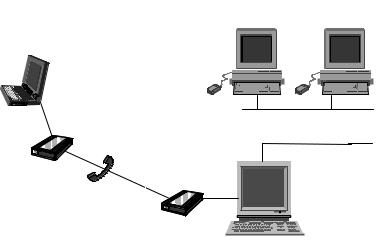
CoreMAS uses a client/server architecture. The client computers are used to provide interfaces and pretest data. The server controls access to the database. Fig. 7.10 shows a standard CoreMAS working environment. In its center the system has a server computer which is accessible from the client workstations. There are two communication options: via the EtherNET local network and, via modems, over the telephone line. There is the following software to support operations of the system:

∙Windows NT 4.0 operating system;

∙MS SQL Server 6.5 DBCS;

∙Visual Basic 5.0 visual programming system.


Windows NT

Windows NT


Client

Client

Distant


client


Secure


telephone line


SQL Server

Dedicated

Dedicated

Windows NT

modem

modem


Server


Remote


access server

Fig. 7.10. Standard CoreMAS work environment

The Software Requirements Specification (SRS) specifies the following characteristics of the CoreMAS system:

∙ A capability to generate and print out the inventory records for all material in less than 3 hours. This is one of the key parameter requirements to A&C systems as imposed by the DOE standards.

343

∙Exact status and location determination for items in not less than 99% of cases, given there is adequate data input by operator (the system does not identify item locations physically).

∙At least 150000 transactions per month.

∙Up to 30 users simultaneously served with a time delay of not more than 3 s.

∙Support of at least 500000 inventory items.

∙Support of at least 10 000 000 transactions.

These characteristics of the system make it potentially the right choice for large-sized and complex enterprises with a great deal of active material (dynamic material, multiple MBAs and material loss mechanisms). Still, such parameters also make the system hard to utilize by small research establishments, this having led to E/Z MAS, a later, simplified, A&C system.

In the context of accounting, CoreMAS features a range of properties that characterize its functionality. These, as identified by the system creators, include:

∙a complete set of accounting functions;

∙support of special reports;

∙cost effectiveness (against systems using other architectures);

∙supportability and scalability (installable at different sites with diversely scaled networks and requirements);

∙reliance on commercial software only;

∙high security level;

∙no requirement for spatially confined rooms, and entrance and door control functions.

The reliance on commercial software, the system developers believe, makes the system, by and large, more informationally secure. Russian software engineers think quite differently. The point is that the base software the COREMAS is based on was originally designed for systems handling national security information. The products were developed, rather, for smalland medium-sized business applications. So giving the COREMAS the status of a highly secure system, as LANL experts do, is, to put it mildly, not quite fair.

A test was devised to verify the system performance. This was designed for 10000 items with a supposed history of 100 earlier entries for each. The system was expected to give out, in a span of 1 to 2 minutes, a list of inventory items for the randomly chosen storage location. The real database, for which the test was performed, contained 16000 items with
344

160 historical entries each. It took the system 3 seconds to produce the inventory listing for the required location.

Now, we are going to discuss the key structural features of the system. First comes an overview of the database design.

CoreMAS database design

Much in computerized accounting systems relies on how the database is designed. The quality of database design is what all other system parts depend on. The quality of the ready-made product is to a great extent defined by the approaches taken in designing the database. The CoreMAS database employs chiefly Third Normal Form with certain variations reasonably involved for efficiency reasons.

Technologically, the CoreMAS basis is the client/server concept. In this, the database core is server-based, while the user interface is based on the client computer and networked to the server via a “ trusted connection”. An SQL Server and Windows NT security framework is used for the data security purposes. An ODBC mechanism is employed for client-database communications.

We shall further dwell on the key database objects used to describe information about these objects.

Nuclear material is the central object in any NM A&C system. The database was designed so that to span all of the required material attributes. Each existing material can be characterized by any number of elements. Each element can be characterized by any number of isotopes. Knowing everything about the chemical identity of a material, the system’s database allows multiple user demands to be satisfied.

Essential database notions are locations and counts of material. Each site is required to have, at least, one MBA. Many departments have each ”accounting location” in the A&C system matched by a physical location, still some may have an MBA shared by more than one physical location, while there may be a physical location that contains more than one MBA. The CoreMAS system takes the material count (whether the material belongs to the MBA) and the material location as separate concepts. Most departments refer to locations by naming the one they need. For example, a location’s name may be the building, room or cabinet number. Locations are viewed as physical locations and not as structures to account for. Each material is matched by a unique material count, which is required to be such for data in the CoreMAS core database to be easier to manage. To this end exactly, the location name demands that the CoreMAS should

345

Источник: https://studfile.net/preview/16708779/