Материал: Крючков Фундаменталс оф Нуцлеар Материалс Пхысицал Протецтион 2011
Внимание! Если размещение файла нарушает Ваши авторские права, то обязательно сообщите нам

for the table containing item, container and location data. Any change to each material record is to be saved to enable this to be revised in different cases.

Where a transaction happens to involve a case of an identifier having been entered erroneously, this case is dealt with as an exception and the procedure should respond with a code indicating the error handled.

In the event of an attempted access to an unauthorized account, the core application should give out the exception code, deny access and log the attempt of unauthorized access.

Functionality of CoreMAS

The diversity of stored procedures can be employed by the user to realize the A&C functions. The CoreMAS core application includes the following functions and standard programs:

∙movements of material, including relocations within the MBA, movements between MBAs, as well as receipts and shipments with the report identification external tag;

∙transformation of material – split, combination, de cay, adjustment and change of project numbers;

∙containerization of material;

∙example of the state report system;

∙physical inventory support features;

∙supply of data to prepare standard and special reports, as well as to respond to queries. Outside programs will handle special reports and queries;

∙a complete history of transactions for each item;

∙support for striking the balance in the accounting period;

∙TID tracking;

∙saving of instrument readings;

∙management of the system and administrative functions;

∙example of built-in user help functions.

Now we shall look in more details at some of the A&C system functions.

Movement of material. There can be internal or onsite and offsite material movements. Material can be shipped to and received from anyone. To be moved, the item concerned is put into an in-transit condition and, after having been moved, out of the in-transit condition with its new position recorded. For offsite shipments/receipts, the CoreMAS supports

351

the logging and identification mechanisms, and generation of respective documents (reports).

Transformation of material. This function describes transformations of respective material. Transformation is understood as split of material, adjustment of records and combination of material. It is not applicable to containers. When this transaction is performed, one needs to determine:

∙the identifier of the material transformed;

∙the identifier of the new material;

∙the type of the transaction performed.

Containerization. There are two transactions through which this function is implemented: placement of a material, a package or a container inside a container and removal of these from the container. The items require the following source data to be identified: a material, a package or a container to be placed inside a container or withdrawn from the container, and the receiving or giving container.

Seal tracking. Seals are subject to record–keeping with reports generated for seal locations and seals linked to containers.

Radioactive decay. This function accounts for changes in the quantity of a nuclear material over time. So that this material to be accounted for accurately, masses thereof are required to be updated given radioactive decay of the material. The CoreMAS computes decay on a monthly basis for all nuclear material for which quantities subject to accounting can be changed by decay. These computations and corrections are applicable to all material items of types 44 (americium 241), 47 (berkelium), 48 (californium), 83 (plutonium 238) and 87 (tritium).

Control of measurements. The CoreMAS supports control of instrumentation. Each measurement is added to the measurement control history which contains all measurement information. If indication values of an instrument fall beyond the set limits as defined by independent calculations, the instrument can be rendered “inope rative”. Such instrument cannot be used for accounting measurements. Only authorized personnel have the right to bring it back to operation. This function is set by two transactions: instrument disactivation and activation.

Any A&C system should operate as a reference system. Therefore, the CoreMAS core should support responds to queries. The data wanted should be put out in response to queries. Each installing department is expected to devise its own techniques for setting out results in response to queries. The system core supports responds to the following queries:

∙location queries;

352

∙count queries;

∙container content listing;

∙material condition listing;

∙in-movement material listing;

transaction details.

Crystal Report is the software used for the CoreMAS report generation function.

Security requirements

The US DOE’s requirements to A&C systems are set forth hereinafter. These include only the requirements to which the CoreMAS core satisfies. The satisfaction to specific requirements is with the developers adapting the system to national uses.

∙The purchased CoreMAS software should be examined prior to being used to make sure it does not contain anything to be potentially compromising to security.

∙All commercial software should be respectively licensed before it can be inserted into the CoreMAS core development environment.

∙Each user is subject to authentication by the respective user identifier.

∙A password should be used along with the user identifier.

∙The CoreMAS core should permit access only to those users having an approved user identifier and a password.

∙Access should be denied after a maximum of five failed attempts to log into the system using the same user identifier.

∙The password should have a maximum of 12 month validity and be invalid thereafter.

∙Stored passwords should be protected by means of access control, coding or both.

∙Access control provisions should be made to protect the database against unauthorized modification or cracking.

∙Measures should be taken to avoid display of the password.

∙The computer’s operating system should store the password change record. This record is storable for at least 6 months.

∙The computer’s operating system should store records of each system login and logout. This record is storable for at least 6 months.

∙The computer’s operating system should store records of each action leading to file creation, opening, closing or destruction. This record is storable for at least 6 months.

353

∙The computer’s operating system should store records of each action leading to access to the files system. This record is storable for at least 6 months.

∙The computer’s operating system should supply file access control listings. A file access control listing should allow the file owner to permit access to the file (separately to each file).

∙The computer system should be fitted with a dialog session disable mechanism after the user idle time. The idle time after which the disable function is initiated is specified by the installing department.

Components of the CoreMAS computerized A&C system

Excluding the data transformation and transport component, the CoreMAS NM accounting and control system comprises two basic components: Admin and CoreMAS.

Admin has been developed to give administrative support to the A&C system and authorize the initial system installation by the system administrator. The Admin capabilities include:

∙configuration of user groups;

∙authorization thereof;

∙configuration of the site specifics. Where the developers have created site-specific tables or wish to create a new form to model one of the forms of this component, they are expected to authorize operation of these tables.

The CoreMAS component is properly an automated NM accounting system based on a client/server architecture and an advanced relational database management system. The CoreMAS tracks the site activities that influence the NM status. The system design offers broad accounting and reporting capabilities. The CoreMAS design is based on an readily expandable system compatible to site-specific modifications and functionality.

To launch the program, the name “CoreMAS” shall be specified as the source of the ODBC data on the client machine. The connection to the database is by calling the OpenData data access subprogram. The ODBC connection is via the ODBC data name “CoreMAS”. Unl ike the User Data source, this is to be set as the System Data Source so that all those connecting to the system have access to it.

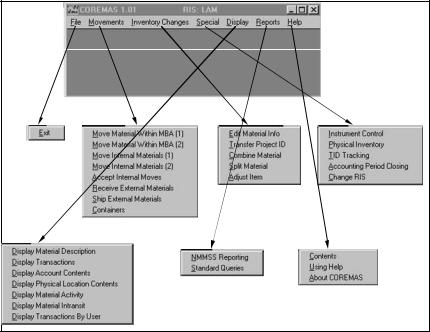
Fig. 7.11 shows the system’s interface master form with the unfolded system menu.

354

Fig. 7.11. Main menu of the CoreMAS component

E/Z MAS as an example of Web-based systems

The E/Z MAS, a simplified A&C system, may be viewed as one of client/server systems which have been defined hereinabove as three-linked [21]. Fig. 7.12 shows a schematic of the system’s architecture components.

In this terminology, there are three system components standing out: presentation logic, business logic and database access logic. Here, as in the CoreMAS system, the database access logic is concentrated on the database server. The difference is that Access can be used as the DBMS, so no capabilities of stored procedures are employed to transport part of the business logic to the database server. Most of the business logic is concentrated on the Web–server in the form of *.asp files. Finally, the presentation logic is distributed between the Web-server in the form of www pages and the workstation as the browser program. Such program is readily expandable to multilinked connections.

355

Источник: https://studfile.net/preview/16708779/