Материал: Маслов ИНТРОДУЦТИОН ТО ПХЫСИЦС ОФ СЕЦОНД-ОРДЕР МАГНЕТИЦ 2015
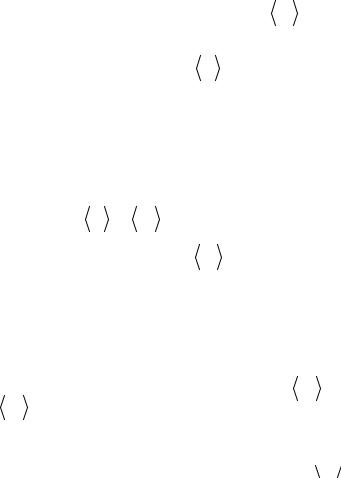
and, second, the field generated by the i-th magnetic moment has no effect on this moment itself (there is no self-action), the net field acting on i-th moment is
|
H / = H + λM , |
(7.2) |
||
|
|
|
|
|
|
|
|
|
does not de- |
where λ < 4π. Taking into account that the value of µk |
||||
pend on k, we have |
|
|
|
T |
|
|
|
|
|
/ |
|
N |
|
|
H |
= H + λ |
|
|
|
|
µi T . |
(7.3) |
||
V |
||||
The second term in Eq. (7.3) is called the molecular field or the Weiss field, and the net field H / is named the mean field or the effective field.
Each magnetic moment experiences the field H / , so that the Hamiltonian is
|
|
|
|
|
N |
|
|
/ |
|
|
|
|
|
|
|
|
|
|
|
|
|
|
(7.4) |
||
|
|
|
H |
= ∑(−µi H ). |
|
|
||||||
|
|
|
|
|
i=1 |
|
|
|
|
|
/ |
|
|
|
|
|
|
|
|
|
/ |
||||
Let H = Hez and |
|
|
|
|
|
ez . Then |
H = H ez , where |
|||||
µi |
T |
= µiz |
T |
|||||||||
|
|
|
|
|
|
|
|
|
|
|
||
|
|
H |
/ |
= H + λ |
N |
|
T , |
|
(7.5) |
|||
|
|
|
|
µiz |
|
|||||||
and the Hamiltonian is |
|
|
V |
|
||||||||
|
|
|
|
|
|
|
N |
|
|
|
|
|
|
|
|
|
|
|
|
/ |
|
|
|
(7.6) |
|
|
|
|
|
H |
= −H |
∑µiz . |
|
|
||||
i=1
This is the Hamiltonian of a system of noninteracting magnetic moments in an effective magnetic field. By analogy with Eq. (4.9) we have
|
|
|
|
|
|
|
|
|
|
|
N |
|
|
|
|
|
|
|
|
µ0 H |
/ |
|
|
|
|
µ0 |
H + λ |
|
|
µiz |
|
|
|
|
|
|
|
|
|
|||||||||||
|
|
|
|
|
|
|
|
V |
|
T |
|
. (7.7) |
||||
µiz |
= µ0 |
tanh |
T |
|
|
= µ0 |
tanh |
|
|
T |
|
|
|
|||
|
T |
|
|
|
|
|
|
|
|
|
||||||
|
|
|
|
|
|
|
|
|
|
|
|
|
|
|
|
|
|
|
|
|
|
|
|
|
|
|
|
|
|
|
|
|
|
Contrary to Eq. (4.9), this is not expression but equation for  µiz
µiz  T .
T .
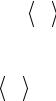
Let us examine whether Eq. (7.7) has nonzero solutions at H = 0. Denoting
16
|
|
µiz |
T |
|
≡ x |
|
(7.8) |
||||
and |
µ0 |
|
|
|
|
||||||
|
|
|
|
|
|
|
|
|
|||
|
|
|
N |
|
|
|
|
||||
|
|
|
|
|
2 |
≡ θ, |
(7.9) |
||||
µiz T |
= λ |
|
|
µ0 |
|||||||
V |
|||||||||||
we have |
|
|
|
|
|
|
|
|
|
|
|
|
|
|
|
|
|
θ |
|
|
|
||
x = tanh |
|
|
|
x . |
(7.10) |
||||||
|
|
||||||||||
|
|
|
|
|
T |
|
|
|
|||
Taking into account that tanh(z) is a monotonically increasing function of z, being linear in z at z << 1 and approaching ±1 when z → ±∞, we conclude that Eq. (7.10) has just one trivial solution x = 0 at T < θ, while at T > θ there are three solutions: one x = 0, one x < 0, and one x > 0. It
can be shown that solutions with x ≠ 0 correspond to the lower free energy of the system, that is, they are thermodynamically more stable.
So, at T < θ the average values of all magnetic moments and hence the magnetization M are nonzero even in the absence of the external
field H . This is just what is referred to as ferromagnetism. Let us esti-
mate the value of the Curie temperature θ, see Eq. (7.9). Taking λ ~ 10, N/V ~ 1023 cm-3, and µ0 ~ 10-20 erg/G, we have θ ~ 1 K. Meanwhile fer-
romagnetic materials with θ ~ 1000 K do exist. To explain such high Curie temperatures within the Weiss approach one should assume unre-
alistically large values of λ, N/V, and µ0 in Eq. (7.9). Hence, the Weiss idea appears to be at variance with experimental data. Moreover, numerous experiments revealed that the “molecular field” generated by the local moments is, if any, orders of magnitude weaker than that required to account for the phenomenon of ferromagnetism. Surprisingly, based on the mistaken assumption, Weiss arrived at qualitatively (although not quantitatively) correct results. The main merit of Weiss is that he has pointed to the necessity of account for interactions between the local magnetic moments. Below we shall see how such interactions naturally arise when the problem is treated quantum-mechanically.
17
8. Exchange interaction
For simplicity sake assume that the local magnetic moment of every atom in the solid-state system results from a single valence electron occupying the energy level with the s-wave wave function ϕ(r ) and thus
having no orbital magnetic moment. In this case the atomic magnetic moment is entirely due to the electron spin S = 1/2, and the magnetic moment operator is
|
|
|
|
|
(8.1) |
µ = −2µB S , |
||
see § 1, so that µz = ± µB. |
|
|
Now consider two atoms, i and j, with coordinates Ri |
and Rj , hav- |
|
ing magnetic moments µi and µj |
respectively. Our objective is to de- |
|
termine the interaction energy Uij |
of those moments as a function of |
|||||||
their mutual orientation and the distance |
|
Ri − Rj |
|
|
between them. In fact, |
|||
|
|
|||||||
|
|
|
|
|
|
|
|
|
we should express the operator U ij |
in terms of operators µi |
and µj : |
||||||
|
|
|
|
|
, |
(8.2) |
||
µi |
= −2µB Si , µj = −2µB S j |
|||||||
where Si = Sj = 1/2. The (normalized to unity) wave functions ϕi (r ) and jj (r ) of an electron in i-th and j-th atoms can be found from the corre-
sponding Schrödinger equation. They are identical in form but localized in different regions of space:
ϕ (r ) = ϕ(r − R ) , j |
(r ) =j(r − R |
) , |
(8.3) |
||
i |
i |
j |
j |
|
|
having their maxima at r = Ri and r = Rj respectively.
Let us now consider the two-electron wave function for a pair of electrons in atoms (i, j):
Ψ(1,2) = Ψ(r1,σ1;r2 ,σ2 ) , |
(8.4) |
where "1" = (r1,σ1 ) and "2" = (r2 ,σ2 ) are the sets of spatial and spin
coordinates of the first and second electron respectively, σ1 = 2Sz1 = ±1, σ2 = 2Sz2 = ±1. Since every electron has a half-integer spin, the electrons
18

obey the Fermi-Dirac statistics, and the many-electron wave function changes sign upon permutation of any two electrons. In our case
Ψ(1,2) = −Ψ(2,1) , |
(8.5) |
that is, |
|
Ψ(r1,σ1;r2 ,σ2 ) = −Ψ(r2 ,σ2 ;r1,σ1 ) . |
(8.6) |
In the absence of spin-orbit interaction, the wave function can be represented as a product of coordinate and spin wave functions:
Ψ(r1,σ1;r2 ,σ2 ) = Φ(r1,r2 )Χ(σ1,σ2 ) |
(8.7) |
From Eqs. (8.6) and (8.7) one has |
|
Φ(r1,r2 )Χ(σ1,σ2 ) = −Φ(r2 ,r1 )Χ(σ2 ,σ1 ) , |
(8.8) |
that is, either |
|
Φ(r1,r2 ) = −Φ(r2 ,r1 ) and Χ(σ1,σ2 ) = Χ(σ2 ,σ1 ) |
(8.9) |
or |
|
Φ(r1,r2 ) = Φ(r2 ,r1 ) and Χ(σ1,σ2 ) = −Χ(σ2 ,σ1 ) . |
(8.10) |
It is known that symmetric and antisymmetric functions Χ(σ1,σ2 )
correspond to the total spin of two electrons S = 1 and 0 respectively. Hence, as follows from Eqs. (8.9) and (8.10), the function Φ(r1,r2 ) is
antisymmetric if S = 1 and symmetric if S = 0, that is, the symmetry of the coordinate wave function depends on the spin state. Since from the viewpoint of classical physics the values of S = 1 and 0 correspond, respectively, to parallel and antiparallel spins of two electrons, the sym-
metry of Φ(r1,r2 ) may be thought of as being dependent on mutual spin
orientation.
Let us construct the function Φ(r1,r2 ) from one-electron wave functions ϕi (r ) and jj (r ) . Taking into account that at i ≠ j these functions overlap weakly, that is,
we have |
|
∫ji (rd)jj (rd)drd ≈ dij , |
|
|
|
(8.11) |
||||||
|
1 |
|
|
|
|
|
|
|||||
|
|
|
|
|
|
|
||||||
Φ(r1 |
,r2 ) = |
|
|
|
ji (r1 )jj (r2 ) + ηjj (r1 )ji (r2 ) |
, |
(8.12) |
|||||
|
|
|
||||||||||
2 |
||||||||||||
|
|
|
|
|
|
|
|
|
|
|||
19
where η = 1 at S = 0 and η = –1 at S = 1. In order to express η in terms
|
|
of electron spin at |
atoms |
i and j, note that |
|
of operators Si |
and S j |
||||
|
|
|
|
|
|
(Si S j )= = 1/4 and –3/4 at S = 1 and 0, respectively. Hence, |
|||||
|
|
η = −1 1 |
|
|
|
|
|
+ 4(Si S j ) |
, |
(8.13) |
|
|
|
2 |
|
|
|
|
|
|
|
||
so that the function Φ(r ,r ) depends explicitly on Si |
and S j . |
||||
|
1 |
2 |
|
|
|
Since electrons at atoms i and j repulse each other, from Coulomb’s law we have for their interaction energy:
* |
d |
d |
e2 |
|
|
d |
d d d |
||
Uij = ∫Φ |
(r1 |
,r2 ) |
|
d |
|
d |
|
Φ(r1 |
,r2 )dr1dr2 . |
|
|
|
|||||||
|
|
|
|
r1 |
− r2 |
|
|
|
|
Making use of Eqs. (8.11) and (8.12), we arrive at
Uij = Aij + ηJij ,
where
Aij = ∫ |
|
ji (rd1 ) |
|
2 |
|
jj (rd2 ) |
|
2 |
de2 d |
|
drd1drd2 |
|
|
|
|
||||||||
|
|
||||||||||
|
|
|
|
|
|
|
|||||
|
|
|
|
|
|
|
|||||
|
|
|
|
|
|
|
|
|
r1 − r2 |
|
|
is the energy of Coulomb repulsion, and
* |
d * d |
d |
d |
e2 |
|
d d |
|
Jij = ∫ji |
(r1 )jj (r2 )jj (r1 )ji (r2 ) |
d |
|
d |
dr1dr2 |
||
|
|
|
|
r1 |
− r2 |
|
|
(8.14)
(8.15)
(8.16)
(8.17)
is the so called exchange energy (or exchange integral, or the energy of exchange interaction). The latter is of purely quantum-mechanical origin and arises because of change of sign in the electron wave function upon permutation (i.e., exchange) of two electrons, see Eq. (8.5). Since both
functions ϕi (r ) |
and |
jj (r ) |
are exponentially localized at a distance |
|||||||||||||||||||
a 1 Å from the corresponding atoms, it can be shown that |
|
|
||||||||||||||||||||
|
|
|
e |
2 |
|
|
|
|
|
|
e |
2 |
|
|
|
|
R − R |
j |
|
|
|
|
|
|
|
|
|
|
|
|
|
|
|
|
|
|
|||||||||
A ≈ |
|
|
|
|
and |
J |
|
≈ |
|
|
|
|
exp − |
|
|
i |
|
|
(8.18) |
|||
|
|
|
|
|
|
|
|
|
|
|
|
|
||||||||||
|
|
|
|
|
ij |
|
|
|
|
|
|
|
|
|
|
|||||||
ij |
|
|
|
|
|
|
|
|
|
|
a |
|
|
|
|
|||||||
|
|
Ri − Rj |
|
|
|
|
Ri − Rj |
|
|
|
|
|
|
|||||||||
|
|
|
|
|
|
|
|
|
|
|
|
|
|
|||||||||
|
|
|
|
|
|
|
|
|
|
|
|
|
|
|
|
|
|
|
||||
at Ri − Rj a .
20