Материал: 2434


 Listen to the speaker and practise pronunciation of the following words:
primary |
concise |
tertiary |
title |
journal |
author |
referee |
affiliation |
manuscript |
introduction |
monograph |
summary |
encyclopedia |
summarize |
proceedings |
nomenclature |
immediacy |
acknowledgement |
cite |
reference |
citation |
source |
quote |
plagiarize |
quotation |
plagiarism |
accuracy |
plagiarist |
logic |
copy |
cohesion |
copying |
coherence |
paraphrase |


 A. In your group share ideas about the meaning of the following phrases, give some examples. Check your ideas on scanning text A.
“primarв scientific literature”
“secondarв scientific literature” “tertiarв scientific literature” “greв scientific literature”
B. Build a classification hierarchy on reading text A (a flow chart). Compare your flow chart with those of your groupmates.
Different types of scientific literature exist, normally referred to as the primary, secondary, tertiary and grey literature.
98
The primary literature refers to accounts of research carried out per-
sonally by an individual scientist and published in a peer-reviewed scientific journal. These accounts are commonly МКХХОН “pКpОrs”. There are dif-
ferent types of journals that range from international to regional to local and there are also systems that grade the importance of journals on the basis of how often papers carried by the journal are cited in other scientific papers (called the “ТЦpКМt ПКМtШr”). Most primary literature is published in scholarly journals, but some research is published as monographs, theses or dissertations, conference papers and reports.
The secondary literature consists of publications that rely on primary sources for information. Here it is not a requirement for the authors to have done the work themselves, since the purpose of the publication is to summarize and synthesize knowledge in a specific area for other scientists who already have an understanding of the topic. The secondary literature includes review journals, monographic books and textbooks, handbooks and manuals. Although normally written in a scientific style, secondary publications are not organized in the same way that primary publications are.
The tertiary literature consists of published works that are based on primary or secondary sources and that are aimed at scientists who work in different areas from the subject matter of the publication, or towards an interested but lay audience. Such publications are normally written in a popular rather than a scientific style and while such publications may include a short bibliography, they do not usually include references to the primary literature. Examples of the tertiary literature include science magazines, newsletters, science articles in newspapers, introductory textbooks and encyclopedias.
The grey literature refers to sources of scientific information that are not published and distributed in the usual manner and which therefore may be difficult to obtain. Grey literature includes theses and dissertations, technical reports with a limited distribution, journals published by special interest groups that have a limited distribution, abstracts of conference papers and conference proceedings that are only made available to conference participants, some types of Government documents, working papers, and some types of online documents. “GrОв” rОПОrs tШ the limited distribution and difficulty of accessing the publication.
99
C. Attribute the given below forms of publication to the types of scientific literature (primary, secondary or tertiary).
1.An encyclopedia.
2.A monograph that presents new ideas as a result of scientific research tСКt СКs ЛООЧ rОЯТОаОН Лв К ЧuЦЛОr ШП rОПОrООs (usuКХХв МКХХОН ‘rОКНОrs’ ТЧ
the case of a book).
3. A science magazine article.
4. A science magazine article, written by a Nobel laureate.
5. Conference proceedings, peer-reviewed and published, either as a book of conference proceedings, or as a special issue of a scientific journal.
6. Abstracts of papers presented at a conference, or the papers themselves which have not been peer-reviewed.
7. A patent.
8. A review.
9. Engineering drawings.


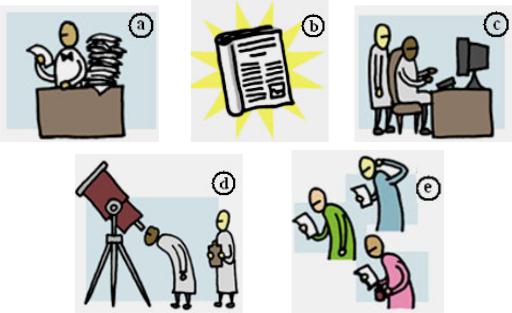
 A. In pairs arrange the pictures (pic. 2, a e) in the correct order to represent the peer review process. Can you describe these steps?
Pic. 2
B. Check your answers (task 1.3 A) on reading the passage below.
Scientific papers are submitted to the journal editor who then asks a number of recognized experts (referees) in the area of study addressed by the paper to give an opinion on whether the work presents new scientific
100
information, and to report on the merits and deficiencies of the work. Peer
reviewers read the article and provide feedback to the editor. On the basis ШП tСО rОПОrООs’ rОpШrts, tСО ОНТtШr ЦКв КМcept the paper as it was submit-
ted, or may require minor revision from the authors, or may require major revision, or the paper may be refused outright. If the article finally meets
editorial and peer standards it is published in the journal. This formal reviewing process Тs ФЧШаЧ Кs “pООr rОЯТОа”.
C. Give examples of peer-reviewed journals. Have you got papers published in peer-reviewed journals? Can you share your experience in publishing these works?


 A. Summarize the following paragraph in one sentence.
Scientific information available on the Internet ranges from absolute rubbish to high quality. There are very authoritative looking sites that present completely wrong information, sometimes deliberately, whereas at the other end of the spectrum, there are primary peer-reviewed scientific journals that are published online (normally, but not always, with at least a limited print edition as well). Professional looking websites are no guarantee of quality information. It is sometimes very difficult to evaluate the quality of data contained in non-professional sources, such as some Open Access journals. The situation described above basically means that the concept of Semantic Web, promising the coordinated global network of information, failed to materialize.
B. EvКluКtО tСО “sМiОntiПiМ quКlitв” oП inПormКtion Пrom tСО Пollowing books.
1. Robertson ben Abraham, Kent. New Gravity. Bozo Faust, Project 2, 1975.
You will learn ПrШЦ tСТs sЦКХХ pКpОrЛКМФ tСКt “Gravity is the 4th dimension, Electricity is the 5th dimension, and Magnetism is the 6th dimension”.
2. Vizas, C. B. Cosmic Cyclones. A New, Revolutionary Picture of the Universe. Greenwich Book Publishers, 1956.
It is another revival of the ether theory with ether wind and vortices. 3. Barnes, Thomas G. Physics of the Future, a Classical Unification of Physics. Institute for Creation Research, 1983.
Barnes claims to expose problems with Einstein's relativity and with quantum mechanics, and proposes a program of research to correct them.
101

4. Seiss, Joseph A. The Great Pyramid. Steiner reprint, 1973.
The author argues that the Egyptian builders of the Giza pyramids encoded in their architecture coded history of the world, past and future, as well as scientific constants.
|
http://www.lhup.edu/ |
|
C. In pairs suggest ideas to answer the question: how can a re- |
|
searcher cope with the task of getting reliable information from |
|
the Internet? Then discuss your ideas with your groupmates. |
|
A. Study the given below questions which help to evaluate the |
|
web sources. Write down your own questions to help your |
|
groupmates when choosing reliable Internet resources for their |
|
research. |
Who is the audience? |
|
|
How complete and accurate are the information and the links provided? |
|
Does the site claim to represent a group, an organization, an institution, |
|
a corporation or a governmental body? |
Does the site offer a selected list of resources in a particular discipline |
or field or does it claim to offer a complete list?
Does the site claim to describe or provide the results of research or
scholarly effort?
Are sufficient references provided to other works, to document hypoth-
eses, claims or assertions?
Are references cited fully?
Can the results be refuted or verified through other means, e.g., by use
of library-related research tools?
Is advertising included at the site, and if so, has it had an impact on the
content?
Can the researchers, scholars, groups, organizations, institutions, corporations or governmental bodies listed as authors, sponsors or support-
ers, be verified as such, and what are their qualifications?
Is any sort of bias evident?
Do the documents follow good graphic design principles?
Do the authors explain their research methods as well as results?
B.Can you associate the picture below with any actual problems of researchers concerning their work on the Web?
102