Материал: 2434
6. IЧ КЧ ОбpОrТЦОЧt tСО … ЯКrТКЛХО Тs tСО ПКМtШr tСКt rОspШЧНs аСОЧ КЧШtСОr
factor is manipulated. (dependent/dependant)
7. We know that a given volumО ШП РКsШХТЧО МШЧtКТЧs … ЦКss КЧН, tСОre-
fore, weighs less than does an equal volume of water. (less/fewer)
8. As a result of these barriers, … ЛuТХНТЧРs КrО Кs ОЧОrРв ОППТМТОЧt Кs tСОв should be. (less/fewer)
B. Translate the values into English (in writing). |
|
200 439 ; 1038 ; 3,2 ; 0, 0157 ; 0,05 ; 2,1 |
. |
. Make corrections in the paragraph from a PhD thesis as if you were an editor. Compare your corrections first, with those of your groupmates, then – with the corrections of an expert (see answer key).
Introduction
Microstructure researches mainly focus on the transaction mechanics in the financial market all the time. In recent years, scholars are mainly concerned about the issues such as liquidity and asymmetric information. Nowadays, people generally accept the concept of the influence of liquidity on the asset-pricing (Amihud and Mendelson (1986); Acharya (2005)), but the sources of the liquidity which influences the asset pricing have always been ambiguous. However, the liquidity of stocks partly originate from the information asymmetry. There are some supports in the side of asset-pricing affected by the information asymmetry. Beaver (1998) divided the information asymmetries into two parts: one is the asymmetric information between investors, the other is between investors and managers of firm.


 Read the passage about writing papers for scientific journals and answer the questions following it.
A research paper is a method of communication, an attempt to tell
others about some specific data that you have gathered and what you think those data mean in the МШЧtОбt ШП вШur rОsОКrМС. TСО “rules” of writing a
scientific paper are rigid. For clear communication, the paper obviously requires proper usage of the English language and this will be considered in evaluating your reports. Scientific papers must be written clearly and concisely so that readers with backgrounds similar to yours can understand easily what you have done and how you have done it should they want to repeat or extend your work. Although scientific journals differ somewhat in their specific requirements, a general format for most journals is accepted.
113
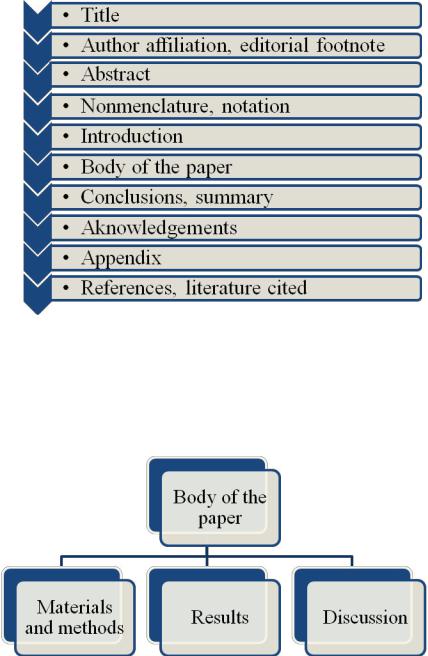
What requirements do scientific papers published in journals meet?
Do these requirements differ significantly in various scientific jour-nals? Give examples.
What is the general format for most publications?


 A. Look through a couple of scientific papers and describe their structure. What information is included in the following sections? (see the diagram below)
B. What information is presented in the following sections of scientific papers?
114


 Scan text C and pick out the most important rules on writing scientific papers. Look through some sample papers to see if they meet these requirements.
A scientific paper is a report about something that has been done in the past. Most of the paper should be written in the past tense. The present tense is used when stating generalizations or conclusions. The present tense is most often used in the Introduction, Discussion and Conclusion sections of papers. The paper should read as a narrative in which the author describes what was done and what results were obtained from that work.
Every scientific paper must have a self-explanatory title. By reading the title, the work being reported should be clear to the reader without having to read the paper itself.
Abstract. The abstract section in a scientific paper is a concise digest of the content of the paper. An abstract is more than a summary. A summary is a brief restatement of preceding text that is intended to orient a reader who has studied the preceding text. The abstract should present, in about 250 words, the purpose of the paper, general materials and methods, summarized results, and the major conclusions.
Introduction. This section is the statement of the problem that you investigated. It should give readers enough information to appreciate your specific objectives within a larger theoretical framework. This section may also include background information about the problem. All background information must be appropriately cited. Do not make the introduction too broad. Present only the most relevant ideas and get quickly to the point of the paper.
Materials and methods. This section explains how and, where relevant, when the experiment was done. The researcher describes the experimental design, the apparatus, methods of gathering data and type of control. This section should be detailed and clear enough so that any reader knowledgeable in basic scientific techniques could duplicate the study.
Results. In this section the researcher presents summarized data for inspection using narrative text and, where appropriate, tables and figures to display summarized data. The text describes the data presented in the tables and figures and calls attention to the important data that the researcher will discuss in the Discussion section and will use to support Conclusions.
Discussion. In this section the researcher interprets the data in terms of any patterns that were observed, any relationships among experimental variables that are important and any correlations between variables that are discernible. The author should include any explanations of how the results differed from those hypothesized, or how the results were either different
115
from or similar to those of any related experiments performed by other researchers. “NegatiЯО” results also need to be explained.
Conclusions. The section states what the researcher thinks the data mean, and should relate directly back to the problem/question stated in the introduction. At the end of the section the author should consider perspectives, i.e. an idea of what could or should still be done in relation to the issue addressed in the paper.
Acknowledgements. In this section you should give credit to people who have helped you with the research or with writing the paper. If your work has been supported by a grant, you would also give credit for that in this section.
Literature cited. This section lists, in alphabetical order by author, all published information that was referred to anywhere in the text of the paper. It provides the readers with the information needed should they want to refer to the original literature on the general problem. Most references should be to the primary literature. The system of citing reference material in scientific journals varies with the particular journal.


 Practise your reading skills: check if you understand information from author affiliation and editorial footnote section.
a)
1.C. Newberry, H,S. Dresser, J.W. Byerly and W.T. Riba, Rockwell International, Downey, CA.
2.S.K. Lee and T.J. Chung, Univ. of Alabama, Huntsville, AL.
3.C. Norden, AFWAL/POTA, Wright-Patterson AFB, OH.
4.D, Thorp, Garrett Turbine Engine Co., Phoenix, AZ.
5.G. Savela, Pratt & Whitney, West Palm Beach, FL.
6.M.C. Lindell and W.A. Stainaker, NASA Langlcy Research Center, Hampton, VA.
7.J.R. Rollins, R.K. Grove and D.R. Wallig, Lockheed Missile & Space Co., Sunnyvale, CA.
b)
Willy Albanes
Computer Sciences Corp., Huntsville., Ala.
Received Aug. 12, 1985; revision received Nov 19, 1985. This paper is declared a work of the U.S. Government and therefore is in the public domain.
Principal Engineer, Defence'Systems Division; currently with the U.S. Army Missile Command, Army Missile Laboratory.
116



 Choose the best sections of scientific papers. Account for your opinion.
A. Title
Sample 1 |
Sample 2 |
Engineering Faculty |
Engineering Faculty |
Monash University |
Monash University |
ALTERNATIVE DESIGNS OF |
TWO ALTERNATIVE |
THE FUEL CELL CAR |
CONCEPTUAL DESIGNS |
B. References
Sample 1
Reference list:
Electric and hybrid electric vehicles and fuel cell technology, Warrndale PA, Society of Automotive Engineers, 1999.
http://www.sae.org/fuelcells/fuelcells.htm
Jay Pukrushpan, Stefanopoulou, A.G., Peng Huei. (2004) Control of fuel cell power systems: principles, modeling, analysis and feedback design, Call number at Hargrave-Andrew Library: 621.312429 P979C2004
Sample 2
References
Pedler, M, Burgoyne J & Boydell, T 2004, A manager's guide to leadership, McGraw-Hill Professional, UK.
Thompson, G 2000 'Where do multinationals conduct their business activity and what are the consequences for national systems?', John Benjamins Publishing Company, Amsterdam/Philadelphia, pp. 191 212.
White, AL 2005, New wine, new bottles: the rise of non-financial reporting, Business for Social Responsibility, viewed 23 August 2007, <http://www.bsr.org/Meta/200506_BSR_Allen-White_Essay.pdf>.


 A. In pairs define the words from the box. Give examples to reveal their meaning. Share your ideas with your group.
to plagiarize plagiarism
117