Материал: 2434
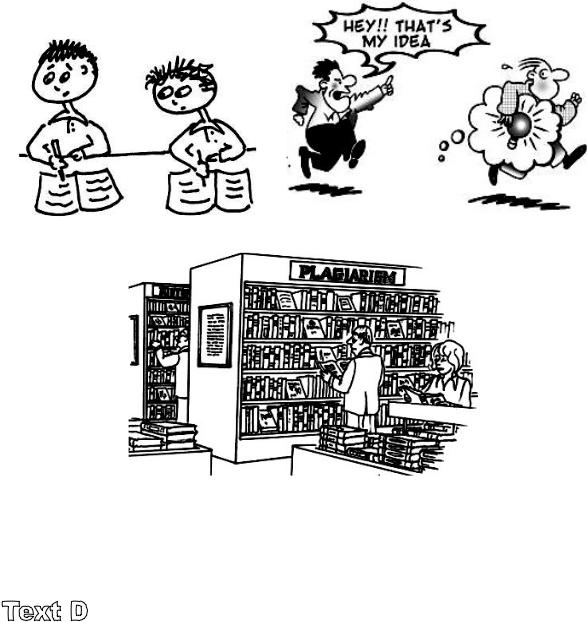
B. Choose the picture (pic. 3, a, b, c) which represents plagiarism in the best way. Account for your opinion.
a |
b |
c
Pic. 3


 A. Compare your definition of plagiarism with the information from text D.
Plagiarism is the process of taking another person's work, ideas, or words, and using them as if they were your own. Someone who does this is called a plagiarist. The Merriam-Webster On-line Dictionary defines theverb “to plagiarize” in these ways:
to steal and pass off (the ideas or words of another) as one's own;to use (another's production) without crediting the source;
to commit literary theft;
to present as new and original an idea or product derived from an existing source.
118
Examples of academic plagiarism include: copying or paraphrasing information from a source without proper acknowledgement or any acknowledgement at all; failing to give a citation to the source of infor-
mation obtained from print, electronic or other media; copying another pОrsШЧ’s ОssКвs, КssТРЧЦОЧts, ХКЛШrКtШrв rОpШrts, НТssОrtКtТШЧ ОtМ. without
that persШЧ’s knowledge; and commissioning another person to do your work for you.
Plagiarism can also refer to copying images, graphs, tables. If you translate the work of another person into French or English and do not cite the source, this is also plagiarism. If you cite your own work without the correct citation, this is also plagiarism.
Some people plagiarize unknowingly, often through lack of experience, while others do it deliberately to deceive. As plagiarism is one of the worst crimes that one can commit in academia, students should know how to avoid it.
B. PrОpКrО К quОstionnКirО to stuНв tСО “prКМtiМО” oП plagiarizing in your group. Collect, analyze the data and make a conclusion.


 Read the following fragments and say, which of the texts (1 2) can be considered plagiarized. Why?
Original
Students frequently overuse direct quotation in taking notes, and as a result they overuse quotation in the final research paper. Probably only about 10% of your final manuscript should appear as directly quoted matter. Therefore, you should strive to limit the amount of exact transcribing of source materials while taking notes.
Lester, J. D.Writing Research Papers. 2nd ed. (1976) 46-47
Text 1
In research papers, students often quote excessively, failing to keep quoted material down to a desirable level. Since the problem usually originates during note taking, it is essential to minimize the material recorded verbatim (Lester, 1976).
Text 2
Students often use too many direct quotations when they take notes, resulting in too many of them in the final research paper. In fact, only about 10% of the final copy should consist of directly quoted material. So it is important to limit the amount of source material copied while taking notes (Lester, 1976).
119



 A. First, suggest your ideas on the ways to avoid plagiarism in research papers. Then, compare your ideas with the information from the following passage.
When you write a research paper, you have to explain where you got your information. Some of the ideas you use will be your own, but many will come from information you read. If you rely on other sources to provide the evidence for any claims that you make, then you need to inform the reader where the original claims, and evidence supporting them, are
. Follow these rules to avoid being accused of plagiarism:
paraphrase information and provide a reference;
summarize or synthesize information and provide a reference;
quote directly the words and provide a reference;
copy tables, graphs, diagrams and so on and provide a reference.
B.Explain the meaning of the verbs from the box. Give some
examples to reveal their meaning.made
to paraphrase to summarize


 A. Summarize the following information.
The ability to summarize and paraphrase is an essential academic skill. Summary and paraphrase help substantiate ideas in research papers without the need to quote every word from source material. To paraphrase means to express someone else's ideas in your own language. To summarize means to distill only the most essential points of someone else's work. You can be accused of plagiarism if you change only a few words from the original source and use that as your summary or paraphrase. Be careful to use YOUR OWN words and sentences, YOUR OWN style. Merely citing the source is not enough if you then go on to copy the language and structure of the source. This can also help you to save space and connect ideas smoothly.
B. Which of the samples (1 4) are examples of plagiarism?
ORIGINAL VERSION (Lightfoot, 1995)
The upshot of maintaining separate subfields is that the archaeological remains of native peoples in any one region are being investigated by different teams of specialists who employ very different theoretical approaches and methodological techniques.
120
Sample 1
The perpetuation of distinct subfields in archaeology means that Native American archaeological sites in the same region are being analyzed by different groups of scholars using different analytical approaches and methodologies.
Sample 2
LigСtПШШt (1λλ5μβ0γ) КrРuОs tСКt, “The upshot of maintaining separate subfields is that the archaeological remains of native peoples in any
one region are being investigated by different teams of specialists who employ very different theoretical approaches КЧН ЦОtСШНШХШРТМКХ tОМСЧТquОs”.
Sample 3
Prehistoric archaeologists of a given region are usually called in to investigate Native American sites. These sites may be analyzed by completely different specialists using completely different theories and methodologies (Lightfoot 1995:203).
Sample 4
The subfield division between prehistoric and historic archaeology sometimes interferes with comparison and cooperation, argues Lightfoot (1995:203). As an illustration, he points out that Native American sites are investigated by prehistoric archaeologists. The problem stems from the fact that even though such sites might be similar, they will be analyzed using very different research tools depending on who is doing the investigation.


 A. Study the given phrases and verbs commonly used to intro-
duce quotations.
In the words oП …; AММШrНТЧР tШ …; IЧ …’s ЯТОа …
argues; |
writes; |
points out; |
concludes; |
comments; |
notes; |
maintains; |
suggests; |
insists; |
observes; |
counters; |
asserts; |
states; |
claims; |
demonstrates; |
says; |
explains; |
reveals. |
B. Practise making quotations. Use any research papers relevant to your research topic.
121


 Give your groupmates recommendations on the ways to avoid mistakes in the process of writing about their research.
Useful phrases: |
|
|
I tСТЧФ … |
refer to |
put … ПТrst/ХКst |
tШ Цв ЦТЧН … |
make sure |
match |
yШu sСШuХН … |
omit |
enclose |
yШu МКЧ ЧШt … |
prefer |
ineffectual phrases |
rather than ... |
use |
never |
submit to |
place |
always |


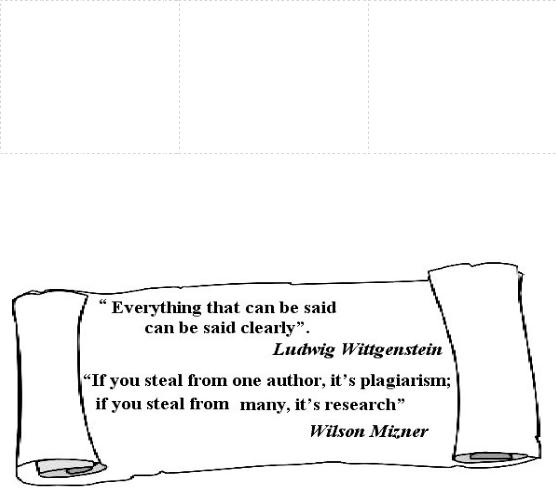
 Comment on the quotes below.
122