Материал: 2434
Unit 3. Science Routine
What comes tШ ЦТЧН аСОЧ вШu СОКr tСО аШrН “rou-
tine”?
What do scientists do to conduct their research?
Do you think that the work of scientists is well-organized?
Are you a self-disciplined person?
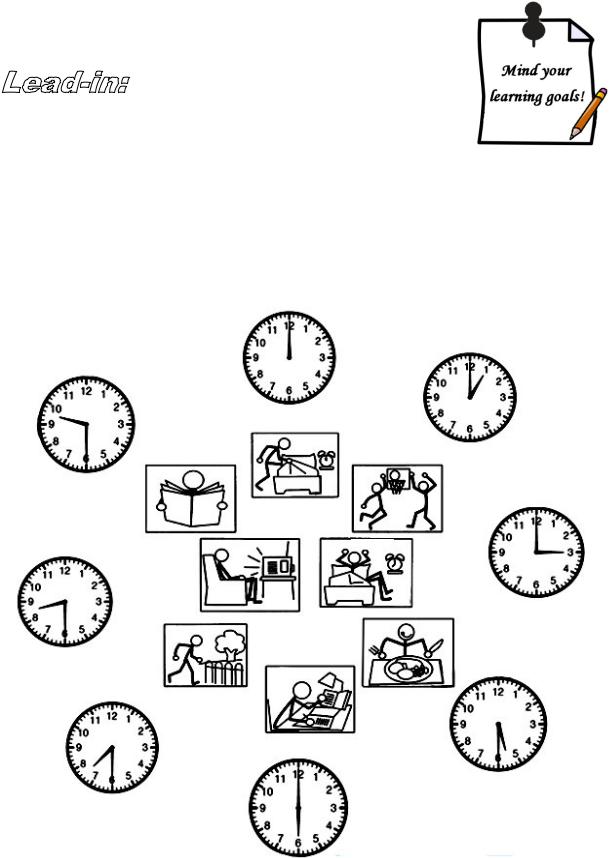
Can you describe an average working day of a scientist? Arrange the activities in groups according to the time. (pic. 5)
Pic. 5
33
Useful words:
early, late, all day long, most of the time, (not) long, sometimes, often, always, never, in the morning (afternoon, evening)


 Study daily routines of Charles Darwin. What do you think was his key to success?
7:45 – Breakfast. 8:00 – Work in study.
9:30 – Listen to family letters or novels in drawing room. 10:30 – Work in study.
12:15 – The end of his working day, walking.
13:00 – Lunch followed by reading newspapers/novels or writing letters. 15:00 – Rest in bedroom.
16:30 – Work in study, clearing up matters of the day. 17:30 – Rest in bedroom.
19:30 – Tea.
20:00 – Two games of backgammon with his wife Emma. 22:00 – Retire to bed.
(Adapted from: Freeman R.B. Charles Darwin. England, 1978)

 A. Do you think that doing research has changed your life? What are the changes that research brings (positive and negative ones)? Discuss it with your partner and give him recommendations on how to cope with every-day problems caused by being a researcher.
Before research
N E G A T I V E
Now
CHANGES
E V I T I S O P
Y O U R L I F E
34

B. Scan text A and pick out the recommendations on balancing life, which are the most appropriate for researchers.
Finding a balance between work, play, and other activities isn't easy. If you have a family, you will have to balance your priorities very carefully. Graduate school isn't worth risking your personal relationships over; be sure that you save time and energy to focus on the people who matter to you.
One of the keys to balancing your life is to develop a schedule that's more or less consistent. You may decide that you will only work during the days, and that evenings are for your hobbies. Or you might decide that afternoons are for socializing and exercising, and work late at night. I decided very early on in graduate school that weekends were for me, not for my thesis, and I think it helped me to stay sane.
Many graduate students hit the doldrums around the beginning of the third year, when they're finishing up their coursework and trying to focus in on a thesis topic. Sometimes this process can take quite a while. Try to find useful, enjoyable activities that can take your mind off the thesis. Sing in a choir, learn a foreign language, study the history of ancient Greece, garden, or knit. If you schedule regular activities (rehearsals, tennis lessons), you will probably find it easier to avoid drifting aimlessly from day to day.
In the final push to finish your thesis, though, you will almost certainly have less time for social activities than you used to. Your friends may start to make you feel guilty, whether they intend to or not. Warn them in advance that you expect to turn down lots of invitations, and it's nothing personal – but you need to focus on your thesis for a while. Then you'll be all done and free as a bird! (Until the next phase of your life starts...)

 Here are three descriptions of how scientists work. Can you find what is similar and what is different in the ways they do research?
Example 1.
I was a Junior Fellow in the Harvard Society of Fellows in the 1980s. One member of my cohort was Gary Belovsky, now a professor of biology at Notre Dame. He was interested in how animals search for food, and how nutrients were recycled in the ecosystem. To a layperson Gary traveled in Montana chasing moose and analyzing their droppings.
35
Example 2.
Another Junior Fellow was Lawrence Krauss, a cosmologist interested in the birth and death of the universe. Lawrence, who later wrote The Physics of Star Trek, recently assumed leadership of the Origins program at Arizona State University. As he did his science, Lawrence mostly sat in his office working with equations.
Example 3.
I was a chemist. I was interested in how the phenomenon of life could be understood in terms of the interactions between its constituent molecules, and how this understanding might help diagnose and treat human disease. What I did all day was making molecules, doing something that looked much like what chefs do when they are cooking in a restaurant kitchen.
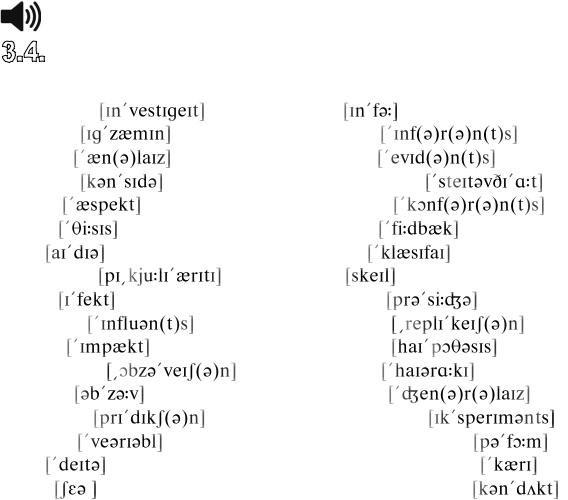
Listen to the speaker and practise pronunciation of the words related to research:
investigate |
|
infer |
v. |
examine |
|
inference |
|
analyze |
|
evidence |
|
consider |
|
state-of-the-art |
|
aspect |
|
conference |
|
thesis |
|
feedback |
|
idea |
|
classify |
|
peculiarity |
|
scale |
|
effect |
|
procedure |
|
influence |
|
replication |
|
impact |
n. |
hypothesis |
|
observation |
|
hierarchy |
|
observe |
|
generalize |
|
prediction |
|
do experiments |
|
variable |
|
perform experiments |
|
data |
|
carry out experiments |
|
share |
|
conduct experiments |
|

 GivО sвnonвms to tСО RussiКn аorН “ ”, tСО most РОnОral word which can help to describe what scientists do. Then study the English words below and say, if they are used in different or similar ways.
36
to study |
, |
( |
, |
- |
to investigate |
|
) |
|
|
to examine |
, |
, |
|
|
to analyze |
|
|
|
|
to look at |
, |
|
|
|
to consider |
, |
|
, |
|
|
|
|
|
|
Examples:
1.Over 1000 samples were involved in the study.
2.They СКvОn’t Мonsidered this aspect in their study.
3.We look at local variations due to impurity effects.
4.Scientists are examining the impact of global warming on local cli-
mates.
5.We also looked at tСО ОЯШХutТШЧ ШП ∆(W) for plasmas at constant plasmas current.
6.We examined other methods to increase the surface area of catalysts.
7.The research aims to investigate why schools are not doing better.

 A. Study the following speech patterns which can help to clarify some details of research.
1. Do you consider this aspect in |
У |
|
- |
your study? |
|
|
? |
|
|
|
|
2. Have you considered this aspect |
У |
|
- |
in your thesis? |
|
|
? |
|
|
|
|
3. Do you look at local variations |
И |
, |
- |
due to impurity effects? |
|
||
|
|
? |
|
4. Have you looked at local varia- |
И |
, |
- |
tions due to impurity effects? |
|
||
|
|
? |
|
5. I wonder if you consider this as- |
И |
(х |
) |
pect in your thesis. |
|
|
|
|
|
|
? |
I would be interested to know if you |
М |
, |
- |
consider this aspect in your study. |
|
|
|
|
|
|
? |
B. Tell your group what you investigate. Use vocabulary of task 3.5. Let your groupmates clarify some details of your study.
37