Материал: Oxford American Handbook of Urology ( PDFDrive )

562 CHAPTER 15 Pediatric urology
Epispadias
In epispadias, the urethra opens onto the dorsal surface of the penis, anywhere from the glans, penile shaft, or, most commonly, the penopubic region. An incomplete urethral sphincter mechanism results in a high risk of incontinence.
Epispadias is also associated with dorsal chordee (causing an upward curvature of the penis), with incomplete foreskin dorsally. Epispadias is part of the exstrophy–epispadias complex (which also includes bladder exstrophy and cloacal exstrophy) (see p. 560).
Associated anomalies
Diastasis of the symphysis pubis results in splaying of the corpora cavernosa and shortening of the penile shaft. Females have a bifid clitoris and poorly developed labia and demonstrate a spectrum of urethral deformities ranging from a patulous urethral orifice to a urethral cleft affecting the entire length of the urethra and sphincter.
There is a 40% risk of vesicoureteric reflux (VUR).
Incidence
Epispadias affects 1 in 117,000 males. It is rarely seen in females (male– female ratio is 5:1).
Management
This involves urethroplasty with functional and cosmetic reconstruction of the external genitalia (penile lengthening and correction of chordee) at 6–12 months.
The modified Cantwell–Ransley technique is commonly used in males. It describes mobilizing the urethra to the ventral aspect of the penis, with advancement of the urethral meatus onto the glans with a reverse MAGPI (meatal advancement-glanduloplasty). The corporal bodies are separated and rotated medially above the urethra and re-approximated.
From age 4–5 years, when children can be toilet trained, bladder neck reconstruction can be performed (Young–Dees–Leadbetter procedure). This achieves continence, and any bladder residuals may then be emptied by urethral catheterization.
If this surgery fails, insertion of artificial urinary sphincters or collagen injections of the sphincter may be tried.
This page intentionally left blank

564 CHAPTER 15 Pediatric urology
Posterior urethral valves
Definition
Posterior urethral valves (PUV) are abnormal congenital mucosal folds in the prostatic (posterior) urethra causing lower urinary tract obstruction.
Classification
•Type I (90–95%): Membranes arise from the distal lateral aspect of the verumontanum,1 which extend distally and anteriorly to fuse in the midline.
•Type II: Longitudinal folds extending from the verumontanum to bladder neck (of historical interest only)
•Type III (5%): A ring-like membrane found distal to the verumontanum
Incidence is 1 in >5000 males.
Etiology
Normal male urethra has small, paired lateral folds (plicae colliculi) found between the lateral, distal edge of verumontanum and lateral urethral wall. PUVs probably represent a congenital overgrowth of these folds from abnormal insertion of Wolffian ducts into the posterior urethra during fetal development.
Presentation
Prenatal US features
These include bilateral hydroureteronephrosis, dilated bladder with elongated ectatic posterior urethra, thick-walled bladder, oligohydramnios (reduced amniotic fluid), and renal dysplasia.
Early features are associated with poor prognosis.
Newborn and infants
These children have respiratory distress (secondary to pulmonary hypoplasia), palpable abdominal mass (hydronephrotic kidney or distended bladder), ascites, UTI, electrolyte abnormalities, and failure to thrive.
Older children
Milder cases may present later with recurrent UTI, poor urinary stream, incomplete bladder emptying, poor growth, and incontinence. There is a risk of renal failure, vesicoureteric reflux, and voiding dysfunction (overactive or underactive bladder), also described as valve bladder syndrome.
Associated features
POP-off valve syndrome is seen in 20%. It describes mechanisms by which high urinary tract pressure is dissipated to allow normal renal development. It includes leaking of urine from small bladder or renal pelvis ruptures (urinary ascites), reflux into a nonfunctioning kidney (vesicoureteral reflux with renal dysplasia [VURD]), and formation of bladder diverticuli.
Investigation
•Ultrasound scan of kidneys and bladder.
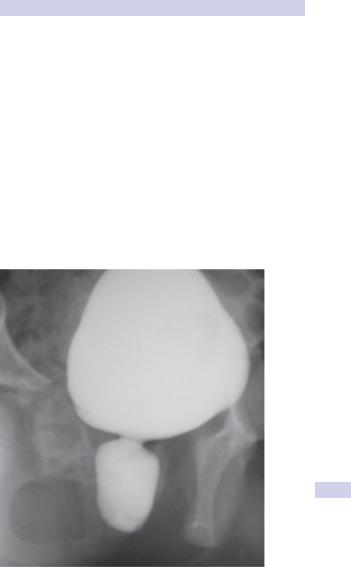
•VCUG shows distended and elongated posterior urethra (shield shaped; see Fig. 15.9); partially filled anterior urethra; bladder neck

566 CHAPTER 15 Pediatric urology
Non-neurogenic voiding dysfunction
Definition
This is an abnormal voiding pattern without an underlying organic cause (neurological disease, congenital malformation, or injury), which usually results in urinary incontinence (diurnal, nocturnal, or both). It is often associated with constipation and fecal retention.
Normal bladder control
•Neonates: Sacral spinal cord reflex triggers voiding when the bladder is full.
•Infants: Primitive reflexes are suppressed, bladder capacity increases, and voiding frequency is reduced.
•2–4 years: Development of conscious bladder sensation and voluntary control occurs.
Classification
Urinary incontinence can be divided into primary (never been dry) or secondary (re-emergence of incontinence after being dry for 6 months) types. Voiding dysfunction can be described as mild, moderate, or major.
•Mild: daytime urinary frequency syndrome; giggle incontinence; post-void dribbling (urine refluxes into the vagina, then dribbles into underwear on standing); nocturnal enuresis
•Moderate: lazy bladder syndrome (large capacity, poor contractility, infrequent voids); overactive bladder (detrusor overactivity associated with urgency and frequency). Children may demonstrate holding maneuvers (leg crossing, squatting, Vincent curtsey). There is increased risk of UTI, vesicoureteric reflux, and upper tract dilatation.
•Major: Hinman syndrome (non-neurogenic neurogenic bladder) involves dyscoordination between the bladder muscle and external urethral sphincter activity, resulting in a small, trabeculated bladder, VUR, UTI, hydronephrosis, and renal damage. It is caused by abnormal learned voiding patterns.
Evaluation
History
Enquire about UTIs; voiding habits (frequency, urgency, primary or secondary incontinence); family history; bowel problems; social history; and behavioral problems.
Examination
Conduct a full, noninvasive examination (palpable bladder or kidneys). Be vigilant for signs of sexual abuse in children with an atypical history (penile or vaginal discharge). Exclude an organic cause (hairy patch, lipoma, dimple on lower back may indicate lumbosacral spine abnormalities).