Материал: Oxford American Handbook of Urology ( PDFDrive )

KIDNEY STONES: EPIDEMIOLOGY 357
Water intake
Low fluid intake (<1200 mL/day) predisposes to stone formation.2 Increasing water hardness (high calcium content) may reduce risk of stone formation, by decreasing urinary oxalate.
Diet
High animal protein intake increases risk of stone disease (high urinary oxalate, low pH, low urinary citrate).3,4 High salt intake causes hypercalciuria. Contrary to conventional teaching, low-calcium diets predispose to calcium stone disease, and high-calcium intake is protective.5
Occupation
Sedentary occupations predispose to stones more than manual work.
2 Borghi L, et al. (1996) Urinary volume, water and recurrences in idiopathic calcium nephrolithiasis: a 5-year randomized prospective study. J Urol 155:839–843.
3 Curhan GC, et al. (1997) Comparison of dietary calcium with supplemental calcium and other nutrients as factors affecting the risk for kidney stones in women. Ann Intern Med 126:497–504.
4 Borghi L, et al. (2002) Comparison of 2 diets for the prevention of recurrent stones in idiopathic hypercalciuria. N Engl J Med 346:77–84.
5 Curhan GC, et al. (1993) A prospective study of dietary calcium and other nutrients and the risk of symptomatic kidney stones. N Engl J Med 328:833–838.

358 CHAPTER 8 Stone disease
Kidney stones: types and predisposing factors
Stones may be classified according to composition (Table 8.1), X-ray appearance, or size and shape.
Other rare stone types (all radiolucent) include indinavir (a protease inhibitor for treatment of HIV), triamterene (a relatively insoluble potas- sium-sparing diuretic, most of which is excreted in urine), and xanthine.
Radiodensity on X-ray
Three broad categories of stones are described, based on their X-ray appearance. This gives some indication of the likely stone composition and helps to some extent to determine treatment options.
However, in only 40% of cases is stone composition correctly identified from visual estimation of radiodensity on plain X-ray.1
Radio-opaque
Opacity implies presence of substantial amounts of calcium within the stone. Calcium phosphate stones are the most radiodense stones, almost as dense as bone. Calcium oxalate stones are slightly less radiodense.
Relatively radiolucent
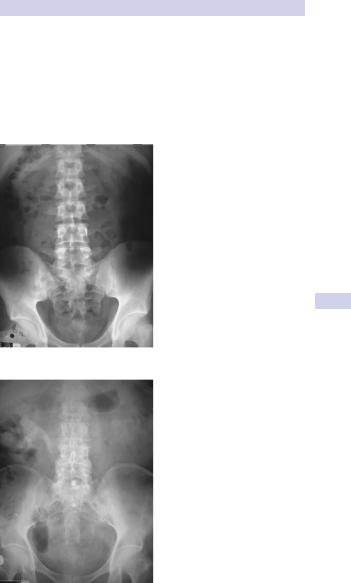
Cystine stones are relatively radiodense because they contain sulfur (Fig. 8.1). Magnesium ammonium phosphate (struvite) stones are less radiodense than calcium-containing stones.
Completely radiolucent
Uric acid, triamterene, xanthine, indinavir stones are in this category (cannot be seen even on CTU).
Table 8.1 Composition of kidney stones
Stone composition |
% of all renal calculi* |
Calcium oxalate |
85% |
Uric acid† |
5–10% |
Calcium phosphate + calcium oxalate |
10% |
Pure calcium phosphate |
Rare |
Struvite (infection stones) |
2–20% |
Cystine |
1% |
* The precise distribution of stone types will vary depending on the characteristics of the study population (geographical location, racial distribution, etc.). Hence, the quoted figures do not equate to 100.
†~80% of uric acid stones are pure uric acid; 20% contain some calcium oxalate.
1 Ramakumar S, Patterson DE, LeRoy AJ, et al. (1999) Prediction of stone composition from plain radiographs: a prospective study. J Endosc Urol 13:397–401.
KIDNEY STONES: TYPES AND PREDISPOSING FACTORS 359
Size and shape
Stones can be characterized by their size, in centimeters. Stones that grow to occupy the renal collecting system (the pelvis and one or more renal calyx) are known as staghorn calculi, since they resemble the horns of a stag (Fig. 8.2). They are most commonly composed of struvite—magne- sium ammonium phosphate (being caused by infection and forming under the alkaline conditions induced by urea-splitting bacteria), but may consist of uric acid, cystine, or calcium oxalate monohydrate.
Figure 8.1 A left cystine stone, barely visible just below the midpoint of the 12th rib.
Figure 8.2 A large, right staghorn calculus.

360 CHAPTER 8 Stone disease
Kidney stones: mechanisms of formation
Urine is said to be saturated with, for example, calcium and oxalate, when the product of the concentrations of calcium and oxalate exceeds the solubility product (Ksp). Below the solubility product, crystals of calcium and oxalate will not form and the urine is undersaturated. Above the solubility product, crystals of calcium and oxalate should form, but they do not because of the presence of inhibitors of crystal formation.
However, above a certain concentration of calcium and oxalate, inhibitors of crystallization become ineffective, and crystals of calcium oxalate start to form. The concentration of calcium and oxalate at which this is reached (i.e., at which crystallization starts) is known as the formation product (Kf), and the urine is said to be supersaturated with the substance or substances in question at concentrations above this level.
Urine is described as being metastable for calcium and oxalate at concentrations between the solubility product of calcium and oxalate and the formation product (see Box 8.1).
The ability of urine to hold more solute in solution than can pure water is due partly to the presence of various inhibitors of crystallization (e.g., citrate forms a soluble complex with calcium, preventing it from combining with oxalate or phosphate to form calcium oxalate or calcium phosphate stones). Other inhibitors of crystallization include magnesium, glycosaminoglycans, and Tamm–Horsfall protein.
Periods of intermittent supersaturation of urine with various substances can occur as a consequence of dehydration and following meals.
The earliest phase of crystal formation is known as nucleation. Crystal nuclei usually form on the surfaces of epithelial cells or on other crystals. Crystal nuclei form into clumps—a process known as aggregation. Citrate and magnesium inhibit not only crystallization but also aggregation.

KIDNEY STONES: MECHANISMS OF FORMATION 361
Box 8.1 Steps leading to stone formation
•Calcium and oxalate concentration < solubility product lNO STONE FORMATION
•Metastable calcium and oxalate concentrations lNO STONE FORMATION
•Calcium and oxalate concentrations > formation product lSTONE FORMATION
In the urine of subjects who do not form stones, the concentrations of most stone components are between Ksp and Kf.