Материал: Russian Journal of Building Construction and Architecture
Russian Journal of Building Construction and Architecture
Table 3
Dependence of heaving on α for trapezoidal loading
|
|
|
|
Vertical stress |
Deformation |
Coefficient of change in the deformation modulus α |
||||||
|
|
|
|
caused by external |
|
|
|
|
|
|
|
|
|
|
h |
|
0.25 |
0.33 |
0.50 |
1.00 |
2.00 |
3.00 |
4.00 |
||
|
|
|
|
loading |
modulus |
|||||||
|
|
|
|
|
|
|
|
|
|
|
|
|
|
|
|
|
|
|
|
|
|
|
|
|
|
mm |
0.0 |
|
|
120.1 |
107.3 |
90.0 |
63.6 |
42.5 |
32.8 |
27.0 |
||
|
|
|
|
|
|
|
|
|
|
|||
∆, % |
|
E = const |
0.0 |
0.0 |
0.0 |
0.0 |
0.0 |
0.0 |
0.0 |
|||
|
|
|
|
|||||||||
|
|
|
|
|
|
|
|
|
|
|
|
|
mm |
|
|
|
zp |
113.5 |
101.2 |
84.5 |
59.4 |
39.4 |
30.3 |
24.8 |
|
|
|
|
|
|
|
|
|
|
|
|
|
|
∆, % |
|
|
|
|
5.5 |
5.7 |
6.1 |
6.7 |
7.4 |
7.8 |
8.1 |
|
|
|
|
|
|
||||||||
|
|
|
|
|
|
|
|
|
|
|
|
|
mm |
|
|
|
|
E = f(σx) |
103.5 |
92.9 |
78.4 |
55.9 |
37.6 |
29.1 |
24.0 |
|
|
|
|
|
|
|
|
|
|
|
|
|
∆, % |
0.2 |
|
13.9 |
13.4 |
12.9 |
12.2 |
11.7 |
11.4 |
11.3 |
|||
|
|
|||||||||||
|
|
|
|
|
|
|
|
|
|
|||
mm |
|
E = const |
99.6 |
87.8 |
72.0 |
48.4 |
30.1 |
22.0 |
17.4 |
|||
|
|
|
|
|||||||||
|
|
|
|
|
|
|
|
|
|
|
|
|
∆, % |
|
|
|
* |
17.1 |
18.2 |
20.0 |
23.9 |
29.1 |
32.8 |
35.7 |
|
|
|
|
|
|||||||||
|
|
|
|
|
|
|
|
|
|
|
|
|
mm |
|
|
|
zp |
E = f(σx) |
90.8 |
80.7 |
66.8 |
45.7 |
28.9 |
21.3 |
16.9 |
|
|
|
|
|||||||||
|
|
|
|
|
|
|
|
|
|
|
|
|
∆, % |
|
|
|
|
24.4 |
24.9 |
25.8 |
28.2 |
32.1 |
35.1 |
37.6 |
|
|
|
|
|
|
||||||||
|
|
|
|
|
|
|
|
|
|
|
|
|
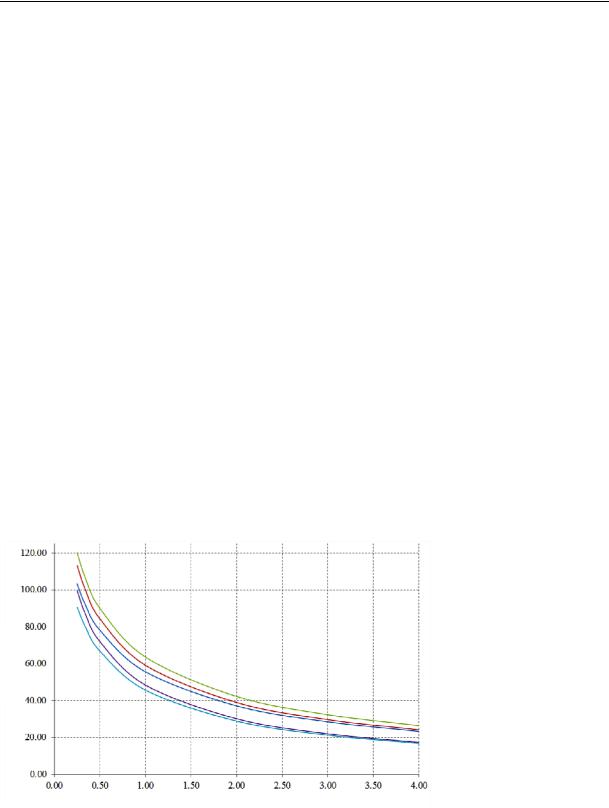
The difference in the change in the effect of decreasing heaving is due to mutual overlapping of the influence of horizontal stresses and changes in the deformation modulus with the depth [10]. Graphically heaving with changes in the deformation modulus with the depth can be fairly accurately described using a power function (Fig. 9).
Heaving, mm
 h = 0.5; E = const; zp
 h = 0.5; E = const; *zp
 h = 0; E = const
 h = 0.5; E = f (σx); zp
 h = 0.5; E = f (σx); *zp
Coefficient of changes in the deformation modulus
Fig. 9. Influence of α on heaving of a foundation under trapezoidal loading
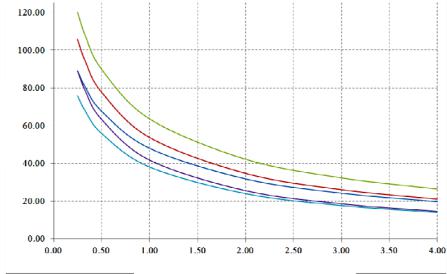
For triangular loading (Fig. 10, Table 4) the effect of decreasing heaving considering and E = f(σx) at α = 0.25 is 36.9 %, at α = 4 it reaches 47.9 % for this particular task.
46
Issue № 4 (36), 2017 |
ISSN 2542-0526 |
Therefore loading along a curved surface in the general case is more effective as the deformation modulus increases with the depth.
Heaving, mm
 h = 0,5; E = const; zp
 h = 0,5; E = const; *zp
 h = 0; E = const
 h = 0,5; E = f (σx); zp
 h = 0,5; E = f (σx); *zp
Coefficient of changes in the deformation modulus
Fig. 10. Influence of α on heaving of a foundation under triangular loading
Table 4
Dependence of heaving on α for triangular loading
|
|
|
|
Vertical stress |
Deformation |
Coefficient of change in the deformation modulus α |
||||||
|
|
|
|
caused by external |
|
|
|
|
|
|
|
|
|
|
h |
|
0.25 |
0.33 |
0.50 |
1.00 |
2.00 |
3.00 |
4.00 |
||
|
|
|
|
loading |
modulus |
|||||||
|
|
|
|
|
|
|
|
|
|
|
|
|
|
|
|
|
|
|
|
|
|
|
|
||
mm |
0.0 |
|
|
120.1 |
107.3 |
90.0 |
63.6 |
42.5 |
32.8 |
27.0 |
||
∆, % |
|
|
|
|
E = const |
0.0 |
0.0 |
0.0 |
0.0 |
0.0 |
0.0 |
0.0 |
|
|
|
|
|
|
|
|
|
|
|
|
|
mm |
|
|
|
zp |
105.6 |
93.8 |
77.8 |
53.8 |
34.7 |
26.1 |
21.1 |
|
|
|
|
|
|||||||||
|
|
|
|
|
|
|
|
|
|
|
|
|
∆, % |
|
|
|
|
12.1 |
12.6 |
13.5 |
15.5 |
18.4 |
20.4 |
22.1 |
|
|
|
|
|
|
||||||||
|
|
|
|
|
|
|
|
|
|
|
|
|
mm |
|
|
|
|
E = f (σx) |
90.1 |
81.5 |
68.6 |
48.8 |
32.7 |
25.4 |
20.9 |
|
|
|
|
|
|
|
|
|
|
|
|
|
∆, % |
0.2 |
|
25.8 |
27.0 |
26.1 |
25.3 |
25.2 |
24.7 |
24.5 |
|||
|
|
|||||||||||
mm |
|
|
|
|
E = const |
89.1 |
78.1 |
63.4 |
41.8 |
25.6 |
18.6 |
14.7 |
|
|
|
|
|
|
|
|
|
|
|
|
|
∆, % |
|
|
|
* |
25.0 |
24.1 |
23.8 |
23.3 |
23.2 |
22.7 |
22.5 |
|
|
|
|
|
|||||||||
|
|
|
|
|
|
|
|
|
|
|
|
|
mm |
|
|
|
zp |
E = f (σx) |
75.8 |
67.5 |
56.0 |
38.1 |
24.0 |
17.7 |
14.1 |
|
|
|
|
|||||||||
|
|
|
|
|
|
|
|
|
|
|
|
|
∆, % |
|
|
|
|
36.9 |
37.1 |
37.8 |
40.1 |
43.6 |
46.0 |
47.9 |
|
|
|
|
|
|
||||||||
|
|
|
|
|
|
|
|
|
|
|
|
|
Conclusions
1. In order to reduce the compression of a foundation and heaving of a foundation loaded along a curved surface, such parameters of a foundation should be selected that diagrams of
47

Russian Journal of Building Construction and Architecture
contact pressures have a trapezoidal almost triangular contour with maximum values near the edges.
2.An increase in the hardness of a foundation base loaded along an upward bulging curved surface has been theoretically justified due to an increase in the deformation modulus that is a stress-strain function. An increase in the deformation modulus of a foundation in the active zone of deformity of a foundation base is associated with extra lateral compression, horizontal pressure σх of a foundation in the active zone of a foundation associated with the shape of a contact surface.
3.An increase in the effectiveness of loading a foundation along a curved surface was revealed as the deformation modulus Е drops. I.e. the deformity of a foundation loaded along a curved surface largely decreases for weak, strongly compressed foundation bases, which is in accordance with the application of the investigated band-shell foundations.
4.Loading along a curved surface in the general case is more effective as the deformation modulus increases with the depth.
5.The shape coefficient kф is set forth as a ratio of average heaving: kф = sпл / sоб. The coefficient should be introduced as an increasing multiplier to the deformation modulus in geomechanical models of a foundation base or an increasing multiplier for determining the coefficient of a subbase in contact models. Based on the experimental data, kф can be significantly over one, according to the numerical analysis for a homogeneous foundation kф nonlinearly depends on a relative value of the curved part in the overall width of a foundation.
References
1.Aimbetov I. K. K opredeleniyu modulya deformatsii gruntov metodom trekhosnogo szhatiya dlya raschetov NDS osnovaniya s ispol'zovaniem programmy PLAXIS [The determination of the deformation module of soils by triaxial compression for calculation of the VAT base using the program PLAXIS]. Geotekhnika, 2010, no. 1, pp. 62—67.
2.Boldyrev G. G., Novichkov G. A. O vliyanii metoda opredeleniya modulya deformatsii na ego znachenie [On the influence of the method of determination of the deformation modulus on its value]. Geotekhnika, 2010, no. 3, pp. 36—43.
3.Galerkin B. G. Sobranie sochineniy [Works]. Moscow, Izd-vo AN SSSR, 1952, vol. 1. 391 p.
4.Gorbunov-Posadov M. I., Malikova T. A., Solomin V. I. Metod resheniya smeshannoy zadachi teorii uprugosti i teorii plastichnosti gruntov [The method of solution of the mixed problem of the theory of elasticity and theory of plasticity of soil]. Osnovaniya, fundamenty i mekhanika gruntov, 1971, no. 2, pp. 4—7.
5.Zaruchevnykh, I. Yu., Nevzorov A. L. Mekhanika gruntov v skhemakh i tablitsakh [Soil mechanics in diagrams and tables]. Moscow, ASV Publ., 2007. 136 p.
48
Issue № 4 (36), 2017 |
ISSN 2542-0526 |
6.Lyav A. Matematicheskaya teoriya uprugosti [The mathematical theory of elasticity]. Moscow –– Leningrad, ONTI NKTP SSSR Publ., 1935. 674 p.
7.Muskhelishvili N. I. Nekotorye osnovnye zadachi matematicheskoy teorii uprugosti [Some basic problems of mathematical theory of elasticity]. Moscow, Nauka Publ., 1966. 708 p.
8.Pronozin Ya. A., Rachkov D. V. Issledovanie vliyaniya formy kontaktnoy poverkhnosti fundamenta na deformiruemost' gruntovogo osnovaniya estestvennogo slozheniya [A study of the influence of the shape of the contact surface of the base on the deformability of the Foundation soil is a natural addition]. Vestnik Tyumenskogo gosudarstvennogo arkhitekturno-stroitel'nogo universiteta, 2015, no. 2, pp. 20—24.
9.Pronozin Ya. A., Zazulya Yu. V., Mel'nikov R. V., Stepanov M. A. Opyt sovmestnogo primeneniya in"ektsionnykh svay i kessona pri ustroystve podzemnogo etazha zdaniya istoriko-kul'turnogo naslediya v g. Tobol'ske [Experience of joint use of injection piles and caisson in the device of the underground floor of a building of historical and cultural heritage in the city of Tobolsk]. Available at: www.science- education.ru/109-9206
10.Pronozin Ya. A., Naumkina Yu. V., Rachkov D. V. Utochnennyy metod posloynogo summirovaniya dlya opredeleniya osadki plitnykh fundamentov [Refined layer-by-layer summation method to determine precipitation slab base]. Akademicheskiy vestnik UralNIIProekt RAASN, 2015, no. 3, pp. 82—86.
11.Pronozin Ya. A., Samokhvalov M. A., Rachkov D. V. Rezul'taty laboratornykh i polevykh issledovaniy izgotovleniya buroin"ektsionnoy svai s kontroliruemym ushireniem [The results of laboratory and field studies of the manufacture of grout-injected piles controlled broadening]. Promyshlennoe i grazhdanskoe stroitel'stvo, 2014, no. 3, pp. 56—60.
12.Pronozin Ya. A., Stepanov M. A. Eksperimental'noe obosnovanie ispol'zovaniya lentochnykh svaynykh fundamentov s predvaritel'no napryazhennym gruntovym osnovaniem [Experimental substantiation of the use of tape of pile foundations with pre-stressed soil ground]. Vestnik Permskogo natsional'nogo issledovatel'skogo politekhnicheskogo universiteta. Stroitel'stvo i arkhitektura, 2014, no. 2, pp. 180—189.
13.SP 22.13330.2011. Osnovaniya zdaniy i sooruzheniy. Aktualizir ovannaya redaktsiya SNiP 2.02.01-83* [SP 22.13330.2011. The base of the buildings. The updated edition of SNiP 2.02.01-83*]. Moscow, 2011. 161 p.
14.Ter-Martirosyan Z. G. Mekhanika gruntov [Soil mechanics]. Moscow, ASV Publ., 2009. 552 p.
15.Chikishev V. M., Pronozin Ya. A., Mal'tsev L. E., Zazulya Yu. V., Stepanov M. A. Raschetno-ekspe- rimental'noe obosnovanie ispol'zovaniya svayno-obolochechnykh fundamentov v vysotnom stroitel'stve [The settlement and experimental substantiation of the use of the pile-shell Foundation in high-rise construction]. Available at: www.vestnik.vgasu.ru/?source=4&articleno=798
49

Russian Journal of Building Construction and Architecture
UDC 624.154
M. A. Samoxvalov1, Yu. V. Zazulya2, M. D. Kajgorodov3
RESULTS OF A STUDY OF STRESS-STRAIN STATE
OF THE SOIL MASSIVE AROUND THE RESULTING BROADENING
AT THE END DRILL-INJECTION PILE
Tyumen' Industrial University
Russia, Tyumen’, tel.: +7-919-943-13-79, e-mail: 89199431379@yandex.ru 1PhD in Engineering, Assoc. Prof. of the Dept. of Geotechnics
2PhD in Engineering, Assoc. Prof. of the Dept. of Construction Industry 3PhD student of the Dept. of Geotechnics
Statement of the problem. The article provides an analysis of the results of full-scale test in actual field conditions of the interaction of piles with the clayous soil foundation associated with the research of the radius of the consolidated zone, vertical deformations of the soil massive around the zone of widening and changes its initial state of stress.
Results. A pile having at its end a broadening in the form of a membrane cup was designed. Static studies showed that a controlled broadening at the end of the pile on average causes a two-fold increase in the load-carrying capacity of the soil massive in the area of the broadening. According to the results of the fieldwork to investigate the interaction of piles with a clayous soil foundation, the radius of the compacted area, vertical displacements of the soil massive in the area of the broadening and changes of its initial stress-strain state were determined.
Conclusions. The fieldwork data have shown the feasibility of a controlled broadening in the form of a membrane cup at the end of drill-injection pile. Studies have shown a significant improvement in the characteristics of the soil after the formation of the broadening at the end of the pile.
Keywords: drill-injection pile, controlled broadening, weak clay soils, static testing, stress-strain state.
Introduction
Currently in the Russian Federation there is a large number of buildings and structures (as well as cultural heritage objects) that are in need of reconstruction, restoration and modernization according to the latest regulations that require that underground spaces of these buildings are utilized for social and engineering infrastructure.
© Samoxvalov М. А., Zazulya Yu. V., Kajgorodov М. D., 2017
50