Материал: Russian Journal of Building Construction and Architecture
Issue № 4 (36), 2017 |
ISSN 2542-0526 |
а)
b) |
|
c) |
|
|
|
d) |
|
e) |
|
|
|
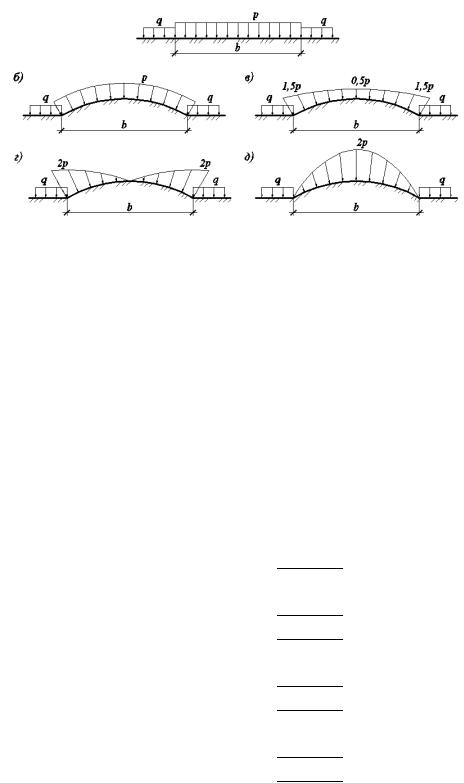
Fig. 3. Variants of loading a foundation base
It was found that for the constant deformation modulus Е the curved foundation loaded according to the scheme d (Fig. 3) has a minimum heaving. (The curved foundation loaded according to the scheme e has a maximum heaving (Fig. 3). Heaving caused by the loadin in scheme d in relation to a flat surface (scheme a, Fig. 3) dropped by 19.8 %. In the upper layer of the foundation along the loading axis deformity is almost zero. Loading according to the scheme e with the load concentration in the middle causes heaving to go up by 7.7 % in relation to loading along the surface (Table 1).
|
|
|
|
|
|
|
|
|
Таble 1 |
|
Dependence of deformity of the foundation base on a loading type |
|
|
|
|||||
|
|
|
|
|
|
|
|
|
|
|
Deformation |
Vertical strain caused |
|
Loading options for a foundation base |
|
||||
|
modulus |
by external loading |
|
|
Type B |
|
|
|
|
|
Type А |
|
Type C |
Type D |
|
Type E |
|||
|
|
|
|
|
12.64 |
|
|
|
|
mm |
|
zp |
12.49 |
|
11.98 |
11.5 |
|
13.18 |
|
|
|
|
|
|
|
|
|
|
|
∆, % |
E = const |
0 |
|
–1.20 |
4.08 |
7.93 |
|
–5.52 |
|
|
|
|
|||||||
|
|
|
|
|
|
|
|
|
|
mm |
* |
12.49 |
|
12.34 |
11.09 |
10.02 |
|
13.45 |
|
|
|
|
|||||||
|
|
|
|
|
|
|
|
|
|
∆, % |
|
zp |
0 |
|
1.20 |
11.21 |
19.78 |
|
–7.69 |
|
|
|
|
||||||
|
|
|
|
|
12.68 |
|
|
|
|
mm |
|
zp |
12.49 |
|
11.84 |
11.26 |
|
13.43 |
|
|
|
|
|
|
|
|
|
|
|
∆, % |
E = f (σx) |
0 |
|
–1.52 |
5.20 |
9.85 |
|
–7.53 |
|
|
|
|
|||||||
|
|
|
|
|
|
|
|
|
|
mm |
* |
12.49 |
|
12.37 |
10.98 |
9.89 |
|
13.73 |
|
|
|
|
|||||||
|
|
|
|
|
|
|
|
|
|
∆, % |
|
zp |
0 |
|
0.96 |
12.09 |
20.82 |
|
–9.93 |
|
|
|
|
||||||
|
|
|
|
|
|
|
|
|
|
In studies by G. G. Boldyrev [2], I. К. Аimbetov [1] the dependencies were found for an increase in the deformation modulus of a foundation base on the lateral pressure for different types of foundations, i.e. E = f(σx). Therefore stress-strain caused by loading along a curved surface in the active zone affects the compression of a foundation base.
41
Russian Journal of Building Construction and Architecture
At E = f(σx) there is not much difference. Due to considering changes in the deformation modulus caused by lateral compression, the loading scheme has more effect. Hence heaving caused by loading according to scheme d in relation to the basic solution (scheme a, Fig. 3) dropped by 20.8 %. Loading according to the scheme e with the loading concentration in the middle caused a 9.9 % increase in heaving in relation to loading on the plane (Table 1). Note that according to the experimental data, the schemes с and d are the most identical to actual ones for loading of a foundation with an upward bulged shell (Fig. 3) [9, 11].
Thus in order to reduce the compression of a foundation and the resulting heaving, such parameters of a shell should be chosen that diagrams of contact pressures have a trapezoidal almost triangle contour with its maximum at the edge.
3. Effect of a relative rising height of a curved loading surface on the deformity of a foundation
Numerical modeling is performed for a curved cylindrical surface with the width with the projection onto the axis Х which is 2.4 m according to the example from [5].
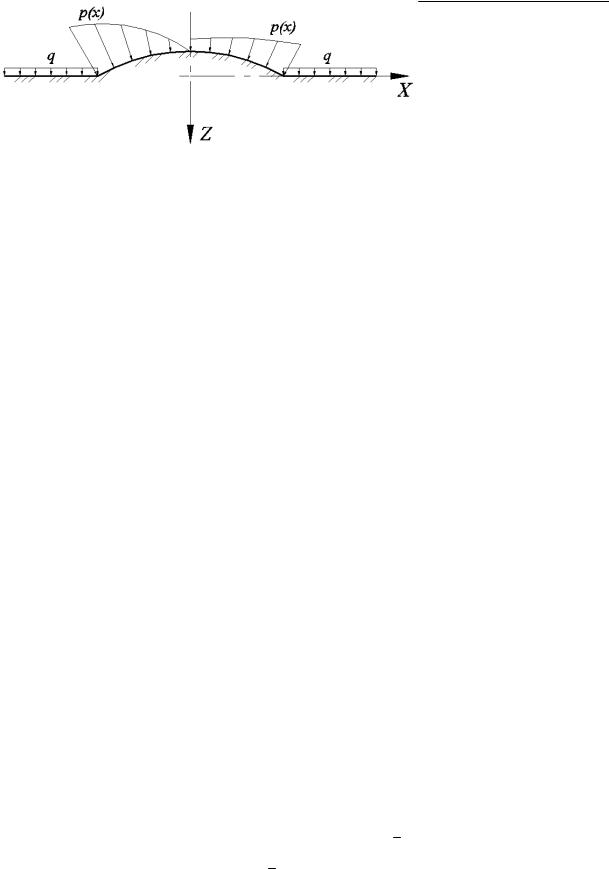
Loading onto a curved surface is applied along the triangle p = 0.5pср+ 2хpср/ В (Fig. 4а) and trapezium p = 3хpср / В where 0 < х < B/2 (Fig. 4b), which is in compliance with the experimental data [8, 12, 15].
а) |
b) |
Fig. 4. Calculation scheme: а) triangular loading; b) trapezoidal loading
The calculation of heaving was performed with constraints of a compressed massive according to SP (СП) [13]. The original data are В = 6.0 m, pср = 135.7 kPa, q = 30 kPa, ν = 0.499, Нсж = 6.0 m.
A varying parameter is a relative rising height of a surface h h /b . A relative rising height of a shell is considered in the range 0 < h < 0.2, which corresponds to the sloping shells examined in the study.
42
Issue № 4 (36), 2017 |
ISSN 2542-0526 |
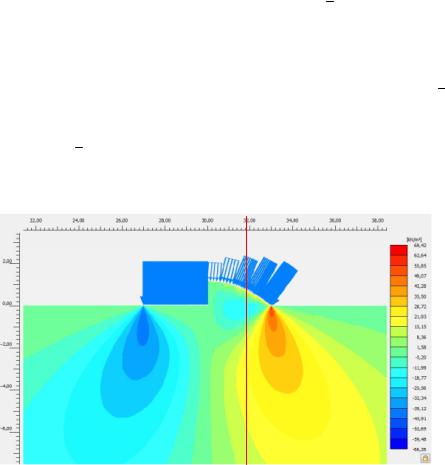
According to the results of numerical modeling, a reduction in the deformity of a foundation base increases as does a relative rising height of the curved part h , which is due to an increase in the compression of a foundation in the active zone by horizontal (lateral) strains (Fig. 5). An increase in the rising height of the curved part non-linearly affects a reduction in the deformity of a foundation. Hence, e.g., an increase in the rising height from 0 to h = 0.1 for a triangular loading reduces the average heaving by 12.9—26.8 % for the examined foundations and an increase in h to 0.2 reduces the average heaving by 16.4—30.2 % respectively (Table 2).
Fig. 5. Diagrams of tangential stresses in a foundation loaded along a flat and curved surface according to numerical modeling in PLAXIS 2D AE
Таble 2
Dependence of the deformity of a foundation base on the type of loading and relative rising height of the curved surface
Type of a foundation |
|
|
|
Trapezoidal loading |
Triangular loading |
||
|
h |
|
|
|
|
|
|
|
|
Heaving, mm |
, % |
Heaving, mm |
, % |
||
|
|
|
|
||||
|
|
|
|
|
|
||
|
0 |
30.51 |
0.0 |
30.51 |
0.0 |
||
Solid clay sand, |
|
|
|
|
|
||
0.1 |
28.05 |
8.1 |
26.58 |
12.9 |
|||
E = 0.066ϭx + 10 МPа |
|
|
|
|
|
||
0.13 |
27.88 |
8.6 |
26.1 |
14.5 |
|||
|
|
|
|
|
|
||
|
0.2 |
27.84 |
8.8 |
25.51 |
16.4 |
||
|
|
|
|
|
|
||
|
0 |
127.21 |
0 |
127.21 |
0 |
||
Plastic clay sand, |
|
|
|
|
|
||
0.1 |
109.32 |
14.1 |
93.08 |
26.8 |
|||
E = 0.065ϭx + 2.5 МPа |
|
|
|
|
|
||
0.13 |
107.65 |
15.4 |
90.99 |
28.5 |
|||
|
|
|
|
|
|
||
|
0.2 |
106.84 |
16.0 |
88.78 |
30.2 |
||
|
|
|
|
|
|
|
|
43
Russian Journal of Building Construction and Architecture
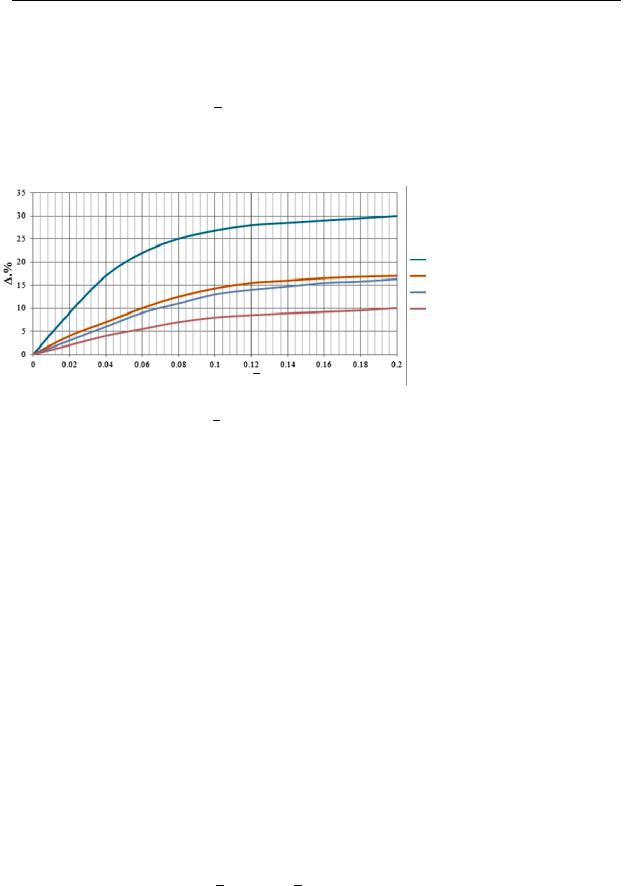
This effect is due to the influence of opposite factors. Hence as the rising height increases, so do horizontal efforts of the compression of a foundation, however the depth of the distribution of extra lateral compression goes down. Therefore a further increase in the rising height and excess of the sloping criterion h = 0.2 are not effective for regulating the deformity of a foundation base (Fig. 6).
Plastic clay sand, triangular loading
Plastic clay sand, trapezoidal loading
Solid clay sand, triangular loading
Solid clay sand, trapezoidal loading
Relative rising height h
Fig. 6. Effect of h on a reduction in the average heaving of a foundation in relation to loading along a flat surface
Another important implication of the numerical calculations is an increase in the efficiency of loading of a foundation along the curved surface as the deformation modulus of the foundation Е drops.
I.e. the deformity of a foundation loaded along a curved surface mostly goes down for weak, strongly compressed foundation bases, which is indicative of the application of the investigated shell foundations.
It should also be noted that while studying the influence of a relative rising height on the stress-strain of a foundation base, the areas of the specific condition of a foundation were evaluated while extra loading exceeded the calculation resistance. For that, the elasticplastic model of a foundation base was applied using the strength criterion by MohrCoulomb.
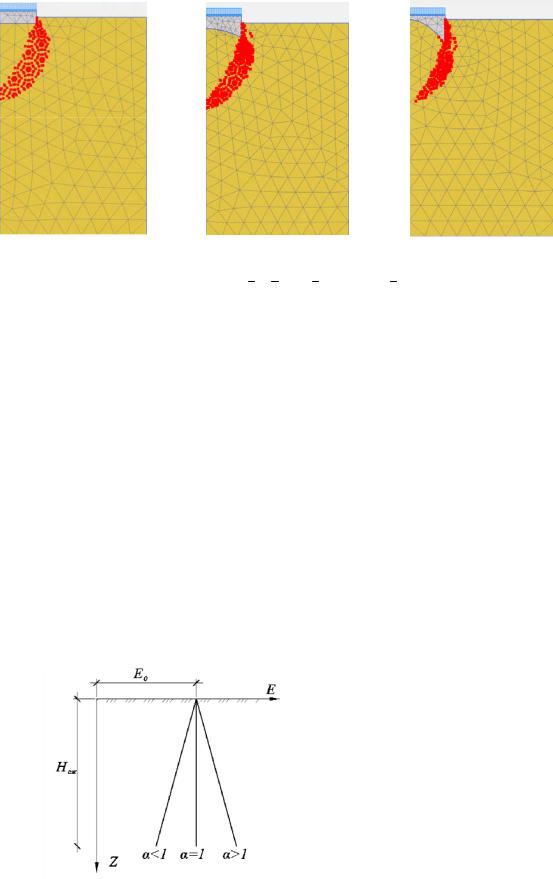
As seen from the resulting data (Fig. 7), an increase in the rising height of the shell causes a decrease in the area of the points of the specific balance under the edges of the foundation models, which improves the bearing capacity of a foundation respectively. E.g., a change in the relative rising height from h = 0.125 toh = 0.33 decreases the area of the specific balance zone by 30 %.
44
Issue № 4 (36), 2017 |
ISSN 2542-0526 |
а) |
b) |
c) |
Fig. 7. Distribution of zones of specific balance under the foundation models for the elastic-plastic model of a foundation base: а) h =h 0; b) h = 0.125; c) h = 0.33
4. Influence of changes in the deformation modulus along the depth on the deformity of a foundation
Let us consider the influence of the distribution of the deformation modulus along the depth for a trapezoidal and triangular loadings for the following original data (Fig. 4): = 0.2, b = 6.0 m, p = 135 kPa, q = 30 kPa, ν = 0.499, Нсж = 6.0 m, α = ЕНсж / Е0.
For trapezoidal and triangular loadings the compression effect of a foundation with laterial pressure in the general case is on the rise as the deformation modulus increases from a contact surface to the depth of a compressed massive.
For trapezoidal loading (Fig. 8, Table 3) the effect of decreasing heaving considering *zp and
E = f(σx) at α = 0.25 is 24.4 %, at α = 4 it reaches 37.6 % for this particular task. However, at σzp and E = f(σx) an increase in the deformation modulus with the depth somehow decreases the effect from 13.9 to 11.3 % for α that equals 0.25 and 4 respectively.
Fig. 8. Scheme for determing Е = f(H)
45