Материал: Russian Journal of Building Construction and Architecture
Russian Journal of Building Construction and Architecture
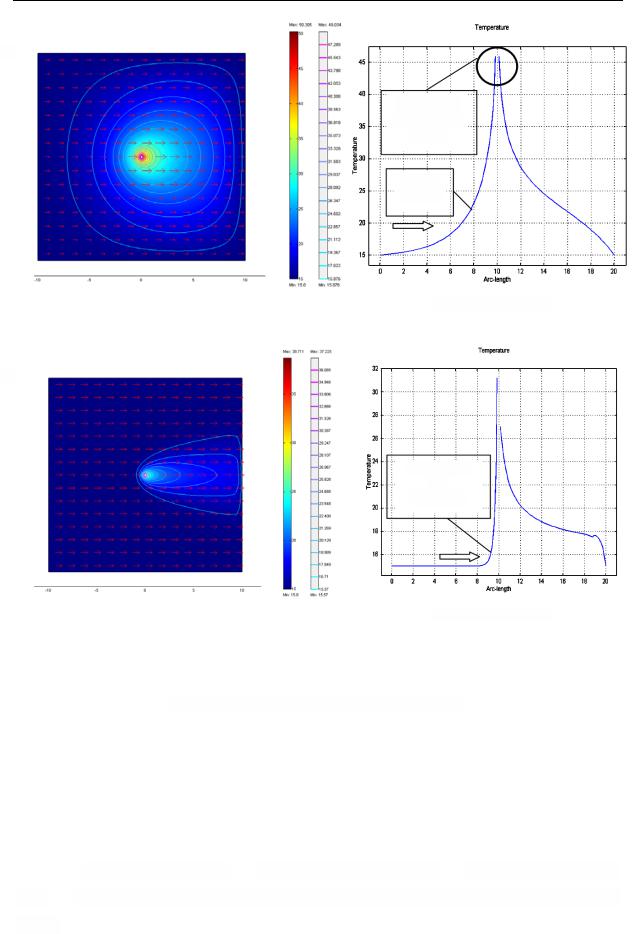
III
Break along the length of the well
Bend of the field
e) a temperature field |
f) a temperature graph |
IV
Tends to the axis
of the well
g) температурное поле |
h) a temperature graph |
Fig. 6 (end). The field and temperature at different rates of groundwater:
III — υ = 0.0000005 m/seс; IV — υ = 0.000006 m/seс
We have identified the effect of a filtration flow on the temperature field and the criterion equation [11] (7) where the corrections for a filtration flow are taken into account:
( 5 10 9 Q Fo2 2 10 8 Fo Q 0.0003 Q 5.1 (0.0002kP 1.98)) |
(7) |
|
( 0.165 С 1), |
||
|
where Fo is the Fourier criterion; Q is a dimensionless heat flow; kp is a regeneration coeffi-
cient; С is the criterion of the multiplicity coefficient of water exchange (a dimensionless value).
66
Issue № 4 (36), 2017 |
ISSN 2542-0526 |
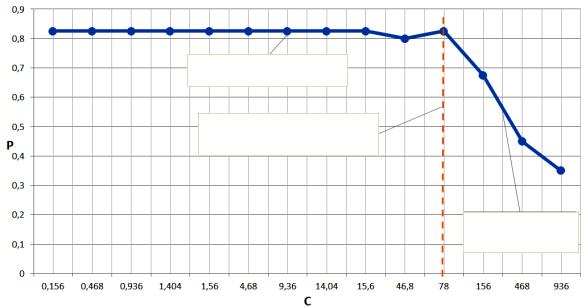
No effect
Boundary of a filtration flow
Effect is present
Fig. 7. Dependence of the correction for the filtration flow P on the water exchange criterion С
Using the similarity theory and calculations of the coefficients with the corrections, the obtained equation can be employed as a modified equation for obtaining the results of the prediction of the operation of the heat pump for long operation periods considering the effect of a filtration flow of groundwater.
Conclusions
Based on the research, the following conclusions can be made.
1.During active operation of the heat pump setup there is a displacement of a temperature field ranging from 0.1 to 0.4 m due to the effect of filtration of groundwater.
2.During the downtime of the heat pump there was no deviation from the axis of the temperature field under the influence of groundwater, but a temperature wave approaches the influence boundary of a heat flow.
3.Stabilization of a temperature field of the soil during active operation of the heat pump setup occurs during the second year of operation and a temperature field tends to the background temperature during the downtime period. Such a temperature distribution remains through the entire operation period of the non-active mode.
4.The rate flow of filtration water was divided into four modes: the first one was when the rate of a filtration flow is slow and has no effect on changes in the temperature field of the soil; the second one was when the rate increases and so does the displacement of a temperature field of the soil. Thus the influence of a flow in areas with plain rivers but it has to be taken into account during long operation.
67

Russian Journal of Building Construction and Architecture
5. The criterion equation introduced with the correction for a filtration flow allows one to determine changes in the temperature of a soil body making an engineering calculation during the designing stage easier as a tool of a technical and economical analysis of the heat pump setup.
References
1.Vasil'ev G. P. Teplokhladosnabzhenie zdaniy i sooruzheniy s ispol'zovaniem nizkopotentsial'noy teplovoy energii poverkhnostnykh sloev zemli. Diss. dokt. tekhn. nauk [Teplogazosnabzhenie of buildings using low-grade thermal energy of the surface layers of the earth. Dr. eng. sci. diss.]. Moscow, 2006. 423 p.
2.Kostikov A. O., Kharlampidi D. Kh. Vliyanie teplovogo sostoyaniya grunta na effektivnost' teplonanosnoy ustanovki s gruntovym teploobmennikom [The influence of the thermal state of the soil on the effectiveness of teplonasos installing ground heat exchanger]. Energetika: ekonomika, tekhnologiya, ekologiya, 2009, no. 1, pp. 32—40.
3.Krylov V. A., Chernoozerskiy V. A., Nikitin A. A., Baranov I. V. Uchet neravnomernosti temperaturnogo polya v geotermal'noy skvazhine teplovogo nasosa [The account of the irregularity of the temperature field in the geothermal well heat pump]. Vestnik MAX, 2015, no. 1, pp. 75—80.
4.Lykov A. V. Teoriya teploprovodnosti [Theory of thermal conductivity]. Moscow, Vysshaya shkola Publ., 1967. 600 p.
5.Malykh V. V., Udalov S. N., Zakharov A. A. [The method of calculation of a soil battery]. Trudy nauchnoprakticheskoy konferentsii «Energo- i resusoeffektivnogst' maloetazhnykh zdaniy» [Proc. of scientific-practical conference "Energy - and respeetively low-rise buildings"]. Moscow, 2013, pp. 317—318.
6.Maslov N. N. Osnovy mekhaniki gruntov i inzhenernoy geologii [Fundamentals of soil mechanics and engineering Geology]. Moscow, Vysshaya shkola Publ., 1982. 511 p.
7.Nerpin S. V., Chudnovskiy A. F. Fizika pochvy [Physics of soil]. Moscow, Nauka Publ., 1967. 584 p.
8.Patankar S. Chislennye metody resheniya zadach teploobmena i dinamiki zhidkosti [Physics of soil]. Energoatomizdat Publ., 1984. 152 p.
9.Rudenko N. N., Fursova I. N. Modelirovanie temperaturnogo polya v grunte [Modeling of the temperature field in the soil]. Available at: http://www.ivdon.ru/magazine/archive/n2y2013/1697
10.Rukovodstvo po primeneniyu teplovykh nasosov s ispol'zovaniem vtorichnykh energeticheskikh resursov i netraditsionnykh vozobnovlyaemykh istochnikov energii: (utv. i vved. v deystvie ukazaniem Moskomarkhitektury ot 31.01.2011 № 8). [Guidance on the application of heat pumps using secondary energy resources and nontraditional renewable energy sources: (approved and put into effect an indication of the architectural Committee from 31.01.2011 No. 8)]. Moscow, GUP «NIATs», 2001. 32 p.
11.Saprykina N. Yu., Yakovlev P. V. [Statement of the problem of determining the temperature field of a geothermal heat pump for the oil industry]. Trudy VI Mezhdunarodnoy nauchno-prakticheskoy konferentsii [Proc. of the VI International scientific-practical conference]. Astrakhan, Izd-vo AGTU, 2015, pp. 126—130.
68

Issue № 4 (36), 2017 |
ISSN 2542-0526 |
12.Smirnov S. S. Teoreticheskie osnovy i tekhnologii izvlecheniya geotermal'noy energii s ispol'zovaniem absorbtsionnykh teplovykh nasosov. Avtoref. diss. dokt. tekhn. nauk [Theoretical bases and technologies of extraction of geothermal energy using absorption heat pumps. Dr. eng. sci. diss.]. Novocherkassk, 2011. 19 p.
13.Fedyanin V. Ya., Karpov M. K. Ispol'zovanie gruntovykh teploobmennikov v sistemakh teplosnabzheniya [The use of ground heat exchangers in heating systems]. Polzunovskiy vestnik, 2006, no. 4, pp. 98—103.
14.Shishkin N. D., Prosvirina I. S. Otsenka effektivnosti primeneniya teplonasosnykh ustanovok v sistemakh teplosnabzheniya Astrakhanskoy oblasti [Evaluation of the effectiveness of heat pump systems in heating systems in Astrakhan region]. Izvestiya AZhKKh, 2000, no. 4, p. 7.
15.RETScreen®International. Ground-source Heat Pump Project Analysis: Chapter // RETScreen®Engineering & Cases Textbook. Ministry of Natural Sources of Canada, 2005. 70 p.
69

Russian Journal of Building Construction and Architecture
UDC 697.9:621.3
V. P. Shackij1, V. A. Gulevskij2
COOLING OF THE SEALED VOLUMES
USING WATER EVAPORATION COOLERS
Voronezh State University of Agriculture
Russia, Voronezh, tel.: (473)29-103-39, e-mail: sha.vladim@yandex.ru 1D. Sc. in Engineering, Head of the Dept. of Mathematics and Physics 2D. Sc. in Engineering, Prof. of the Dept. of Mathematics and Physics
Statement of the problem. We consider the problem of cooling a sealed volume, in particular electronic equipment using counter-flow water evaporation cooler of indirect principle.
Results. A heat balance equation for limited volume including cooling closed-loop cooling is proposed. A mathematical model of processes of heat and mass transfer in counter-flow evaporation of water chillers of indirect principle, which consists of parabolic and elliptic differential equations with distributed parameters as well as a method of numerical realization of this model were set forth.
Conclusions. The results of the study allow us to conclude about the possibility of lowering the temperature in a sealed volume using an affordable eco-friendly water evaporation coolers of indirect principle.
Keywords: pressurized volume, electronic equipment, water evaporation cooler.
Introduction
Cooling a variety of electronic equipment has long been an urgent task in its construction. An oscillation particularly a dramatic increase in the temperature in similar schemes might change thresholds of comparators, coefficients of increasing the power of transistors, nominal values of resistors and condensers. In digital technology oscillations in temperature are also hazardous. They might lead to breakdowns including thermal ones, a reduction in the measurement accuracy, etc. A growth of the temperature in power equipment that might cause a power source and power blocks to break down poses the most threat.
Cooling systems of insulated premises can be classed into two main groups: passive and active ones. The first group is when the heat is diverted using convection, heat conductivity and radiation. The second group is forced thermal diversion by means ofventilation,thermal electri coolers
© Shatskiy V. P., Gulevskiy V. А., 2017
70