Материал: Russian Journal of Building Construction and Architecture

Russian Journal of Building Construction and Architecture
2.Dubovyy V. K., Sviridov E. B., Kobylin R. A. Bumagopodobnyy kompozitsionnyy material na osnove mineral'nykh volokon s ispol'zovaniem v kachestve svyazuyushchego soley alyuminiya i polivinilatsetatnoy emul'sii (PVAE): zayavka na patent № 2010115143 [Paper-like composite material based on mineral fibers using as a binder of aluminum salts and polyvinyl acetate emulsion (PVA): patent application № 2010115143]. 15.04.2010.
3.Shatskiy V. P., Gulevskiy V. A. Modelirovanie raboty plastinchatykh vodoisparitel'nykh okhladiteley kosvennogo printsipa deystviya [Modeling of the plate photospreteen coolers indirect principle]. Lesotekhnicheskiy zhurnal, Voronezh, VGLTA Publ., 2013, no. 4 (12), pp. 160—166.
4.Shatskiy V. P., Fedulova L. I., Chesnokov A. S., Sedaev A. A. Modelirovanie fizicheskikh protsessov v plastinchatykh vodoisparitel'nykh konditsionerakh kosvennogo printsipa deystviya [Modeling of physical processes in plate photospreteen air conditioners indirect principle]. Nauchnyy vestnik Voronezhskogo GASU. Stroitel'stvo i arkhitektura, 2012, no. 2 (26), pp. 29—34.
5.Shatskiy V. P., Fedulova L. I., Gritskikh O. I. Ob okhlazhdenii germetichnykh ob"emov vodoisparitel'nymi teploobmennikami [About the cooling of the sealed volume photospreteen exchangers]. Izvestiya vuzov. Stroitel'stvo, 2008, no. 11—12,pp.39—43.
6.Shatskiy V. P., Fedulova L. I. [About the cooling of the sealed volume of indirect heat exchanger photospreteen]. Trudy nauchnoy konferentsii «Innovatsionnye tekhnologii i tekhnicheskie sredstva dlya APK»
[Proc. of the scientific conference "Innovative technologies and technical means for agriculture"]. Voronezh, VGAU Publ., 2013, pp. 39—42.
7.Bocock, G. Nekotorye aspekty prinuditel'nogo vozdushnogo okhlazhdeniya istochnikov pitaniya [Some aspects of the forced air cooling of power sources]. Silovaya Elektronika, 2010, no. 5, pp. 80—81.
8.Chengqin R., Hongxing Y. An analytical model for the heat and mass transfer processes in indirect evaporative cooling with parallel/counter flow configurations. International journal of heat and mass transfer, 2006, vol. 49, no. 3, pp. 617—627.
9.Fakhrabadi F., Kowsary F. Optimal design of a regenerative heat and mass exchanger for indirect evaporative cooling. Applied Thermal Engineering, 2016, vol. 102, pp. 1384—1394.
10.Hasan A. Going below the wet-bulb temperature by indirect evaporative cooling: analysis using a modified ε-NTU method. Applied energy, 2012, vol. 89, no. 1, pp. 237—245.
11.Moshari S., Heidarinejad G. Numerical study of regenerative evaporative coolers for subwet bulb cooling with cross-andcounter-flowconfiguration.AppliedThermalEngineering,2015,vol89,pp.669—683.
12.Zhao X., Li J.M., Riffat S.B. Numerical study of a novel counter-flow heat and mass exchanger for dew point evaporativecooling.AppliedThermalEngineering,2008,vol.28,no.14,pp.1942—1951.
76

Issue № 4 (36), 2017 |
ISSN 2542-0526 |
WATER SUPPLY,SEWERAGE,BUILDING CONSTRUCTION
OF WATER RESOURCES PROTECTION
UDC 543.183
G. V. Slavinskaya1, O. V. Kurenkova2
INFLUENCE OF FILTER MATERIALS ON WATER QUALITY
Voronezh State Technical University
Russia, Voronezh, tel.: (473)249-89-70, e-mail: slavgv@mail.ru 1D. Sc. in Chemistry, Prof. of the Dept. of Chemistry Cadet School (Engineering School) of the Air Force
«Military Air Academy Named after N. Ye. Zhukovsky and Yu. A. Gagarin» Russia, Voronezh, tel.: (473)223-46-55, e-mail: kovov84@mail.ru
2PhD in Chemistry, Teacher of Chemistry
Statement of the problem. Тatural water is now being processed using different types of filtering materials-ion and inert materials type of active coal, anthracite, sand, and zeolites, etc. The cleaning process fixed the flow side of the filters. It is particularly the case for ion exchangers. One should be aware of the nature of impurities and thus prevent the secondary pollution of water through special preparation of sorbents.
Results. It is established that the product ion exchangers emit water as mineral and organic compounds. Fixed emission in water previously absorbed substances after regeneration of filters. It is shown that it is even a flow of distilled water that leads to degradation of ion exchangers. In addition all sorbents pollutes water with microorganisms.
Conclusions. The proposed cleaning method of ion exchangers from monomers or other substances entered in the synthesis of ion controlling regenerates was tested. It was found that anionites in the main form are chemically less resistant than in the salt ones. The restrictions on the reproduction of microorganisms in industrial ion exchange filters are proposed.
Keywords: ion exchangers, monomers, purification, reagents, microorganisms.
Introduction
Presently filtering materials are widely used in water treatment on the household and industrial scale. They are used in household filters as well. That were household users of desalinated water that turned their attention to the behavior of ion-exchangers in water, which cannot be obtained without synthetic ionites [1, 8, 19].
© Slavinskaya G. V., Kurenkova О. V., 2017
77
Russian Journal of Building Construction and Architecture
Water treatment experts experience no difficulty in removing mineral components from water. A severe obstacle making deep desalination of natural water challenging is organic substances [5, 22—24, 27—29, 31]. In order to remove them, special methods including selective ionites are being applied along with the traditional ones. They are employed to extract a wide range of organic substances as well as humiс and fulvic acids [1, 30, 33, 34]. However, during water demineralization ion-exchangers (desalinating as well as those absorbing organic substances) add organic impurities into it.
This is called secondary pollution [7, 11, 20, 28, 32, 35]. There have been a lot of studies into the problem including [2, 13, 14, 35]. The emerged issue of preventing washing of impurities from ion-exchangers urged researchers to seek for ways of purifying them of the substances that compromise the quality of desalinated water [3, 6, 9, 12, 17, 26]. Another obstacle in treating water with any sorbents is propagation of microorganisms in ionexchange and sorption filters with an inert loading, which thus leads to bacterial pollution of the purified water.
1. Evaluation of the effect of a water flow on the physical and chemical properties of the anionite АV-17-8
In most papers dealing with secondary pollution of water during its desalination, there is a major focus on identifying the impurities and methods of preparing ion-exchangers for use in industrial ion-exchanging setups. The ionite has never been a focus of research. We seek to investigate the physical and chemical properties of the most commonly used anionite AV-17-8 following a long contact with a flow of desalinated water.
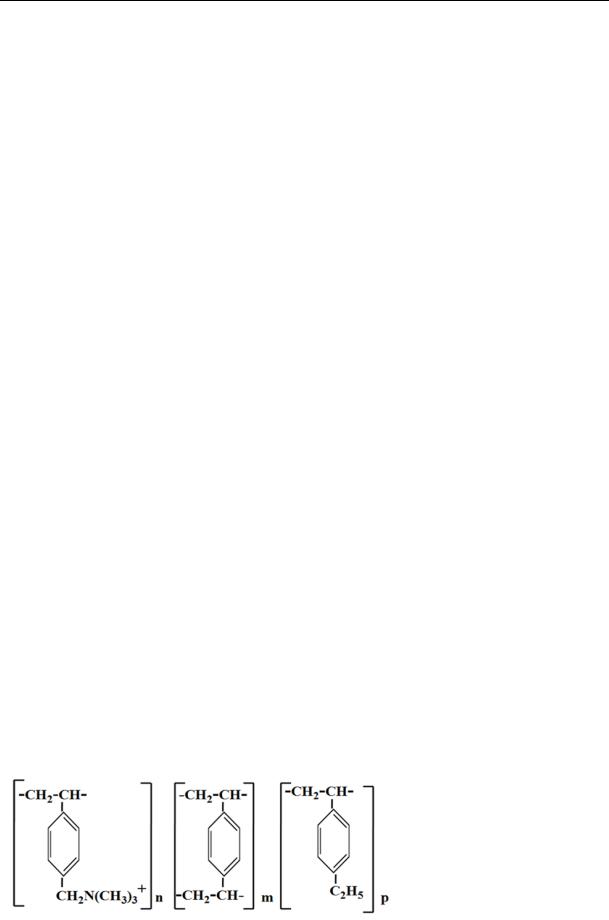
Anionites of this type are synthesized based on styrene and 8 % divinylbenzene. The resulting interpolymer is chloromethylated followed by amination using trimethylamine that leads to quaternary benzene-trimethylamine functional groups that provide exchange of OH-anionites for water anions [4, 21]. In this structural formula there are sections with benzene rings and lateral methyl methylene groups (Fig. 1).
Fig. 1. Structure of an elementary anionite АV-17-8 ring
78
Issue № 4 (36), 2017 |
ISSN 2542-0526 |
Anionites of this type have strongly ionized nitrogen-containing positively charged ionogenic groups that absorb not only anions of strong acids but also weak acids (carbonic and silicic) from water. The content of the latter is strictly limited in desalinated water used for production of precise equipment, atomic, heat and power engineering, etc. [1]. In deep desalination setups filters with such anionites are placed at the end of a technological chain for further purification from microamounts of mineral and organic substances as well as silicon. Besides, anionite АV-17-8 is used at the second stage of desalination in mixed filters (a mix of cationite КU-2-8 and anionite АV-17-8) and then during further desalination in end setups where water is supplied immediately to the user [1].
Data on the chemical stability of ionites in such filters is crucial as after them there will be no more barriers to hold the impurities in the system. According to the composition of an elementary chain of the anionite, this is a rather rough structure (Fig. 1), which causes doubts as to chemical stability of the anion-exchanger.
If during desalination of natural water a filter with the anionite АV-17-8 is used as a first stage filter, it is affected by anions of weak and strong acids, ferro compounds, organic substances, oxidizers that also change the volume of granules as the processed saline ion forms are converted into the OH-form during regeneration using alkaline solutions.
But since it is mostly anionites АV-17-8 that finish water treatment, they are thus used for further purification of already partially desalinated water. Therefore a sample of anionite was investigated following a long contact with distilled water. Unfortunately, we failed to isolate the water from the air oxygen and carbonic acid.
2. The anionite was prepared for the experiment in accordance with the GOST 10986-78 based on the assumption that it is used in pharmaceutical, nutrition and medical industries. A dry ionite was held for 5 hours in a concentrated solution of sodium chloride (24—26 %), then the solution was decanted and the anionite was washed from salt five times. Then it was transferred into a column and sifted through a 5 % solution of hydrochloric acid until the concentration of the ferrous ion was identical in the acid solution and filtrate. Following the washing from the acid using water, a 5 % solution of NaOH was sifted through a loading until the oxidability of the alkaline solution was identical at the input and output of the column. The anionite converted into the ОН-form was washed using depply desalinated water with the specific electrical resistance of 10…18 МОhm∙сm until there were no more electrolytes in the rinsing water.
Using the sifter method for possible further evaluation of the granulometric composition and failure of the anionite granules, a fraction with the grain size of 0.42…0.63 mm was extracted
79
Russian Journal of Building Construction and Architecture
in accordance withthe GOST 16187-70. The total exchange capacity was identifiedinaccordance with the GOST 20255.1-90. It is 3.89 mg-equiv/g with 3.15 mg-equiv/g accounting for the highly dissociated groups. The moisture content is 1.47 g Н2О/g of anionite.
3. Influence of a water flow on the ionite in the dynamic mode
The anionite АV-17-8 was loaded into four glass columns. A different amount of distilled water was sifted through them with a linear flow rate of 15 m/h. Following the filtration of each 2000 volumes of water that equaled the loading volume, the anionite was regenerated with five volumes of the solution of 1 mole/l of NaOH and washed with 50 volumes of distilled water. As a result, 25, 50 and 100 thousand volumes of water was sifted through the column and 12, 25 and 50 regenerations were performed respectively. 100 thousand water volumes was sifted but not regenerated through another column. This experiment might be considered “dummy”.
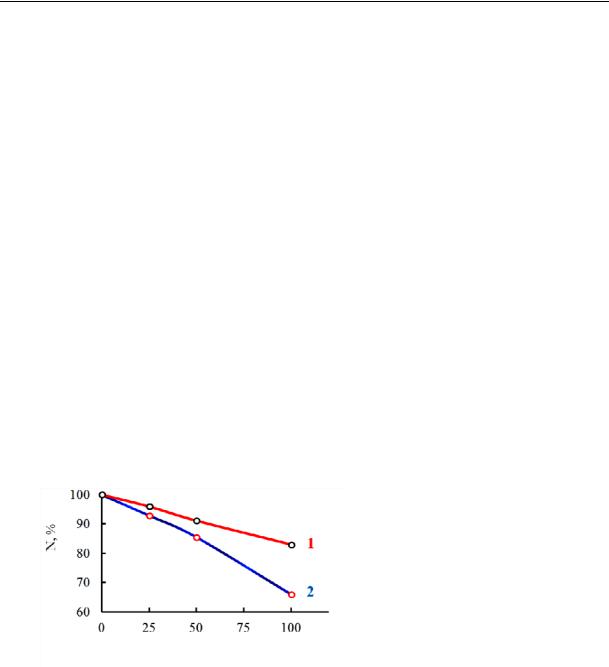
The anionites were unloaded from the columns and sifted through sieves with the specified hole sizes. The volume of the anionite granules that remained on the sieve with the hole size of 0.42 mm (Fig. 2) was identified. I.e. this is the volume of the grains that did not fail during the experiment.
Fig. 2. A decrease in the moisture capacity (1)
and the amount, ml, of the original anionite grains (2)
V×1000, Sifted through the water volumes
According to Fig. 2 (curved line 2), the amount of the intact granules dropped as the volume of the sifted water increased and at the end of the experiment when the volume was 100000 volumes of loadings of the anionite АV-17-8, the loss was 34 %. The contact area of the fragments of an irregular shape increased dramatically, which was expected to intensify the the dissolution of the matrix. All the destruction products remained in the water polluting it.
The curved line 1 (Fig. 2) indicates a decrease in the moisture content of the anionite. It is 4, 9 and 17 % respectively for the volumes of the sifted water of 25, 50 and 100 thousand and 12, 25 and 50 times of regenerations. This is a very important characteristics of the
80