Материал: Russian Journal of Building Construction and Architecture

Russian Journal of Building Construction and Architecture
Over the entire operating period water samples were selected before and after a filter with the cationite КU-2-8. The content of humic and fulvic acids that are invariably found in natural water and yield a yellowish coloring was determined. The results of the analysis of the samples are presented in Table.
Table
Change in the quality of river water during its filtration through the cationite КU-2-8
The |
Content of fulvic acids, |
Increase in the |
Content of humic acids, |
Increase in |
|||
amount of |
50mkg/l |
|
10 mkg/dm3 |
||||
|
СFA, |
the СHA, |
|||||
the sifted |
|
|
|
|
|
||
Before the |
|
|
Before the |
|
|||
|
After it |
mkg/l |
After it |
mkg/l |
|||
water, m3 |
cationite |
|
cationite |
||||
|
|
|
|
|
|||
|
|
|
|
|
|
270 |
|
80 |
860 |
|
200 |
660 |
70 |
200 |
|
|
|
|
|
|
|
300 |
|
400 |
300 |
|
1300 |
1000 |
140 |
160 |
|
|
|
|
|
|
|
190 |
|
1000 |
850 |
|
1750 |
900 |
60 |
130 |
|
|
|
|
|
|
|
160 |
|
1600 |
880 |
|
1040 |
160 |
80 |
80 |
|
|
|
|
|
|
|
75 |
|
1800 |
910 |
|
1030 |
120 |
50 |
25 |
|
|
|
|
|
|
|
|
|
Based on the data, we conclude that during the entire operating period the concentration of humic СHA and fulvic acids СFA in Н-cationed water is larger than in the original water even at the end of the filtration cycle. But their content in the filtrate decreases over time, i.e. the cationite “is washed away” from organic impurities in a way that are desorbed during oxide washing, which is rather unexpected. Cationites that have negatively charged functional groups ( SO3-) are considered to be incapable of absorbing these organic groups. However, this experiment (table) state the contrary.
5. Microbiological pollution of filtrated water was identified in electronic industry enterprises. One of the requirements to the water quality is that there are no solid particles including microorganisms.
The analysis of desalinated water showed [10] that bacteria grow most actively on the anionite filter, which, we think, is easily explained by the fact that there are aminogroups in its structure whose nitrogen is a biogenic element, i.e. it is necessary to sustain the lives of other organisms. In addition, humic and fulvic acids containing nitrogen are absorbed on the granules of anionite during water treatment. This contributes to a rapid growth of microorganisms in water.
A significant growth of the number of bacteria is typical of isolated contours [16]. Tehse systems occur in the cooling cycles of electrophysical tools. They are filled with desalinated wa-
86
Issue № 4 (36), 2017 |
ISSN 2542-0526 |
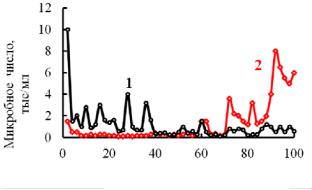
ter. It circulates through the contour and column with the ionites: the cationite КU-2-8 and anionite АV-17-8. The results of the evaluation of the number of bacteria are in Fig. 8.
number ofmicrobes, |
thousand/ml |
The |
|
|
|
Time, h
Fig. 8. Сontent of microorganisms at the input (1) and output of the column (2)
There is an interesting dependence here: originally the amount of microbes was smaller than that for the incoming water. They it becomes different (40…70 hours of operation). In some time there is more microflora in the filtrated than in the original water. Note that the amount of microorganisms was determined using the sifter method, i.e. by applying an aliquot of water onto a substantial medium.
Such a growth in the amount of microflora is due to the fact that bacteria originally fix on the surface of the ionite granules and remain there. Then the other bacteria are absorbed forming a few layers. Their interaction energy with the solid surface is not large. If the surface is considerably filled, some of the microflora is simply washed away and end up in the water flow. Then they are replaced by other microorganisms and their amount in the water flow drops again [16]. The type of bacteria and their amount was evaluated in [15]. While controlling the upper layer of the ion-exchanger it was found that it was infested with microorganisms. Water samples were selected and 21 media was used for sifting. The amount of bacteria in the original pipe water is an average of 2…7. Following desalination their amount goes up from 13000… 24000 per 1 ml.
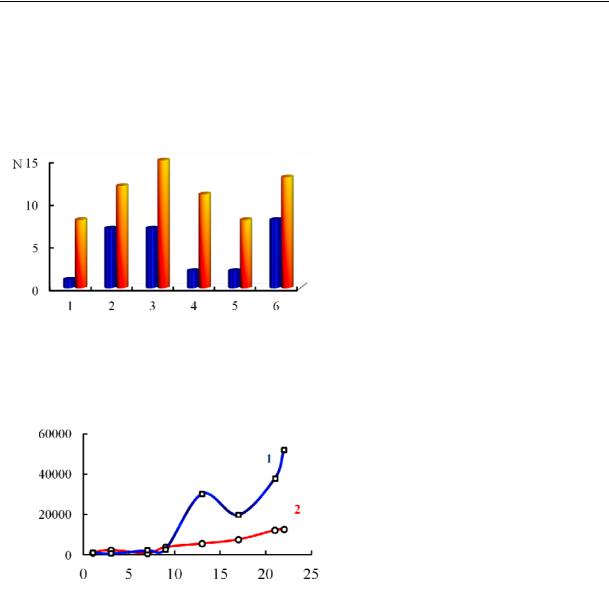
The type of microorganisms and the number of samples N was determined where they were identified (the total of 15). The data are presented in Fig. 9.
As we can see, the microorganisms of all types that ended up on the ion-exchange materials along with the original pipe water do not die but keep reproducing [15]. They adapt to the conditions that are formed in the filter, make up capsule forms that produce a lot of slime. It accumulates in the water pipes and around the ionite grains. The amount of impurities in water grows quickly over the entire observation period.
87
Russian Journal of Building Construction and Architecture
The data on the bacterial pollution of water during its filtration through inert materials are of interest as well. It is described in [15]. The amount of the microorganisms that emerge in the water sifted through carbon and sand is compared. Pipe water was almost free from them (2…8 bacteria in 1 ml).
Fig. 9. Change in the amount of microorganisms of pipe (blue) and desalinated water (yellow). The following microorganisms are numbered: 1 are thiobacteria; 2 arepurple bacteria; 3 are tyone bacteria; 4 are ferrobacteria; 5 are desulfurization bacteria; 6 are oil bacteria
The results of the calculation of the amount of microorganisms of different types in the original water and following the filtration are shown in Fig. 10.
Amount of microorganisms in 1 ml of water
Time of the observation, days
Fig. 10. Change in the content of microorganisms in the pipe water following the filtration through active carbon
(1) and sand (2)
The contact with both components is seen to enrich the water with microorganisms by hundreds and thousands of times. A water pollution degree is larger after carbon has been used. It is easy to explain as carbon absorbs organic impurities including nitrogen-containing ones that are nutrition for bacteria.
Therefore secondary pollution of purified water occurs when ionites of different types are used as well as inert filtration materials.
Conclusions
Synthetic ion-exchangers contain not only a matrix of interpolymers. One of the components of styrene-divinyl ionites that have ethylstyrene, ethylbenzene, styrene, xylol, diethylbenzene in them [21]. Thus some of the substances take part in the polymerization reaction with some of them remaining in the synthesized matrix and washed away by water.
88
Issue № 4 (36), 2017 |
ISSN 2542-0526 |
It is shown that most of them can be removed by means of three-fold interchangeable treatment of ionites with acid and alkaline solutions. In order to reduce the consumption of reagents, it is necessary that the concentration of reagents (compared to the mode [25]) is reduced by 3—4 times but the time ionites are held in these media are extended.
Prior to introducing filters into the operation, the first portions of water should be damped and its quality should be controlled according to its optical density. If the index is equal at the input and output, water should be further supplied according to a technological cycle.
Following the treatment it is recommended that ionites in filters are regenerated immediately after they are switched off. If one fails to do that, the motionless ionite will grow with groups of microorganisms particularly the anionite that actively absorbs humic and fulvic acids from water, i.e. nitrogen-containing organic substances that nourish the microflora. In order to prevent these substances from entering filters with anionites and cationites, water should be deeply purified from organic impurities by means of a combination of different methods prior to being supplied for desalination.
Regenerated filters should not be completely be washed from acid and alkaline as microorganisms will stop (or will be more slowly) reproducing in such a medium. The final removal of regenerates will be performed before filters are introduced into operation.
Water after filters with inert nozzles should be sterilized using ultrasound, ultraviolet radiation, boiling.
References
1.Klimenko N. A., Koganovskiy A. M., Smolin S. K. i dr. Adsorbtsionnaya ochistka rechnoy i pit'evoy vody i rol' biodegradatsii adsorbirovannykh veshchestv v etom protsesse [Adsorption purification of river and drinking water and the role of the biodegradation of adsorbed substances in the process]. Khimiya i tekhnologiya vody, 1997, vol. 19, no. 4, pp. 382—385.
2.Grafova I. A., Mel'nik L. A., Penkalo I. I. Glubokaya ochistka ionitov, ispol'zuemykh v protsessakh vodopodgotovki [Deep cleaning of ion exchange resins used in water treatment processes]. Khimiya i tekhnologiya vody, 1992, vol. 14, no. 3, pp. 185—199.
3.Grebenyuk V. D., Mazo A. A. Obessolivanie vody ionitami [Desalination of water by ionites]. Moscow, Khimiya Publ., 1980. 256 p.
4.Zambrovskaya E. V., Belyaev I. A., Shcheglov L. L. Issledovanie primesey, vydelyaemykh iz chistykh form ionitov [The study of impurities emitted from the pure forms of ion exchangers]. Khimiya i tekhnologiya vody, 1990, vol. 12, no. 19, pp. 931—934.
5.Ivanova E. V., Chikin G. A. Otsenka gigienicheskikh svoystv ionoobmennykh materialov [Assessment of hy-
gienic properties of ion-exchange materials]. Teoriya i praktika sorbtsionnykh protsessov, 1991, vol. 21, pp. 119—123.
89

Russian Journal of Building Construction and Architecture
6.Ionity: katalog [Ionity: catalog]. Cherkassy, Izd-vo NIITEKhIM, 1975. 36 p.
7.Klochkova T. A. O khimicheskoy stoykosti polimerizatsionnykh ionitov KU-2 i AV-17 [About the chemical stability of the polymerization ion exchangers KU-2 and AB-17]. Teoriya i praktika sorbtsionnykh protsessov, 1971, vol. 6, pp. 136—139.
8.Kul'skiy L. A., Strokach P. P. Tekhnologiya ochistki prirodnykh vod [The technology of purification of natural waters]. Kiev, Vishcha shkola Publ., 1986. 352 p.
9.Mazo A. A., Granovskaya G. L., Voytovich V. B. K ochistke ionitov ot postoronnikh organicheskikh primesey [Cleaning of ion exchange resins from extraneous organic impurities]. Teoriya i praktika sorbtsionnykh protsessov, 1966, vol. 1, pp. 136—141.
10.Mazo A. A., Novoseletskiy A. G. Izmenenie mikroflory vody v protsesse ee obessolivaniya ionoobmennymi smolami [Changes of the microflora of the water in the process of desalting by ion-exchange resins]. Teoriya i praktika sorbtsionnykh protsessov, 1972, vol. 4, pp. 133—137.
11.Mamchenko V. A., Vaynman A. B., Zanina G. V. Tekhnologicheskie kharakteristiki anionitov razlichnykh tipov pri obessolivanii vody [Technological characteristics of anion exchangers of various types in the desalination of water]. Khimiya i tekhnologiya vody, 1997, vol. 19, no. 4, pp. 404—416.
12.Mel'nik L. A., Grafova I. A., Penkalo I. I. Ochistka anionita AV-17 ot organicheskikh veshchestv [Purification of the anion exchanger AV-17 from organic substances]. Khimiya i tekhnologiya vody, 1990, vol. 12, no. 8, pp. 741—743.
13.Milyukin M. V., Tkachuk T. M., Klimenko N. A. [Identification of organic compounds leached from some of the sorbents]. Trudy Mezhdunarodnoy nauchno-tekhnicheskoy konferentsii «Ekologiya khimicheskikh proizvodstv» [Proc. of International scientific-technical conference "Ecology of chemical manufactures"]. Severodonetsk, 1994, pp. 33—34.
14.Moskvin L. N., Godon L. A., Epimakhova L. V. Opredelenie produktov destruktsii ionoobmennykh smol v vysokochistoy vode [Determination of degradation products of ion exchange resins in high purity water].
Vysokochistye veshchestva, 1988, no. 3, pp. 164—167.
15.Nesterova G. N., Kolmakov O. A., Aleksandrova L. K., Komarov I. I. [Microbiological contamination of deionized water]. Problemy polucheniya osobo chistoy vody [The problems of producing ultra-pure water]. Voronezh, Izd-vo VGU, 1971, pp. 88—93.
16.Novoseletskiy A. G., Demchenko S. N. Kolichestvennye izmeneniya mikroflory obessolennoy vody, tsirkuliruyushchey v zamknutom tsikle [Quantitative changes of the microflora of the desalinated water circulating in a closed loop]. Teoriya i praktika sorbtsionnykh protsessov [Theory and practice of sorption processes], 1972, vol. 7, pp. 139—141.
17.Pashkov S. I. Opyt ul'trazvukovoy ochistki ionitov [Experience of ultrasonic cleaning of ion exchangers]. Energetik, 1976, no. 3, pp. 30—31.
18.Polyanskiy N. G., Gorbunov G. V., Polyanskaya N. L. Metody issledovaniya ionitov [Research methods of ion exchangers]. Moscow, Khimiya Publ., 1976. 206 p.
19.Ryabchikov B. E. Sovremennye metody podgotovki dlya promyshlennogo i bytovogo ispol'zovaniya [Modern methods of preparation for industrial and domestic use]. Moscow, DeLi print Publ., 2004. 328 p.
20.Sal'nikov M. A., Belyaev I. A., Zambrovskaya E. V. Issledovanie kachestva ionitov, ispol'zuemykh v proizvodstve deionizovannoy vody [Study of the quality of ion exchangers used in the production of deionized water]. Elektronnaya promyshlennost', 1991, no. 4, pp. 60—61.
90