Материал: The_Future_of_Hydrogen-IEA-2020

The Future of Hydrogen |
Chapter 3: Storage, transmission and distribution of hydrogen |
|
|
|
|
Liquid hydrogen |
|
|
Ammonia |
LOHC (MCH) |
|
|||
|
|
|
|
|
|
|
|
|
|
|
|
|
|
|
|
|
|
|
|
|
|
|
Toluene: |
|
|
|
|
|
|
Flammable; no smell |
|
|
|
Flammable; acute |
|
flammable; |
|
|
|
|
Hazards** |
|
|
|
|
toxicity; precursor to air |
|
moderate toxicity. |
|
|
|
|
|
|
or flame visibility |
|
|
|
|
|
|
|||
|
|
|
|
|
|
|
pollution; corrosive |
|
Other LOHCs can |
|
|
|
|
|
|
|
|
|
|
|
|
|
|
||
|
|
|
|
|
|
|
|
|
|
be safer. |
|
|
|
|
|
|
|
|
|
|
|
||||
|
|
Conversion and reconversion |
|
Current: 25–35% |
|
|
|
Conversion: 7–18% |
|
Current: 35–40% |
|
|
|
|
energy required*** |
|
Potential: 18% |
|
|
|
Reconversion: < 20% |
|
Potential: 25% |
|
|
|
|
|
|
|
|
|
|
|
|
|
||
|
|
|
|
Production plant |
|
|
|
Integration with flexible |
|
Utilisation of |
|
|
|
|
Technology improvements |
|
|
|
|
electrolysers; improved |
|
conversion heat; |
|
|
|
|
|
|
efficiency; boil-off |
|
|
|
|
|
|
|||
|
|
and scale-up needs |
|
|
|
|
conversion efficiency; |
|
reconversion |
|
|
|
|
|
|
management |
|
|
|
|
|
|
|||
|
|
|
|
|
|
|
H2 purification |
|
efficiency |
|
|
|
|
|
|
|
|
|
|
|
|
|
|
||
|
|
|
|
|
|
|
|
|
|
|
||
|
|
|
|
HySTRA; CSIRO; |
|
|
|
Green Ammonia |
|
AHEAD; Chiyoda; |
|
|
|
|
Selected organisations |
|
|
|
|
consortium; IHI |
|
Hydrogenious; |
|
|
|
|
|
|
Fortescue Metals |
|
|
|
|
|
|
|||
|
|
developing supply chain |
|
|
|
|
Corporation; US |
|
Framatome; |
|
|
|
|
|
|
Group; Air Liquide |
|
|
|
|
|
|
|||
|
|
|
|
|
|
|
Department of Energy |
|
Clariant |
|
|
|
|
|
|
|
|
|
|
|
|
|
|
||
|
|
|
|
|
|
|
|
|
|
|
|
|
*High = proven and commercial; Medium = prototype demonstrated; Low = validated or under development; Small scale = < 5 tonnes per day; Large scale = > 100 tonnes per day.
**Toxicity criteria based on inhalation.
***Given as a percentage of lower heating value of hydrogen; values are for hydrogen that could be used in fuel cells; lower-purity hydrogen would require less energy.
Sources: Aakko-Saksaa et al. (2018), “Liquid organic hydrogen carriers for transportation and storing of renewable energy – Review and discussion”, Journal of Power Sources; Bartels, (2008), “A feasibility study of implementing an Ammonia Economy”, Iowa State University; Brown, (2017), “Round-trip efficiency of ammonia as a renewable energy transportation media”, Ammonia Energy; Giddey (2017), “Ammonia as a renewable energy transportation media”, ACS Sust. Chem. Eng.; Hansen (2017), “Solid oxide cell enabled ammonia synthesis and ammonia based power production”; Reuß et al. (2017), “Seasonal storage and alternative carriers: A flexible hydrogen supply chain model”, Applied Energy; Wulf and Zapp, (2018), “Assessment of system variations for hydrogen transport by liquid organic hydrogen carriers”, International Journal of Hydrogen Energy.
Long-distance transmission
Transporting energy over long distances is easier when the energy is a chemical fuel rather than electricity. Chemical fuels tend to have high energy densities, do not suffer losses while being transported, benefit from economies of scale, and allow point-to-point trading or transmission across widespread networks. Most natural gas and oil are moved around the world in large-scale pipelines and ships, and both these options can also be used for hydrogen and hydrogen carriers. Moving hydrogen using trains could also be an inland option for some regions, although this would in general be a more expensive option than moving the hydrogen by pipeline.
Pipelines
There are close to 5 000 km of hydrogen pipelines around the world today, compared with around 3 million km of natural gas transmission pipelines. These existing hydrogen pipelines are operated by industrial hydrogen producers and are mainly used to deliver hydrogen to chemical and refinery facilities. The United States has 2 600 km, Belgium 600 km and Germany just under 400 km (Shell, 2017).
Pipelines have low operational costs and lifetimes of between 40 and 80 years. Their two main drawbacks are the high capital costs entailed and the need to acquire rights of way. These mean that certainty of future hydrogen demand and government support are essential if new
PAGE | 76
IEA. All rights reserved.

The Future of Hydrogen |
Chapter 3: Storage, transmission and distribution of hydrogen |
pipelines are to be built. Existing high-pressure natural gas transmission pipes could be converted to deliver pure hydrogen in the future if they are no longer used for natural gas, but their suitability must be assessed on a case-by-case basis and will depend on the type of steel used in the pipeline and the purity of hydrogen being transported (NREL, 2013).20 Recent studies in the Netherlands have suggested that the existing natural gas network could be used to transmit hydrogen with small modifications (Netbeheer Nederland, 2018; DNV GL, 2017). The main challenge is that three times more volume is needed to supply the same amount of energy as natural gas. Additional transmission and storage capacity across the network might therefore be required, depending on the extent of the growth of hydrogen.
Ammonia is often transported by pipeline, and new pipelines for ammonia would be cheaper than new pipelines for pure hydrogen. Ammonia pipelines in the United States currently feed hundreds of retail points and total 4 830 km in length. In Eastern Europe the 2 400 km Odessa line pumps ammonia from Russia to fertiliser and chemical plants as far as Ukraine.
LOHCs are similar to crude oil and diesel, and so could use existing oil pipelines. However, the need to transfer the hydrogen carrier back to its place of origin to be re-loaded with hydrogen, either by truck or a parallel pipeline operating in the opposite direction, makes this a complicated and expensive method of transport.
Shipping
Imported hydrogen offers scope for countries to diversify their energy imports, and one result of this is significant interest in using ships to transport hydrogen.
There are currently no ships that can transport pure hydrogen. Such ships would be broadly similar to LNG ships and would require the hydrogen to be liquefied prior to transport. While both the ships and the liquefaction process would entail significant cost, a number of projects are actively looking to develop suitable ships. The expectation is that these ships will be powered by hydrogen that boils off during the journey (around 0.2% of the cargo would likely be consumed per day, similar to the amount of natural gas consumed in LNG carriers). Unless a high-value liquid can be transported in the opposite direction in the same vessel, ships would need to return empty.
Among hydrogen carriers, the most developed in terms of intercontinental transmission is ammonia, which relies on chemical and semi-refrigerated liquefied petroleum gas (LPG) tankers. Trade routes today include transport from the Arabian Gulf and Trinidad and Tobago to Europe and North America. LOHCs would be the easiest form in which to transport hydrogen by ship, because oil product tankers could be used, although the cost of conversion and then reconversion back to hydrogen before use would also need to be taken into consideration. Ships would also need to return with the original carrier, adding to the complexity of supply routes.
In all cases, shipping supply chains require the necessary infrastructure, including storage tanks, liquefaction and regasification plants, and conversion and reconversion plants, to be built at the loading and receiving terminals as appropriate.
20 The purity of the H2 is critical; very pure hydrogen is much more aggressive than 99.5% pure hydrogen, which can be used in hydrogen boilers in homes.
PAGE | 77
IEA. All rights reserved.
The Future of Hydrogen |
Chapter 3: Storage, transmission and distribution of hydrogen |
Long-distance transmission costs
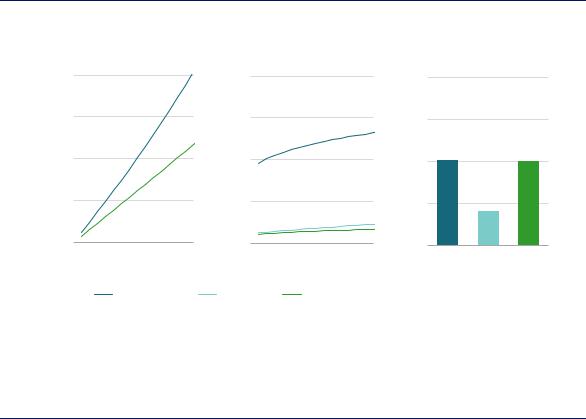
For pipelines, taking into account all capital and operating costs, the IEA estimates that it would cost around USD 1/kgH2 to transport hydrogen as a gas for around 1 500 km (Figure 27). The cost of converting the hydrogen to ammonia is around USD 1/kgH2 (with some variation between different regions). While it is cheaper to move ammonia by pipeline then hydrogen, these conversion costs mean that the total cost of transmitting ammonia for around 1 500 km is about USD 1.5/kgH2. As the transmission distance increases, the cost of transporting hydrogen by pipeline escalates faster than the cost for ammonia since a greater number of compressor stations are required. If the transmission distance is 2 500 km the cost of transporting ammonia by pipeline, including the conversion cost, becomes broadly similar to the cost of transporting hydrogen as a gas (around USD 2/kgH2).
Figure 27. Cost of hydrogen storage and transmission by pipeline and ship, and cost of hydrogen liquefaction and conversion
Pipeline |
Ship |
Hydrogen conversion |
USD/kgH |
2.0 |
|
|
|
2.0 |
|
|
|
2.0 |
|
1.5 |
|
|
|
1.5 |
|
|
|
1.5 |
|
|
|
|
|
|
|
|
|
|
|||
|
1.0 |
|
|
|
1.0 |
|
|
|
1.0 |
|
|
0.5 |
|
|
|
0.5 |
|
|
|
0.5 |
|
|
0 |
|
|
|
0 |
|
|
|
0 |
|
|
0 |
1 000 |
2 000 |
3 000 |
0 |
1 000 |
2 000 |
3 000 |
LiqueLOHC Amm- |
|
|
|
|
|
km |
|
|
|
km |
faction |
onia |
|
|
Hydrogen |
|
LOHC |
Ammonia |
|
|
|
||
Notes: Hydrogen transported by pipeline is gaseous; hydrogen transported by ship is liquefied. Costs include the cost of transport and any storage that is required; costs of distribution and reconversion are not included. More information on the assumptions is available at www.iea.org/hydrogen2019.
Source: IEA 2019. All rights reserved.
The cheapest option to transport hydrogen depends strongly on the mode and distance; the additional costs of conversion need to be weighed against transport savings.
For ships, hydrogen gas must be liquefied or converted prior to transmission. This entails an additional cost to be added to the cost of moving and storing the hydrogen, LOHC or ammonia. For liquid hydrogen, storing the hydrogen at import and export terminals is also relatively expensive. The cost of conversion and moving hydrogen 1 500km by ship as an LOHC is USD 0.6/kgH2, as ammonia is USD 1.2/kgH2 and as liquid hydrogen is USD 2/kgH2. The cost of shipping increases as the transmission distance increases given the need for a greater number of ships, longer voyage distances and additional storage, but not by a significant degree compared to the costs of conversion. The increase in costs at greater distances is also much smaller than is the case for pipelines. As noted above, these costs relate solely to hydrogen transmission; a full cost comparison of the different modes needs to take into account the costs of local distribution and reconversion to hydrogen.
PAGE | 78
IEA. All rights reserved.

The Future of Hydrogen |
Chapter 3: Storage, transmission and distribution of hydrogen |
Local distribution
Once the hydrogen has reached the import terminal or transmission hub, local distribution is necessary to deliver it to final users. As with transmission, the best options for doing this for hydrogen, ammonia and LOHCs will depend on volume, distance and end-user needs.
Trucks
Today hydrogen distribution mostly relies on compressed gas trailer trucks for distances less than 300 km. Liquid hydrogen tanker trucks are often used instead where there is reliable demand and the liquefaction costs can be offset by the lower unit costs of hydrogen transport.21 In both cases, the hydrogen is distributed in tubes that are loaded onto trailers. Trucks can be used to distribute ammonia or LOHCs in a broadly similar way.
In theory a single trailer transporting compressed hydrogen gas can hold up to 1 100 kgH2 in lightweight composite cylinders (at 500 bar). This weight is rarely achieved in practice, however, as regulations around the world limit the allowable pressure, height, width and weight of tubes that can be transported. In the United States, for example, the pressure limit for steel tubes means that a trailer has a maximum load of 280 kgH2 (although the US Department of Transport recently approved the manufacture and use of higher-pressure composite storage vessels).
Highly insulated cryogenic tanker trucks can carry up to 4 000 kg of liquefied hydrogen, and are commonly used today for long journeys of up to 4 000 km. These trucks are not suitable for transport above this distance as the hydrogen heats up and causes a rise in pressure.
Around 5 000 kgH2 in the form of ammonia or 1 700 kgH2 in the form of LOHC could be moved in a road tanker. In the case of LOHC, a truck would also be needed to transport the carrier molecules back to the original destination after the hydrogen has been extracted from them.
Pipelines
Many modern low-pressure gas distribution pipes are made of polyethylene or fibre-reinforced polymer, and would generally be suitable to transport hydrogen with some minor upgrades. In the United Kingdom almost the entire distribution pipe network, which is about 14 times the length of the country’s gas transmission grid, is being replaced with plastic pipes as part of a gas infrastructure upgrade programme. Distribution pipelines for natural gas are extensive in areas with high heating demand, such as northern Europe, the People’s Republic of China and North America, reaching into urban areas as well as industrial clusters.
New dedicated hydrogen distribution pipelines would represent a more significant capital cost, especially on the scale required for supplying hydrogen to heat buildings. Distributing ammonia by pipe over long distances would be less costly, but is likely to be attractive only if there is a large demand for ammonia given the costs of converting ammonia back into hydrogen before use. As with transmission, distribution of LOHCs by pipeline is likely to be impractical given the need to return the carrier molecules to their place of origin at the end of the process.
21 Industry sources indicate that this tipping point is being reached today for hydrogen supply for vehicles in California.
PAGE | 79
IEA. All rights reserved.
The Future of Hydrogen |
Chapter 3: Storage, transmission and distribution of hydrogen |
Local distribution costs
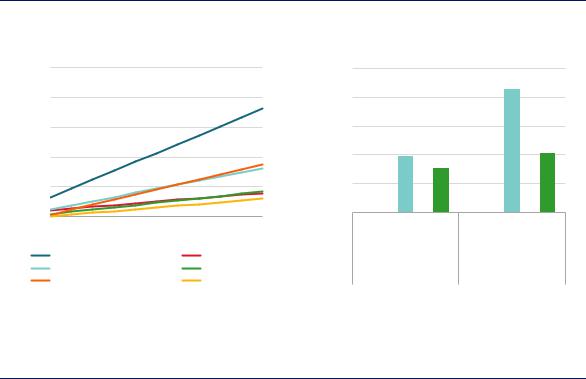
While trucks carrying hydrogen gas distribute the majority of hydrogen today, this is a relatively high-cost option (Figure 28). As the distribution distance increases, pipelines become increasingly cost-competitive with trucks. A critical consideration for distribution is how much hydrogen is required by the end user. If large volumes are needed then larger pipes can be used, which reduces the cost of delivery. For example, if 100 tonnes per day (tpd), roughly the amount of hydrogen that would be required by a single 200 MW hydrogen power plant, are required at a location 500 km away from the point of import, then the use of trucks would be cheaper than constructing a pipeline; if 500 tpd are required, then a pipeline would have lower unit costs. Nevertheless, it is reasonable to expect that, over the next decade, compressed gas tube trailers and liquid hydrogen tanks will remain the main distribution modes, just as distribution of gasoline and diesel to geographically dispersed refuelling stations is mostly carried out using trucks today.
Costs also depend strongly on the required end use of the hydrogen. If pure hydrogen is required, then the additional cost of extracting hydrogen from ammonia or an LOHC must be included. The cost of this reconversion depends on the purity of the hydrogen required: if the hydrogen is to be used in fuel cells rather than combusted, then reconversion is more expensive. Furthermore, reconversion costs at the point of end use (for example at a hydrogen refuelling station) is higher than for centralised reconversion (for example at a transmission import terminal).
The IEA estimates that the cost of distributing LOHC by truck for a distance 500 km would be USD 0.8/kgH2 and the cost of extracting and purifying the hydrogen at the point of end use would be USD 2.1/kgH2. The total cost of local distribution would therefore be USD 2.9/kgH2. For ammonia the equivalent cost would be USD 1.5/kgH2; however, if the ammonia could be used by the final customer without the need for reconversion back to hydrogen, the cost of distribution would considerably lower, at USD 0.4/kgH2.
Figure 28. Cost of hydrogen distribution to a large centralised facility and cost of reconversion to gaseous hydrogen
USD/kgH |
2.5 |
|
Distribution |
|
|
USD/kgH |
2.5 |
Hydrogen reconversion |
|
||||
|
|
|
|
|
|
|
|
|
|
||||
2.0 |
|
|
|
|
|
2.0 |
|
|
|
|
|
||
|
|
|
|
|
|
|
|
|
|
|
|
||
|
1.5 |
|
|
|
|
|
|
1.5 |
|
|
|
|
|
|
1.0 |
|
|
|
|
|
|
1.0 |
|
|
|
|
|
|
0.5 |
|
|
|
|
|
|
0.5 |
|
|
|
|
|
|
0.0 |
|
|
|
|
|
|
0.0 |
|
Ammonia |
|
|
Ammonia |
|
|
|
|
|
|
|
LiquidH |
LOHC |
LiquidH |
LOHC |
|||
|
0 |
100 |
200 |
300 |
400 |
500 |
|
||||||
|
|
|
|
|
|
km |
|
|
|
|
|
|
|
|
Truck (gas H ) |
|
|
Truck (liquid H ) |
|
|
|
|
|
|
|
||
|
Truck (LOHC) |
|
|
Truck (ammonia) |
|
|
Centralised |
|
Decentralised |
||||
|
Pipe (100 tpd) |
|
|
Pipe (500 tpd) |
|
|
|
||||||
Notes: More information on the assumptions is available at www.iea.org/hydrogen2019.
Source: IEA 2019. All rights reserved.
New pipelines are likely to be the cheapest option for distributing large volumes of hydrogen; extracting a pure stream of hydrogen from ammonia and LOHC is expensive.
PAGE | 80
IEA. All rights reserved.